NES outage map: Nashville power outages linger as Tennessee ice storm gives way to dangerous deep-freeze Tuesday, January 27

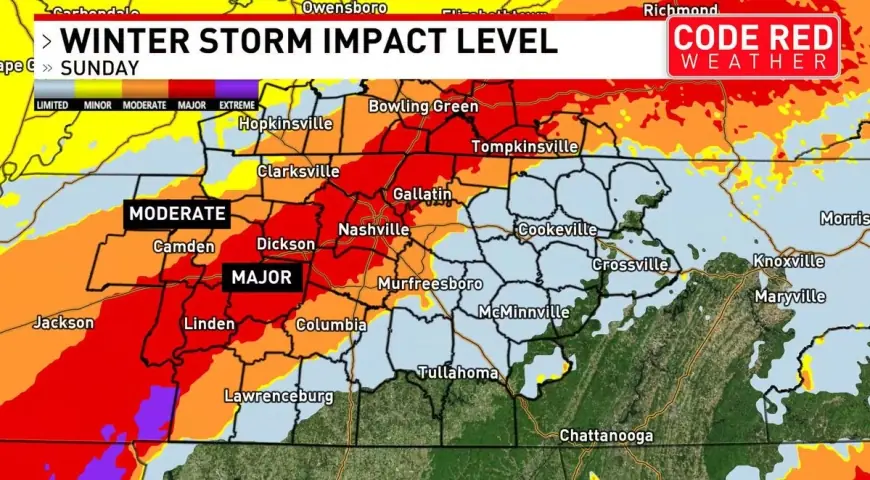
Nashville is heading into Tuesday, January 27 (ET) with a large share of the metro still in the dark, as Nashville Electric Service (NES) crews push through a massive repair backlog created by weekend freezing rain and ice. By Monday morning and into the day, NES reported about 175,000 customers without power after outages peaked near 230,000—the largest single-event outage total the utility has ever recorded—while also tracking well over 90 broken poles and widespread circuit damage across the service area.
For residents refreshing the NES outage map and looking for restoration times, the headline isn’t just “ice storm damage.” It’s what comes after: a hard freeze, blocked access to neighborhoods, and the reality that in many cases your home must be physically ready to accept power again before a crew can reconnect it.
What happened: ice-laden trees broke lines, poles, and entire circuits
This storm followed a punishing pattern for Middle Tennessee: snow first, then freezing rain that coats branches and power lines, turning trees into levers that snap poles and pull down spans. NES said it has already restored power to tens of thousands of customers, but the remaining outages are increasingly the complex ones—broken poles, multiple spans down, or damaged service equipment at the house.
City officials have also emphasized a key safety message: don’t call emergency lines to report an outage, but do call emergency services for downed lines or fires. Ice storms are notorious for leaving energized lines hidden under limbs or snowbanks.
What’s new Tuesday: extreme cold turns “outage” into a health emergency
The weather shift is now the second crisis. In Nashville, an Extreme Cold Warning runs until early afternoon Tuesday (ET), with overnight lows near 1°F and a Tuesday high near 34°F. That matters because cold changes everything:
-
If power is out, indoor temperatures can fall fast, especially in older housing stock.
-
Any damp spots—pipes, ceilings, walls—can freeze and expand into expensive breaks.
-
Roads that looked “fine” late Monday can refreeze into black ice by dawn.
-
Crews face slower, more dangerous work: stiff equipment, brittle lines, and hazardous footing.
Memphis, Knoxville, Chattanooga: weather snapshot for Tuesday (ET)
Tennessee’s weather story isn’t uniform, but the theme is the same: clearing skies with brutal cold.
-
Memphis: bitter cold persists through Tuesday with lows near -1°F and highs around 25°F, keeping wind chills dangerous and refreezing likely on untreated surfaces.
-
Knoxville: a sunnier Tuesday but still cold—lows near 9°F, highs around 36°F, with gusty winds creating low wind chills.
-
Chattanooga: cold advisory conditions linger into Tuesday; expect lows around 10°F and highs near 39°F, with wind chills staying uncomfortable even as skies brighten.
Even where precipitation has ended, “weather radar is clear” doesn’t mean conditions are safe. The refreeze cycle is what turns cleanup into a multi-day grind.
Behind the headline: why the NES outage map can’t promise a simple restoration time
People want an exact ETA. Utilities often can’t give one early because ice-storm restoration is a triage problem, not a queue.
Here’s the incentive structure that shapes what gets fixed first:
-
Safety first: downed lines, broken poles, and hazards blocking roads take priority.
-
Big wins first: crews restore transmission and major distribution circuits to bring back power to the largest groups quickly.
-
Then the hard cases: single homes, isolated outages, and damage on private property—these can take the longest.
The missing piece many residents learn the hard way: NES can’t reconnect a home if the customer’s service equipment is damaged. If the weatherhead, service mast, or meter base is bent, pulled, or broken, a crew may have to leave it until a licensed electrician repairs the customer-owned portion.
That’s why some neighborhoods see lights return quickly while individual houses remain out.
Regional grid reality: this isn’t only Nashville
Across the state, other providers have reported significant damage and warned that some outages may last multiple days, especially in areas with heavy ice and broken poles. Cooperatives serving counties around Nashville have also reported tens of thousands of customers out at various points during the event.
This matters because mutual aid—outside lineworkers coming in—helps, but it doesn’t instantly erase the bottlenecks: damaged poles, restricted access roads, and the time it takes to rebuild sections safely.
What to do tonight if you’re still without power
Practical steps that reduce risk and speed reconnection:
-
Assume downed lines are live. Don’t approach, don’t move branches that may be tangled with wire.
-
Use generators outdoors only, far from doors and windows, to prevent carbon monoxide poisoning.
-
Protect pipes: open cabinet doors under sinks, let faucets drip if safe, and know where your shutoff valve is.
-
Check your service equipment: if the mast or meter base looks pulled, twisted, or damaged, plan for an electrician—utilities typically cannot reconnect until it’s repaired.
-
Find warmth early: warming centers and community shelters can be safer than trying to “tough it out” in subfreezing indoor temps.
What happens next: five realistic scenarios for Nashville power outages
-
Faster restoration Tuesday for large blocks as major circuits come back online.
-
A long tail of single-home outages tied to damaged service equipment or hard-to-reach streets.
-
More tree-related interruptions as ice-loaded limbs drop with wind or shifting temperatures.
-
Water and plumbing problems rise as freeze damage shows up after power returns.
-
A political and planning debate reignites over tree trimming, infrastructure hardening, and whether to bury lines—expensive, slow, but popular after events like this.
For now, the most realistic expectation is progress in waves: big chunks restored first, then a slower push to reach the hardest, most damaged pockets—especially as the cold makes both living without power and restoring it far more dangerous.