Bangor Airport Airplane Crash: Bombardier Business Jet Goes Down on Takeoff During Winter Storm, Investigation Underway

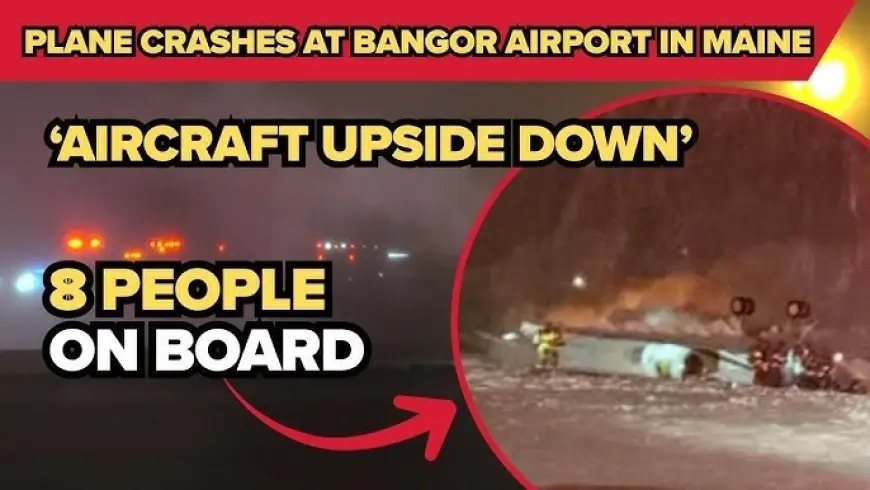
A Bombardier business jet crashed during takeoff at Bangor International Airport in Maine on Sunday, January 25, 2026, around 7:45 p.m. ET, triggering an immediate emergency response, a post-crash fire, and a full-scale federal investigation. The incident happened as a major winter storm pushed into the region, bringing snow, low visibility, and frigid conditions that can complicate both operations and recovery efforts.
Authorities have not released the victims’ identities, and early casualty information has been conflicting, reflecting the difference between preliminary federal reporting and later local airport statements.
What happened at Bangor International Airport
Officials say the aircraft was departing Bangor when it crashed on the airfield shortly after the takeoff attempt, came to rest inverted, and caught fire. First responders reached the scene quickly, and the airport moved to restrict access while investigators prepared to process the crash site.
The jet has been described publicly as a Bombardier Challenger-series aircraft, a type commonly used for private and corporate travel.
How many people were on board? Why the numbers don’t match
This is the biggest point of confusion right now:
-
A preliminary federal incident report indicated eight people were on board, with seven fatalities and one person seriously injured.
-
Bangor airport officials later said the flight manifest listed six people, and that no one from the incident was transported to a hospital, with all on board presumed deceased.
Both sets of information have been circulating at the same time. In the early hours after an aviation accident, passenger counts can differ due to how manifests are filed, whether crew are counted separately, and whether initial reports rely on incomplete or secondhand confirmation. The final accounting typically comes after identification and investigative reconciliation.
What aircraft was it, and where was it coming from?
The aircraft has been linked publicly to an entity based in Texas, and reports indicate it had arrived from the Houston area earlier Sunday before departing Bangor later that evening. Officials have not confirmed the intended destination at the time of the crash.
That detail matters because it shapes the investigative lens: a jet that landed earlier and later attempted departure raises questions about turnaround timing, ground handling, and weather-driven operational decisions.
Weather and de-icing: what role might the storm have played?
The crash occurred as the winter storm moved into Bangor, with snow beginning to intensify around the time of the departure. The airport has emphasized that it routinely operates in winter conditions and that de-icing operations were underway.
Behind the headline, weather isn’t just “snow.” Investigators will look at a cluster of risk variables that tend to stack up during storm windows:
-
runway contamination (snow, slush, ice)
-
braking action reports and friction measurements
-
visibility and wind shifts
-
de-icing timing, fluid type, and “holdover time” before takeoff
-
whether aircraft performance calculations matched conditions at the moment of departure
It’s also important not to jump to conclusions. Many winter-weather incidents involve multiple contributing factors, and the cause can’t be responsibly assigned until investigators review data and evidence.
Investigation status: what happens now
The National Transportation Safety Board is leading the investigation with support from the Federal Aviation Administration. The key next steps typically include:
-
securing and documenting the wreckage field
-
recovering flight data and cockpit voice recorders (if equipped)
-
collecting air traffic control recordings and airport operations logs
-
interviewing responders, controllers, airport staff, and any witnesses
-
reviewing maintenance records, crew qualifications, and preflight decisions
A preliminary update often arrives before a full causal finding, but a definitive report can take many months.
Airport operations and local impact
Bangor International Airport has warned the public to avoid the area while the response and investigation continue. Airport closures and disruptions following a runway-side crash can extend beyond a single day, because the site must be preserved for evidence collection and wreckage removal.
Second-order effects ripple fast in storms: even if the crash site is contained, the combination of winter weather plus an airport closure can snarl travel logistics across the region, affecting diversions, cancellations, medical transport planning, and staffing.
Behind the headline: why this story escalated so quickly
Aviation incidents turn into “breaking news” instantly for three reasons:
-
High visibility, high stakes: An airfield crash signals potential mass-casualty risk even before numbers are confirmed.
-
Information gaps: Early reports are often incomplete, which drives frantic updates and conflicting tallies.
-
Storm context: When severe weather is already straining infrastructure, any additional emergency becomes a wider public-safety story.
The stakeholders here extend beyond the passengers: families awaiting identification, airport workers, investigators, airlines rerouting flights, and the broader traveling public trying to gauge whether conditions are safe.
What we still don’t know
-
the final verified number of occupants and the confirmed fatalities/injuries
-
the aircraft’s exact variant and configuration details relevant to performance
-
the intended destination and the purpose of the flight
-
whether runway conditions, wind, or de-icing timing were factors
-
whether any mechanical issues were reported before the takeoff attempt
What happens next
Expect a sequence of developments rather than one definitive answer:
-
an official victim identification process and next-of-kin notifications
-
a clearer timeline of the aircraft’s movements earlier Sunday and pre-departure actions
-
witness and video collection requests expanding beyond the airport perimeter
-
an initial investigative briefing that narrows the open questions without assigning final cause
If you want, tell me whether you’re asking as a traveler (flight status/airport reopening expectations) or as a local (road closures and nearby access), and I’ll tailor the most practical, up-to-date guidance in ET terms.