Earthquake Near Indio Hills Sparks “Earthquake Near Me” Searches Across Coachella Valley, Palm Springs, San Diego and Los Angeles

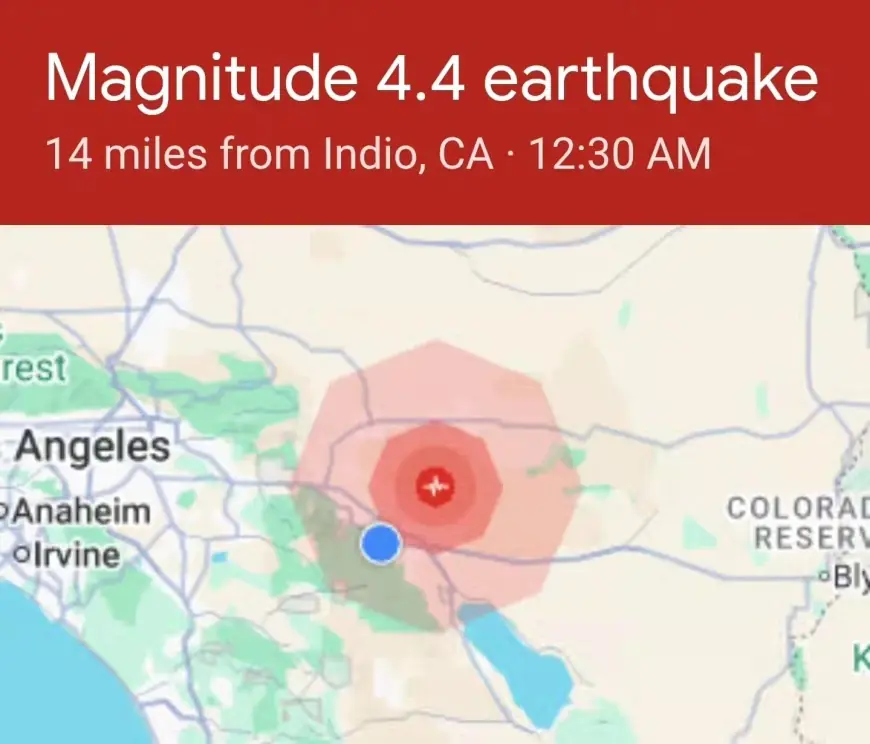
A moderate Southern California earthquake centered near Indio Hills has set off a fresh wave of “earthquake today just now” searches, with many residents across the Coachella Valley reporting noticeable shaking from Palm Springs and Palm Desert to parts of Riverside County, the Los Angeles region, and even into San Diego County.
USGS event data lists the main shock as magnitude 4.9, with the origin time aligning with Monday evening in Southern California. Early public alerts briefly circulated a higher preliminary number, then the magnitude was refined as more seismic stations were processed—a normal part of how quick earthquake estimates get updated in real time.
Where Was the Earthquake Today?
The strongest shaking in this sequence has clustered north-northeast of Indio, near the Indio Hills area. That’s close enough to the Coachella Valley population centers that even a mid-4 magnitude event can feel sharp, especially in upper floors, on soft soils, or in neighborhoods that amplify motion.
If you’re searching “earthquake near me,” the most helpful distinction is this: the epicenter location (near Indio Hills) describes where the quake began, but the felt area can be much wider. Reports of movement in Palm Springs, Palm Desert, Coachella, La Quinta, and Indio itself are consistent with how shaking spreads through the valley, and how people perceive jolts differently depending on building type and local ground conditions.
Earthquake Palm Springs, Palm Desert, Coachella Valley: Why It Felt Strong in Pockets
A magnitude 4.9 is not “major,” but it is absolutely big enough to rattle dishes, sway hanging objects, and wake people up if it hits at the wrong time. In desert communities, the first few seconds often feel like a sudden bump or drop, followed by a brief rolling motion.
Three factors can make the same earthquake feel stronger in one place than another:
-
Soil type and basin effects that can amplify shaking in valley floors
-
Building height and construction differences (mid-rise structures often sway more noticeably)
-
Distance and direction relative to the fault rupture, which can focus energy into certain corridors
That’s why two neighbors can describe the same event as either “a quick jolt” or “a longer shake.”
Earthquakes Today: Aftershocks and a Busy Overnight Near Indio
One reason the topic keeps trending is that the main event didn’t happen in isolation. Smaller aftershocks followed, and additional minor quakes continued into the next day. In practice, that means someone in Indio, Palm Springs, or Palm Desert may feel more than one tremor and assume a new large earthquake just happened “5 minutes ago,” even when the later shaking is a smaller aftershock.
Aftershocks commonly taper off with time, but clusters can persist. Most aftershocks are too small to be felt, yet they can still show up on automatic trackers and trigger another round of notifications and “earthquake now” searches.
Earthquake San Diego, Riverside, Temecula, Los Angeles: Why Distant Areas Noticed It
Even when an epicenter is inland near Indio, it’s possible for people in a broad region to notice movement—especially during quiet evening hours when there’s less background vibration from traffic and daily activity.
In faraway areas such as San Diego, Temecula, Riverside, Orange County, and parts of Los Angeles, the most common experiences are light swaying, a subtle roll, or a quick bump. The distance makes strong shaking less likely, but not impossible to notice—particularly for people sitting still, on higher floors, or in buildings that “ring” more during seismic waves.
San Andreas Fault: Is This Connected?
The Indio Hills and Coachella Valley sit in a seismically active part of Southern California, with major fault systems nearby, including strands associated with the San Andreas fault zone. A moderate quake in this region does not automatically mean “the Big One is next,” and most earthquakes do not cascade into larger events.
Still, the location is a reminder of why preparedness matters in Southern California: the background seismicity is constant, and the region’s fault network produces everything from tiny daily tremors to occasional damaging earthquakes.
USGS, Alerts, and the “5.1 Earthquake” Confusion
If you saw “5.1 earthquake” in early posts, you’re not alone. Rapid initial estimates can shift up or down as analysts refine the magnitude and depth. The best way to confirm the official number and location is to check the USGS earthquake event details once the status stabilizes.
Key points to remember:
-
Preliminary magnitudes can change
-
Depth estimates can change
-
Aftershocks can create the impression of repeated “new” quakes
What to Do If You Felt the Earthquake Just Now
Even when there’s no immediate damage, a felt earthquake is the right moment to reset your readiness:
-
Expect aftershocks; keep shoes and a flashlight accessible overnight
-
Check for gas smell, small leaks, or fallen items—especially water heaters and shelves
-
If another jolt hits, use “Drop, Cover, and Hold On”
-
If you rely on alerts, make sure emergency notifications are enabled on your phone
For residents in the Coachella Valley, Palm Springs, Palm Desert, and Indio, the next 24–48 hours are typically the window when aftershocks are most noticeable. Details may evolve as seismic agencies refine the catalog, but the current pattern points to a main quake near Indio Hills followed by smaller continuing activity rather than a single one-off shake.