Voyager Explores Heliopause: Discovering Where Sun Meets the Stars

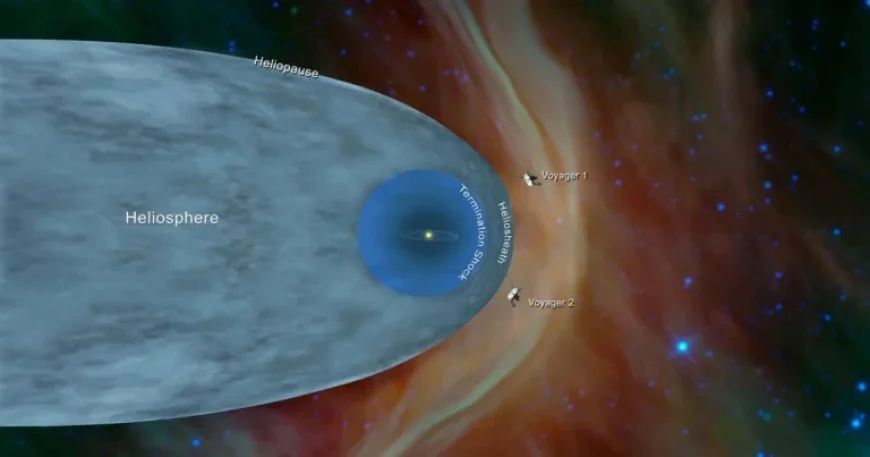
In a groundbreaking exploration effort, NASA’s Voyager spacecraft are venturing into uncharted territories of space, specifically investigating the heliopause, the boundary where the Sun’s influence wanes and interstellar space begins. Launched in 1977, Voyager 1 crossed this critical threshold in 2012, with Voyager 2 following suit in 2018. By traveling beyond the heliopause, these twin spacecraft have enabled scientists to gather invaluable data about interstellar space.
Voyager and the Heliopause
The heliopause marks the point where the pressure from the solar wind, a continuous stream of charged particles emitted by the Sun, balances with the pressure of interstellar space. This boundary is not rigid, resembling more of a fluctuating transition zone heavily influenced by solar activity. Crossing the heliopause offers a unique opportunity to study the cosmic environment beyond the solar system.
Science Behind the Journey
Dr. Linda Spilker, a project scientist for the Voyager mission at NASA’s Jet Propulsion Laboratory, explains that the spacecraft’s continued transmission of data reshapes our understanding of the heliopause. The Voyager missions were initially designed to study the outer planets, but their ongoing success has led to unanticipated discoveries that continue to evolve the scientific narrative surrounding solar and interstellar phenomena.
- Voyager 1 is approximately 15.8 billion miles from Earth.
- Voyager 2 is about 13.1 billion miles away.
- They communicate with Earth daily, providing essential data.
Key Milestones in Interstellar Exploration
The Voyager spacecraft have achieved numerous historic milestones during their extended missions:
- First spacecraft to enter interstellar space (Voyager 1, 2012)
- First measurements of cosmic rays from beyond the solar system
- Discovery of a complex and dynamic heliosphere
Future Prospects
Future timelines for the Voyager spacecraft indicate these missions might operate into the early 2030s, further collecting data from the interstellar region. Notably, a significant event is set to occur on November 18, when Voyager 1 will be one light day away from Earth, representing another milestone in human-made exploration of the cosmos.
This pioneering mission has not only changed how scientists view our solar system’s borders but has also inspired future missions aimed at further exploring the heliosphere and beyond. As the spacecraft continue their journey, the insights gained will have lasting implications for our understanding of cosmic phenomena.
Scientific Challenges and Discoveries
The Voyagers still encounter challenges, particularly in power management and communications due to the immense distances involved. Nevertheless, the missions have found exciting observables, such as cosmic ray fluctuations and the dynamics of the heliosphere, that require ongoing study and interpretation. The legacy of the Voyager missions exemplifies human ingenuity in understanding the universe.
As we close in on the 50th anniversary of the Voyager launches in 2027, there is much to celebrate. The continued success of these spacecraft reaffirms their place in the annals of space exploration history while setting the stage for future interstellar missions.