



















Explore 7 Abandoned London Underground Stations Frozen in Time

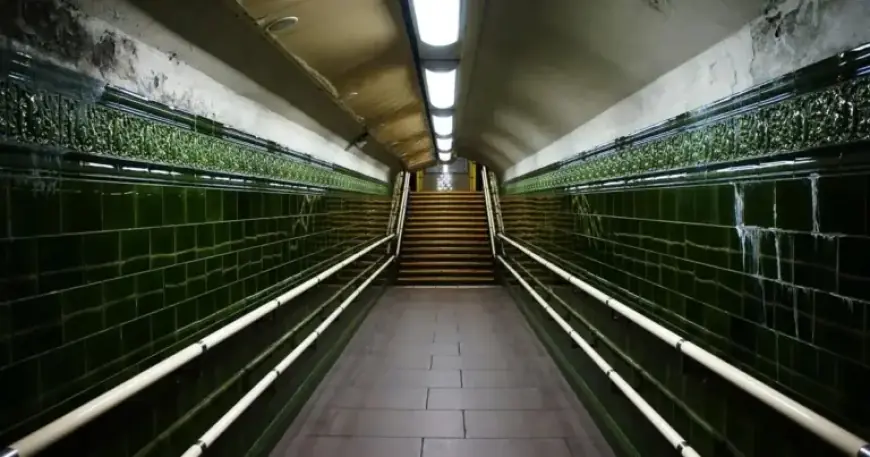
The London Tube remains central to the city’s rhythm. Filmogaz.com looks at abandoned London Underground stations that feel frozen in time. This feature will Explore 7 sites where history and disuse meet.
Down Street
Down Street once sat on the line that became today’s Piccadilly Line. It closed in 1932, twenty-five years after opening.
The wealthy neighbourhood nearby meant passenger numbers were low. During the war, it served as a temporary headquarters for Winston Churchill and his War Cabinet. London Transport Museum hidden tours sometimes visit the site.
Brompton Road
Brompton Road lay between Knightsbridge and South Kensington. It briefly shut during the 1926 General Strike for five months.
Modernisation at Knightsbridge led to its permanent closure in 1934. Some original tiling remains, and parts of the space have been converted into flats.
South Kentish Town
Originally intended to be called Castle Road, South Kentish Town opened for the Northern Line. Developers painted bespoke nameplates over the earlier title.
Passenger numbers stayed low. A nearby power station strike in 1924 prompted its permanent closure. The station now houses an escape room.
Mark Lane / Tower Hill
Mark Lane opened in 1884 to replace the short-lived Tower of London station. Mark Lane was later renamed Tower Hill in 1946.
Rising passenger use required bigger facilities, and the station closed in 1967 to allow expansion. Present-day Tower Hill stands on the site once occupied by the Tower of London station.
King William Street
King William Street opened in 1890 as one of the earliest deep-level electric stations. It formed part of the City & South London Railway.
Line extensions left its platforms facing inconvenient directions. A new northbound tunnel in 1900 bypassed the station. The surface building was demolished in 1930, and the Underground Group sought to sell the site.
British Museum
The British Museum station opened in 1900 opposite High Holborn. It belonged to the Central London Railway, while Holborn belonged to a different company.
Engineers found tunnel alignments difficult to reconcile. Holborn’s connections made it the preferred hub, and British Museum closed in 1933. Local stories later linked the site to sightings of an Egyptian priestess spirit named Amun‑ra.
Walham Green / Fulham Broadway
The station opened in March 1880 as Walham Green on the District Railway. A new entrance replaced the original building in 1905, and the name changed to Fulham Broadway in 1952.
The site reportedly closed as a tube station in 2003. It later operated as a food court in 2018 before closing again in 2021. The former station now functions as a Wetherspoon pub called Walham Green, retaining many original features.
These abandoned London Underground stations present awkward engineering, changing travel patterns, and wartime ingenuity. They remain evocative stops for historians and curious visitors alike.