
























Punch Monkey and the ripple effects: who inside the enclosure and beyond is feeling the impact

The story of punch monkey has become more than a viral clip: it is altering how keepers, the troop and visitors are behaving at one Japanese zoo. Videos showing a young macaque rejected by his mother and clinging to a stuffed orangutan toy have driven crowds, changed enclosure management and opened fresh questions about maternal abandonment and social development among Japanese macaques.
Punch Monkey: immediate impact on the baby, the troop and keepers
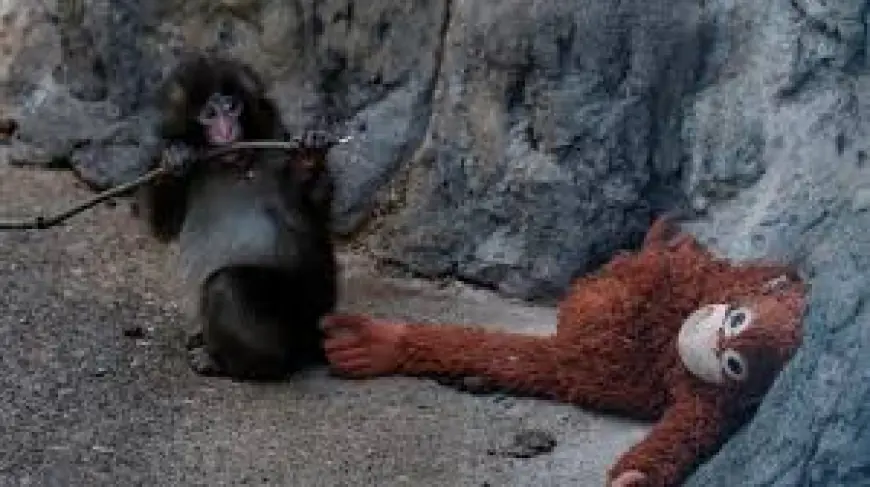
Who is affected first is clear: the infant itself, the adult macaques around him, and the human staff managing the situation. Footage identifies Punch as a seven-month-old Japanese macaque born last July at Ichikawa zoo, and that footage has been shared widely. Without maternal care he has used a soft toy for comfort, been pushed away by older monkeys, and alternately received grooming from and aggressive handling by members of the troop—forceful encounters that complicate his short-term safety and his long-term social development.
Embedded details of the situation and how it unfolded
Punch was born last July at Ichikawa City Zoo (also described elsewhere as Ichikawa zoo). After being rejected by his mother, zookeepers provided a stuffed orangutan toy as a surrogate following earlier attempts to substitute rolled towels of varying thickness. Early clips show him wandering alone with the toy after being pushed away, clutching it while being harassed. Later footage briefly showed another monkey grooming and comforting him, but days after that a much larger monkey was filmed dragging him in a circle, after which Punch ran to hide behind a rock while hugging the toy. The videos went viral last week and have prompted wide public attention and increased visitor numbers.
Expert perspectives and developmental implications
Primatology expert Alison Behie of Australian National University notes that abandonment is unusual but can arise from factors such as age, health and inexperience. In the provided context she identified Punch’s mother as a first-time mother and said zookeepers had suggested Punch was born during a heatwave, a high-stress environment that can lead mothers to prioritise their own health and future reproduction over an infant whose health may be compromised. Behie also described the toy as possibly serving as an attachment figure and said the behaviours of other monkeys toward Punch should be seen as regular social interaction within strict matrilineal hierarchies where higher-ranking families assert dominance over lower-ranking ones.
One detail in the material is inconsistent: the footage and other items identify Punch as seven months old, while Behie used six months in discussing nursing needs; this discrepancy is unclear in the provided context. She also warned that without his mother Punch may not learn appropriate subordinate responses, which could affect how he integrates into the group as an adult.
Zoo response, visitor behaviour and short-term management
The zoo has experienced a surge of visitors hoping to see Punch, and officials responded by enforcing stricter barriers around the enclosure. Staff have urged visitors to remain quiet, to avoid using stepladders or tripods for photography and to limit prolonged [unclear in the provided context]. Keepers first tried rolled towels of different thicknesses to provide something for him to cling to before giving the stuffed orangutan with the intention that an object resembling a monkey might later help reintegration into the troop.
Here’s the part that matters for everyday visitors: increased foot traffic has changed management at the enclosure, and keepers are trying both behavioural and physical measures to protect Punch while encouraging natural social interactions.
- Punch’s immediate comfort has relied on the stuffed orangutan and keeper attention; troop grooming has begun to appear in recent footage.
- The troop’s dominance dynamics remain important to his development; without maternal guidance he may struggle to show appropriate submissive signals.
- Visitor surge is producing stricter barriers and new rules intended to limit disturbance.
- Conflicting age references in coverage (six months versus seven months) are unclear in the provided context and could matter for nursing and development assessments.
Other recent developments mentioned alongside the story
- A suspect wanted for multiple counts of theft was caught outside a temple on the outskirts of Bangkok.
- A court is due to deliver its verdict in the insurrection trial of Yoon Suk Yeol.
- Arunoday Mukharji explains why India needs to capitalise on the momentum (context provided without additional detail).
- A Lakshmi goddess shrine at a Bangkok shopping mall has become a place where young people come to pray for love.
- South Asia correspondent Azadeh Moshiri visited Sheikh Hasina's former residence, now a memorial for student protesters killed in the 2024 uprising.
- It is noted as the first election since the 2024 Gen Z uprising that toppled Bangladesh's long-serving prime minister Sheikh Hasina.
- A pro-democracy media tycoon was sentenced to 20 years in jail by the Hong Kong High Court.
- At least 31 people have been killed after a suicide bomber detonated a device at a Shia mosque.
- A mayor in the Philippines survived a rocket launcher attack on his vehicle in broad daylight.
- Correspondent Jonathan Head described a 'devastating' accident as an enormous setback for Thailand's efforts to modernise its infrastructure.
- Voters in Myanmar's election say the poll is taking place in a "climate of fear", as the South East Asia correspondent Jonathan Head.
- Hong Kong media tycoon Jimmy Lai has been found guilty of foreign collusion following a landmark national security trial.
- Thousands of adoring supporters had paid up to 12, 000 rupees (£100; $133) to catch a glimpse of the football star.
It’s easy to overlook, but the mix of local animal welfare attention and broader regional stories in the same coverage highlights how a single viral animal story can sit alongside high-stakes political and security developments. A short aside: while the toy and increased human management are pragmatic steps, the long-term social outcome for Punch depends on complex troop dynamics that keepers can influence but not fully control.