





















Khamenei’s Killing Triggers Interim Power Shift: A Three‑Member Council, Security Gaps and Regional Fallout

Why this matters now: the death of supreme leader khamenei has placed Iran’s constitutional succession rules and its armed command under simultaneous strain — a legal stopgap is in place, but political and security questions are immediate and unresolved. The new interim body will run state duties while an 88‑member Assembly of Experts must move to pick a successor “as soon as possible, ” creating a compressed window for power contests and military reshuffling.
Immediate consequences for Iran’s governance and the timetable set by the constitution
The Expediency Council confirmed a three‑member transitional council to exercise state duties after the killing of Ayatollah Ali Khamenei. That council includes Ayatollah Alireza Arafi, President Masoud Pezeshkian and Supreme Court Chief Justice Gholam‑Hossein Mohseni‑Ejei. Under Article 111 of the constitution the council will govern until an 88‑member Assembly of Experts selects a new supreme leader; that Assembly “must, as soon as possible, ” pick a new supreme leader. Here's the part that matters: the constitutional stopgap puts formal authority in a tight, temporary structure but hands the ultimate decision to the Assembly of Experts, creating a race to shape the next leader before the Assembly convenes.
- Ayatollah Alireza Arafi: a 67‑year‑old cleric and member of Council, confirmed by the Expediency Council.
- Other council members: President Masoud Pezeshkian and Supreme Court Chief Justice Gholam‑Hossein Mohseni‑Ejei.
The transitional council: scope, players and constitutional limits
The three‑member council is expressly a temporary mechanism to handle state duties while the Assembly of Experts prepares to choose a new leader. Arafi’s role as a Guardian Council member is notable because that body has later responsibilities in selection processes. The Expediency Council’s confirmation was the formal step that created the interim collective leadership rather than vesting authority in a single acting supreme leader.
Security leadership questions and the IRGC’s internal dynamics
Security organs are also in flux. The commander‑in‑chief of the Islamic Revolutionary Guard Corps was killed in the same US‑Israeli attack that killed the supreme leader — the second such killing in less than a year — and the IRGC’s next leader is yet to be announced. IRGC‑linked Telegram channels are naming deputy chief Ahmad Vahidi, who was appointed to that deputy position by Khamenei two months ago, as a likely candidate. It remains unclear how the IRGC’s succession will interact with the transitional council’s authority.
Domestic unrest and regional escalation: protests, strikes and rhetoric
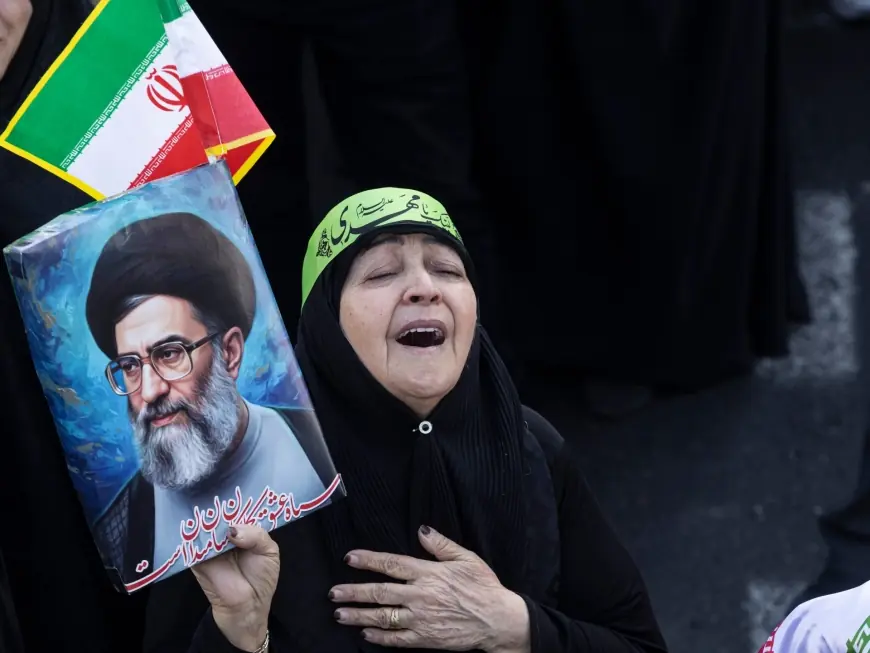
Protests erupted following the killing of Ayatollah Ali Khamenei in the joint US‑Israeli strikes. Iran’s retaliatory attacks on US assets in the region continued for a second day, and fears of a wider conflict have risen as the IRGC pledged fierce retaliation across the region. Political leaders have framed the attack in urgent terms: President Masoud Pezeshkian’s office described the killing as “a great crime. ”
Former parliamentary speaker and senior policy adviser Ali Larijani — who was appointed to advise Khamenei on strategy in nuclear talks with US President Donald Trump’s administration — has accused the US and Israel of trying to plunder and break apart Iran and warned “secessionist groups” within Iran of a harsh response. State media carried Larijani’s remarks, including his declaration that “The brave soldiers and the great nation of Iran will teach an unforgettable lesson to the international oppressors. ”
Key takeaways
- The constitutional route: Article 111 places temporary executive duty in a three‑member council while an 88‑member Assembly of Experts must select a new supreme leader.
- Power centres to watch: the Expediency Council’s confirmation of Arafi, the presidency and the judiciary shape the interim cabinet, while the IRGC and security apparatus remain decisive actors.
- Military succession is unsettled: the IRGC commander‑in‑chief was also killed, the next IRGC leader has not been announced, and Ahmad Vahidi is named by IRGC‑linked channels as a likely candidate.
- Regional risk and domestic unrest: protests have erupted and retaliatory strikes on US assets continued for a second day, increasing the chance of broader confrontation.
- Political messaging is escalating: senior figures are framing the strikes as attempts to fracture the state and are promising forceful responses.
What’s easy to miss is that the constitution both supplies an immediate mechanism for continuity and forces a fast transfer of legitimacy to the Assembly of Experts — that compressed timetable will drive much of the short‑term jockeying.
Where this could move from here
Uncertainties remain about the balance of power between the interim council, the Assembly of Experts and the IRGC. The speed and composition of the Assembly’s response, the appointment of a new IRGC chief, and the trajectory of retaliatory operations are the main signals that will confirm how the transition consolidates. The situation is fluid and details may evolve as institutions act and factions respond.