
























St. David's Day weekend: What the parades, pilgrimages and concerts mean for local communities

For residents, volunteers and visiting families, st. david's day this year reshapes local calendars and community routines: markets, parades and pilgrimages concentrate civic energy across Wales and the English border. That concentrated activity matters most to small-city traders, heritage sites and choirs who carry the day’s logistics, and to pilgrim groups and schoolchildren who convert tradition into a weekend of public participation.
St. David's Day and local communities — who takes the lead
Here’s the part that matters: community groups, museums, churches and charitable organizations are fronting most events, so the weekend’s success depends on volunteer coordination, local fundraising and venue capacity. Oriel y Parc is organising workshops and creative sessions that feed directly into Saturday’s parade, while museums and churches are hosting talks, concerts and pilgrim services that draw families and heritage visitors. For organisers, the weekend is both celebration and practical delivery: costume-making, pilgrim passes and market stalls all need hands on deck.
Event details and the weekend schedule
- Friday/Saturday musical build-up: a St David’s Celebration Concert at the cathedral acts as a curtain‑raiser on February 27 in support of the Army Benevolent Fund.
- Saturday, February 28: the St Davids Dragons Parade gathers at 1. 30pm and steps off at 2. 00pm, running along the High Street between Oriel y Parc and Cross Square and circling the square before returning.
- Saturday market: a day‑long St David’s Day Market runs in Cross Square from 9am to 4pm, showcasing local food, produce and Welsh‑made gifts.
- Races: the Ras Dewi Sant Marathon, Half Marathon and 10K start at 7. 45am on Saturday.
- Sunday, March 1: pilgrimage and worship take centre stage. A six‑mile guided pilgrimage from Porthclais Harbour to St Davids Cathedral traces the coast past St Non’s and Oriel y Parc, finishing with prayers at the shrine of St David.
- Alternate pilgrim route: Tŷ’r Pererin and the cathedral are leading a Gŵyl Dewi pilgrimage from David’s Holy Well at Porthclais, timed to arrive at the cathedral late morning.
- Sunday midday: illumination of the St David’s day Stone at Oriel y Parc is set for 12 noon.
- Family activity: pilgrim passes are available from Oriel y Parc or the National Trust shop for an adventure trail through the city to the shrine across the weekend.
Music, concerts and talks beyond Pembrokeshire
In the West Midlands there are community concerts and talks linked to the day. On Saturday evening the West Midlands Concert Band plays a Music for a SpringTime programme at St Margaret of Antioch in Hasbury, Halesowen, at 19: 00 GMT; the free concert is described as having a Welsh flavour, with free refreshments including Welsh cakes and a church full of daffodils. Also on Saturday, a concert at Theatre Severn in Shrewsbury starts at 19: 30 and features the Penybontfawr Male Voice Choir and Meibion Goronwy Male Voice Choir; that performance is presented by the North Wales Association of Male Voice Choirs and is in support of Alzheimer’s Society Shropshire.
Sunday programming in England includes a 14: 00 St David's Day talk at The Brampton Museum in Newcastle Under Lyme, Staffordshire, delivered by Stuart Haywood, the author of the Welsh in North Staffordshire. Haywood is the current chairman of The Stoke-on-Trent & District Welsh Society and will discuss where migrants settled in north Staffordshire, their incentives to move and how those communities were set up. Also on Sunday, Cradley Church in Cradley, Herefordshire, hosts a 15: 00 concert featuring the Malvern Male Voice Choir and harpist Shelley Fairplay; tickets cost £18 including refreshments, with proceeds shared equally between Cradley Church and Cradley Village Hall.
Roots and rituals that feed the weekend
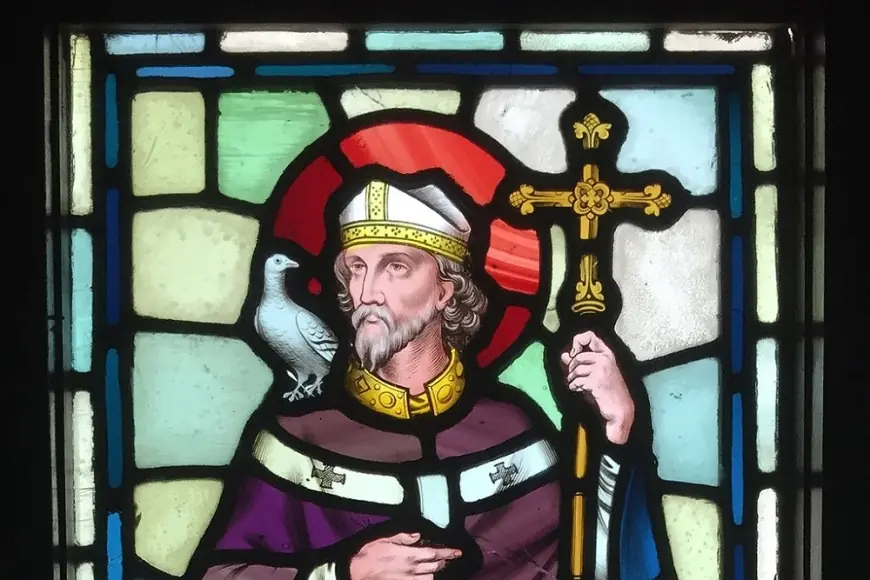
St David — Dewi Sant in Welsh — was born on the south‑west coast of Wales near where the city of St Davids is today and is remembered through pilgrimage and liturgy. Historical texts shaped his image: a Latin life known as Vita S. David was written by Rhygyfarch around 1080; Rhygyfarch was associated with Llanbadarn Fawr in modern Ceredigion and his writing underpins the long devotion to the saint and the many medieval churches dedicated to him. That devotional tradition produced later works such as the 14th‑century Buchedd Dewi, which records David’s last words as gwnewch y pethau bychain, meaning “do the little things. ”
Rhygyfarch presents David both as an archbishop and as an ascetic abbot who demanded a spartan life for his monks — a regimen that earned him the nickname aquaticus, or waterman, and helps explain why the cathedral sits in a marshy valley at the extreme edge of south‑west Wales. The cathedral’s construction began in 1182; the building fell down in 1220 and again in 1248 before stability was achieved. Bishops in 1538 and 1666, who were unsympathetic to pilgrimage and mindful of spiritual concerns, attempted to move the bishop’s thr—unclear in the provided context.
Mini timeline of the key local moments
- February 27: cathedral concert supporting the Army Benevolent Fund.
- February 28: market (9am–4pm), Dragons Parade gathers 1. 30pm and steps off 2. 00pm; races start 7. 45am.
- March 1: guided six‑mile pilgrimage from Porthclais Harbour to St Davids Cathedral and alternative pilgrimage from David’s Holy Well; illumination at Oriel y Parc at 12 noon.
The real question now is how community organisers handle turnout and logistics across this compact schedule.
It’s easy to overlook, but many of these events tie directly into long‑running traditions: daffodils and leeks remain visible emblems, and choirs, museums and charities convert historic memory into weekend programming that benefits both worship and local economies.
Writer’s aside: The mix of creative workshops, market trading and pilgrim routes shows how a single saint’s day continues to organize very different kinds of public life, from craft tables to cathedral services.