























Uc Santa Cruz students build entrance-detection tools in Crown College innovation lab

In Crown College’s Corporate Innovation Laboratory, uc santa cruz students are turning street-level photos into a missing layer for map data: building entrances, a gap that can send people to the wrong side of a structure.
Two seniors, Evan Rantala and Julien Howard, chose CRWN 102 in their final year to work on a project with real industry stakes. Howard is a computer science major graduating this spring and said the class offered a hands-on alternative to theory-heavy coursework. Rantala, an applied mathematics major with a computer science minor, described the course as the most unique he’d taken at Crown College.
The course is taught by Sridhar Rao, an adjunct professor in entrepreneurship and innovation with experience in venture capital and corporate innovation at companies including Meta and Samsung. Rao structures CRWN 102 as a simulated organization called Project TerraForma; students join the company’s organizational chart on day one and set industry-style Objectives and Key Results to guide their quarter-long work.
Rantala and Howard accepted a geospatial challenge from the Overture Maps Foundation: most navigation apps can locate a building but not reliably indicate where to enter it. To tackle that, the team used about 750 street-level images from Mapillary to train a YOLOv8 object-detection model with the goal of detecting entrances and linking each detected entrance to the correct structure.
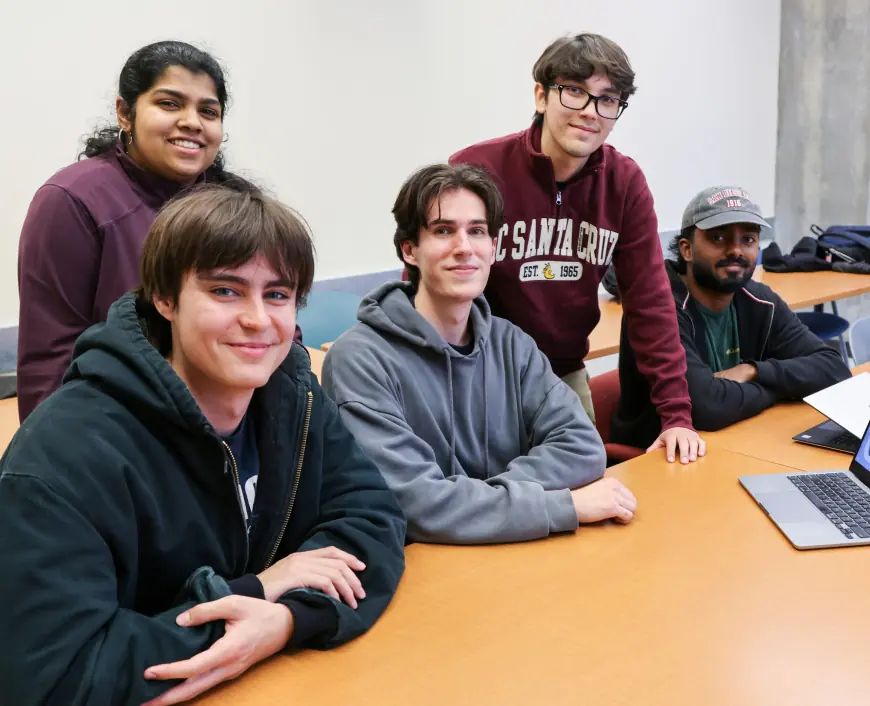
Uc Santa Cruz students in Corporate Innovation Laboratory
CRWN 102 is part of Crown’s Innovation & Entrepreneurship Certificate and pushes students to engage directly with engineers and leaders from partner organizations. Howard said the class focused on solving problems industry partners care about rather than only finding a single correct answer, and Rantala noted students were graded on meeting self-set goals and adapting when experiments failed.
Industry partners supply real challenges
Rao explained that many challenges come from companies that recognize important problems but lack the bandwidth to prioritize them. In the course, students refine OKRs throughout the quarter and present at the end of the term to representatives from sponsoring companies, giving corporate partners a look at exploratory solutions.
Training a model to find building entrances
For the Overture Maps Foundation project, the student team worked with a curated dataset of roughly 750 Mapillary images to train a YOLOv8 model aimed at detecting building entrances in street-level imagery and associating each detected entrance with the correct building footprint—addressing a concrete navigation shortcoming in urban settings.
At the end of the term, students in CRWN 102 present their findings and deliverables to sponsoring companies, giving industry partners a direct view of how the class’s prototypes and experiments might inform real-world mapping and navigation products.