
















Scream 7’s Return Reshapes the Franchise: Fired Star Fallout, a $500K Rewrite and Neve Campbell’s $7 Million Comeback

Here’s the part that matters: scream 7 is arriving not just as another sequel but as a recalibration — for cast careers, studio strategy and a legendarily meta horror series. The film is tracking a projected $45 million to $50 million North American debut that would be a series-best, yet that box-office bet sits on the fallout from a late 2023 firing, director and cast exits, a costly rewrite, and the big-money return of Neve Campbell.
Who feels the shockwaves — and how the franchise is being reshaped
Actors, studios and fans are all absorbing the ripple effects. Melissa Barrera’s firing in late 2023 triggered Jenna Ortega’s exit, the original director’s departure and a public backlash that forced script and leadership changes. Paramount and Spyglass face a new dynamic: the sixth film’s strong box office performance and the need to restore a clear marketing hook pushed Neve Campbell back into the center with a nearly $7 million deal, while Courteney Cox received $2 million. The immediate effect is a production that had to recenter both story and star power amid reputational and creative damage.
Scream 7: the production shakeup, the $500K rewrite and who left
The project was plunged into turmoil after Melissa Barrera, the star of the 2022 relaunch and 2023’s Scream VI, was fired by Spyglass over social media posts the company deemed antisemitic. After war broke out in Gaza that year, Barrera reshared a post accusing Israel of "genocide and ethnic cleansing" and a magazine article alleging the Israeli government was distorting "the Holocaust to boost the Israeli arms industry. " Shortly after Barrera’s axing, Jenna Ortega — Barrera’s on-screen sister — withdrew because of scheduling conflicts with her hit series Wednesday. Original director Christopher Landon left the production after receiving death threats related to the firing, even though he did not make the decision to remove Barrera.
At a creative crossroads, franchise veteran Kevin Williamson stepped in to direct and co-wrote the screenplay with Guy Busick. The rewrite required by those exits is pegged at roughly $500, 000. The filmmakers reshaped a story that had intended to continue the Carpenter sisters’ arc, shifting back toward the franchise’s original lead, Sidney Prescott.
Money, leverage and the return of familiar faces
Paramount executives were concerned about making another entry without Neve Campbell after she declined to return for the sixth film over a salary dispute; Spyglass retained final say on creative decisions. Those worries diminished after Scream VI grossed $161 million globally, the franchise’s largest haul since the first two installments. Without Jenna Ortega on board, the studios needed a clear marketing draw — and Campbell’s leverage produced a substantial payday. Courteney Cox also returned with a $2 million fee. Shawn Robbins, director of movie analytics at Fandango and founder of Box Office Theory, framed Campbell as the franchise’s essential draw, likening her to another legacy horror figure.
On screen: tone, the opening and how the film positions itself
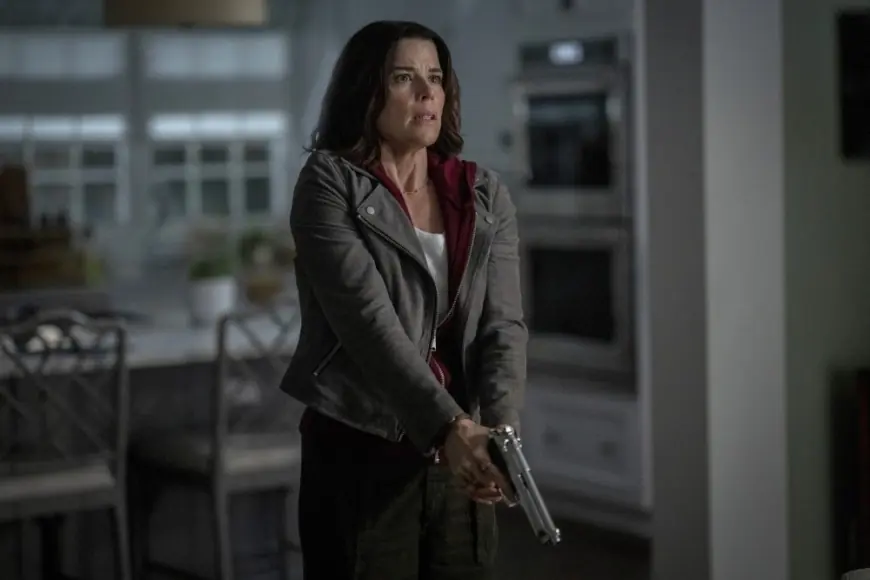
Scream 7 brings Neve Campbell back to the narrative center while aiming to balance nostalgia with freshness. The film’s cold open revisits the infamous Stu Macher house as a true-crime-themed Airbnb; that sequence — involving a quarreling couple — sets a violent, showy tone. Characters in the opener include Scott (Jimmy Tatro) and his girlfriend Madison (Michelle Randolph); the Stu Macher house has been turned into an experience destination filled with Stab memorabilia, outlines of where killers fell, and plaques marking victims. Madison subverts the stereotypical "dumb blonde" trope yet still dies, establishing the film’s harder edge. The narrative also reintroduces Sidney Prescott and her daughter Tatum (played by Isabel May, age 17 in the film), who is curious about her mother’s past — a detail that creates timeline questions because the fourth film was made in 2011. A gory killing spree begins, possibly orchestrated by someone previously assumed dead, and the film generally pulls back from heavy meta commentary in favor of a more direct, visceral sequel.
Three-point timeline and quick production landmarks
- 1996: The original film established the franchise’s rules and launched Kevin Williamson as a screenwriter.
- 2011: The fourth installment was made, a fact that complicates the timeline around Tatum’s age in the new film.
- Late 2023–2024: Barrera’s firing, Jenna Ortega’s exit, Christopher Landon’s departure, a $500, 000 rewrite, and Kevin Williamson’s return as director culminated in Neve Campbell’s near $7 million deal to rejoin the series.
It’s easy to overlook, but the production upheaval required both creative and budgetary trade-offs that shaped the final film.
- Projected North American debut: $45M–$50M, which would be a series-best kickoff.
- Scream VI global gross: $161M, the biggest since the franchise’s first two films.
- Rewrite cost: roughly $500, 000 to retool the screenplay after cast departures.
- Neve Campbell’s return: nearly $7 million; Courteney Cox: $2 million.
- Key creative moves: Kevin Williamson directing and co-writing with Guy Busick; James Vanderbilt is named as a co-writer in prior coverage of the screenplay team.
Key short takeaways:
- The film’s box-office hopes rest on a rebuilt marketing hook centered on Neve Campbell’s return.
- High-profile exits forced narrative and fiscal adjustments, including a $500K rewrite.
- On-screen choices emphasize a violent, nostalgia-aware opening rather than broad meta critique.
- Production decisions were made under intense public scrutiny and real-world backlash.
The real question now is how audiences will respond: will a series-best opening validate the expensive fixes, or will the behind-the-scenes drama overshadow the film’s reception? The coming box-office results and audience conversation will provide the clearest signals.
Writer’s aside: What’s easy to miss is how much a single casting decision can ripple through a franchise — from creative tone to marketing math — and force rapid, expensive course corrections.