





















Al Green’s ejection redirects attention to Democratic protest and chamber clashes during State of the Union

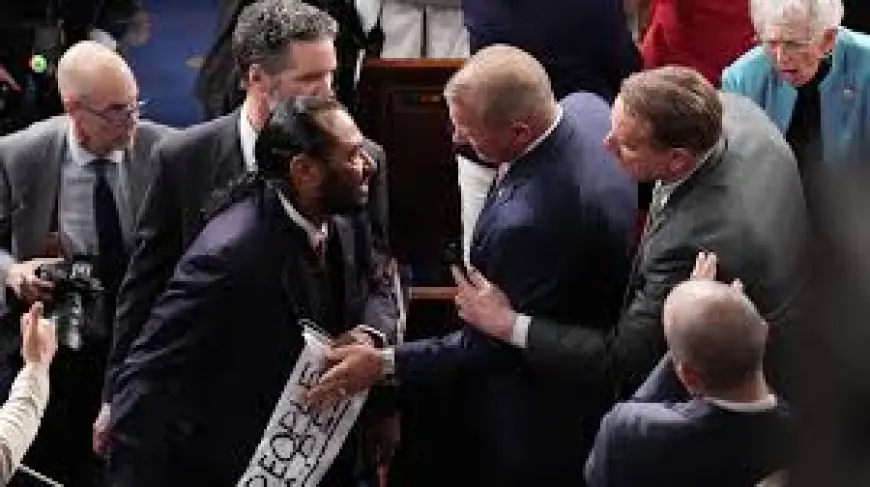
Al Green’s silent protest—holding a sign that read "Black people aren’t apes!"—landed squarely on the visual record and shifted the immediate impact onto House Democrats, the chamber’s optics, and viewers watching the State of the Union. The removal of the Texas congressman signaled who felt the consequences first: lawmakers who stayed seated in protest and a segment of the public seeing the sign’s message and the force used to conceal it.
Immediate impact: Al Green’s removal and the chamber reaction
Green was escorted out of the address almost immediately, marking the second year in a row he has been removed from the annual event. Last year he was ordered out by the House speaker, Mike Johnson, after yelling responses during the president’s speech; this year his protest was silent but pointed. As he was led toward the door, the confrontation drew physical pushes and attempts to block the sign from cameras, turning the protest into a focal point for both parties’ behavior on the floor.
How the protest unfolded inside the chamber
As the president began his address and others sat down, Green lingered in the center aisle holding the cardboard placard that read "Black people aren’t apes!" The wording was presented as a reference to the president sharing a racist video depiction of Barack and Michelle Obama. Multiple Republican representatives tried to grab at the sign or shield it from view while a staffer escorted Green to the door. Representative Troy Nehls, also from Texas, could be seen aggressively engaging with Green just before the escort; Senator Markwayne Mullin also approached in a menacing way. Green left clutching his walking stick and the protest sign; there were acrimonious exchanges with Republicans and a few began chanting "USA! USA!" as he walked out.
Wider Democratic resistance during the address
Green was not alone. Dozens of colleagues had boycotted the State of the Union, and several Democrats in the chamber remained seated as Republicans repeatedly stood and applauded. Some Democrats walked out early. Senator Mark Warner, a Democrat from Virginia, said on a social media network that he "couldn't sit through an hour of Trump's lies" and left while the president was emphasizing his economic claims. Representative Bill Foster from Illinois wrote on a social platform that he gave himself "5 bald-faced lies"—the same as last year—before leaving: "Less than one hour into his speech, I'm out. "
Heated exchanges, pins and shouted rebukes
As the president discussed his immigration enforcement agenda to standing ovations from Republicans and rebuked Democrats for not backing funding for the Department of Homeland Security, several Democrats shouted back. Representative Rashida Tlaib, wearing a pin that read "release the files", could be heard yelling about the killing of Alex Pretti, described in the chamber as a Minneapolis nurse shot to death by federal agents: "They saw the videos, Mr President, " she yelled. Representative Ilhan Omar shouted "You should be ashamed, " and repeatedly yelled "you have killed Americans. " Omar and Tlaib’s vocal responses added to an already tense atmosphere.
Green’s background, his remarks after removal, and the visual left behind
Green has been a prominent critic of the president and was the first member of Congress to call for his impeachment as early as 2017. He represents a predominantly African American district and has long fought for civil rights. After the ejection, Green told reporters outside the chamber that the removal was "of no consequence, " still holding his sign for cameras. He said nothing would prevent him from doing what he believed was righteous: "You have to take a stand, " he added. "I am just a person who has done it – but there are many others, I believe, who would. " Back inside the chamber, Green’s seat sat empty with only a handwritten cardboard sign that said "Al Green. "
Here’s the part that matters for viewers and the chamber alike: the sightlines and physical interactions—the grabbing at a sign, the staffer escort, the chanting, the empty seat with a handwritten placard—created a compact narrative that extended beyond the words of the speech.
What's easy to miss is how the mix of silent protest, shouted retorts, and visible attempts to hide a placard produced a set of images likely to be replayed and debated. The real test will be whether the visual confrontation changes how lawmakers choose to protest or how the chamber enforces decorum in future addresses.