






















State Of The Union: Trump Delivers Longest-Ever Address but Offers Little New

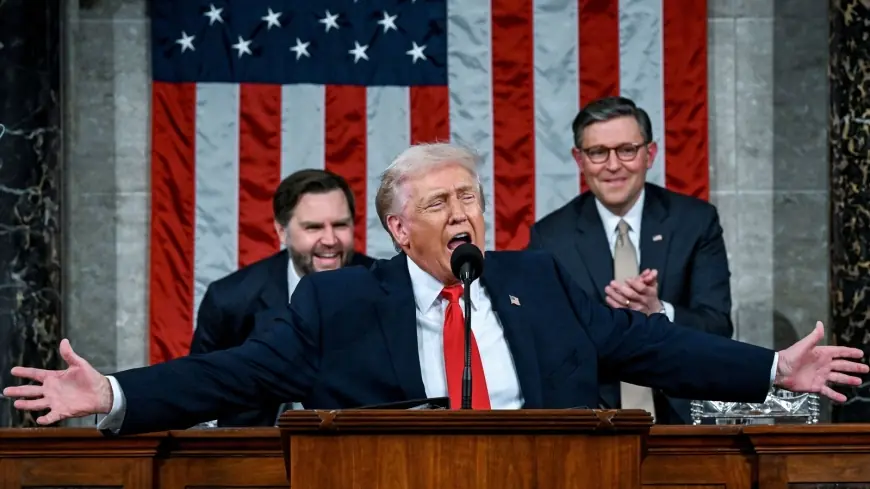
President Donald Trump used his second-term state of the union to reprise familiar themes over a 1 hour and 48 minute address, but the speech produced few substantive policy advances at a moment defined by rising Iran tensions, a Supreme Court setback on tariffs and looming midterm elections. The length and theatrical tone underscored a broader challenge: selling a record when public confidence and approval have weakened.
State Of The Union: 1 hour and 48 minutes tops Bill Clinton record
The night set a new length mark for the ritual: Trump spoke for 1 hour and 48 minutes, eclipsing the previous record of 1 hour and 28 minutes set by Bill Clinton. It was the first such address of his second term and closed where it began, with triumphant rhetoric — declarations that “our nation is back” and promises of a larger, brighter future — but little that changed the political calculus. What makes this notable is that extended stage time did not translate into fresh policy detail or a clear new direction.
Iran: missile warnings and a holding position on force
Hardline language toward Iran dominated large swathes of the evening. The president warned that Iran is working on missiles that could reach the United States, and his tone kept alive the possibility of stronger measures; commentators noted the administration appears on the brink of military options while offering a holding position that did not materially advance the public case for the next step. An analysis referenced in the speech said the president’s plan for Iran ‘‘isn't working’’ and that he faces three options, though those options were not detailed on the podium.
Supreme Court, Section 122 and the new 15% tariff
The speech followed a recent high court decision that invalidated large portions of the reciprocal tariffs the president announced last year. The ruling was described as the most substantial Supreme Court setback for any of his policies. The courthouse presence was conspicuous: while the full court customarily attends the address, only four of the nine justices were present this time — Chief Justice John Roberts, Amy Coney Barrett, Elena Kagan and Brett Kavanaugh. Trump shook Roberts' hand on the way to the podium and exchanged a serious look with him; Amy Coney Barrett, whom he nominated, showed no visible reaction as he called the ruling "disappointing" and "unfortunate. "
Faced with the judicial rebuke, the president announced a new 15% tariff that he said would replace the ones reversed by the justices. He signed a proclamation invoking Section 122, a rarely used statute that lets the president impose tariffs up to 15% for 150 days, after which Congress must act. He told the chamber that congressional action would not be necessary and later framed the tariffs as replacing the income tax.
Economy, affordability and specific figures
A central aim of the address was to sell Trump’s stewardship of the economy. He pointed to Wall Street gains and strong job numbers, while critics noted slower-than-expected growth in 2025 and persistent affordability problems over the last 13 months. Inflation has eased but has not plummeted: January data from the Bureau of Labor Statistics showed food prices were still 2. 9 percent higher than the same period a year earlier. Polling, as described during the evening, indicates declining public confidence on affordability — a vulnerability the president sought to counter by blaming Democrats, including Joe Biden, and by touting initiatives such as the TrumpRx website for cheaper medications and an executive order limiting Wall Street firms from buying single-family homes in bulk.
He also said he had struck a deal with tech companies to keep utility bills low despite the demands of AI data centres.
Audience, tributes and partisan protests
The staging leaned theatrical: the event was at times likened to a TV game show, complete with tributes and awards and a reunion between Venezuelan politician Enrique Marquez and his niece. There was a tribute to the late Charlie Kirk and an explicit condemnation of political violence. The partisan split was visible; dozens of Democrats, including some in leadership, skipped the chamber and held rallies in Washington instead, leaving many empty rows on one side of the aisle, and some Democrats who attended staged their own protests. Trump moved through the chamber, shaking hands with lawmakers before addressing the justices in the front row.
The timing matters because Iran tensions, the Supreme Court ruling on tariffs, and worries about affordability converge in a midterm election year that will shape the president’s ability to pursue his agenda. With approval ratings described as having slumped to their lowest point since the start of his second term, the speech functioned as both a performance piece and a bid to shore up Republican support rather than as a vehicle for breaking new ground on policy.
Observers noted the president appeared at ease on stage — the showbiz aspect of his presidency on display — but the core test for him will be whether familiar lines and theatrical flourishes sway voters and lawmakers when concrete numbers and legal constraints now circumscribe his options.