
























Rose Wylie: The 91-year-old art world rebel in her prime

Rose Wylie, now 91, has become a defining figure of a major London survey and remains outspoken about inequality in the market—saying it is wrong that paintings by men still sell for more than those by women. The latest coverage highlights a milestone exhibition, studio habits that look anarchic but are deeply intentional, and a career that gathered momentum only later in life.
Rose Wylie and the milestone exhibition
The show occupying the main galleries of the Royal Academy is being framed as a major career survey. Coverage describes it as her largest to date, comprising more than 90 works, including a number of new paintings made over the past two years. One account calls it the first solo show by a British woman to occupy all of the academy’s main galleries, while another places her as the first woman painter and only the second female artist to occupy those galleries. The exhibition includes works spanning her career, with earlier pieces such as Yellow Strip represented alongside recent canvases.
Inside the Kent studio: paint, newspapers and Pete
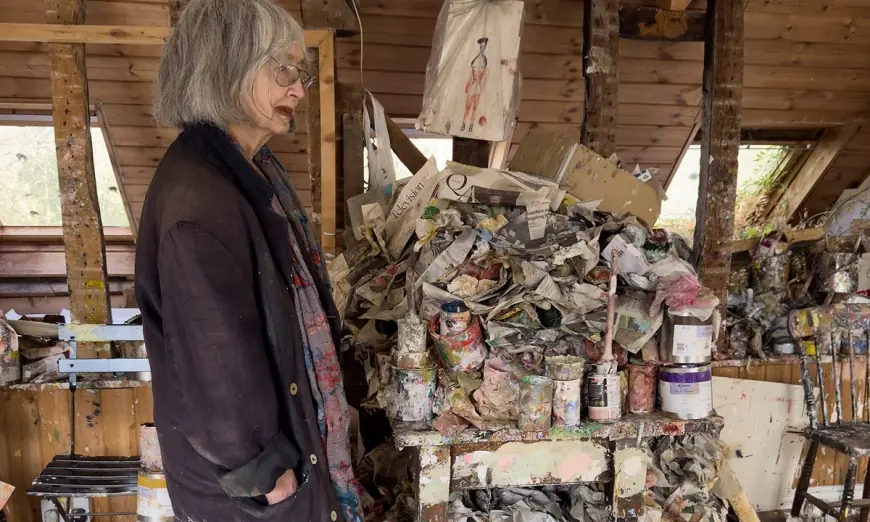
Visitors are shown a paint-spattered wooden floor littered with pages from old newspapers; much of the black-and-white print is obscured by vibrant splotches of colour. Wylie scrapes paint off when a painting is not working, which leaves a lot of paint on the floor. Brushes, some stuck fast, poke out of paint pots piled across the floorboards, table and chairs. There is a big bouquet of long dead flowers she cannot bear to throw away, and a bright pink and blue plastic lobster telephone. Newspapers also provide a source of photographs for her work.
Her rescue cat Pete, whom she acquired more than a decade ago and who she believes is about 16 years old, prowls the studio and is at ease amid the apparent chaos. The studio is hung with strip lights and thickly carpeted with newspaper; dried cans of oil paint crest around those papers. A national newspaper’s pages have been described as creating a soft surface underfoot that suits a painter’s back better than concrete.
Domestic rebellions and personal touches
Wylie has lived for more than 60 years in a low-slung 17th-century house in Sittingbourne, Kent, where she rejects conventional domesticity: jasmine grows in a tangle through the kitchen ceiling and bouquets of dead flowers crowd another room. A ceramic horse given to her by the actor James Norton sits by a windowsill. Next to the sink sit two plates of petrified cakes fuzzy with cobwebs; an associate named Sara who works at Wylie’s London gallery points out one biscuit bought in a coffee shop two years ago and suggests there may be a Battenberg cake buried somewhere upstairs in the studio. Logs burn in an open fireplace, and Wylie makes an event of receiving guests.
She enjoys clothes as a daily analogue of art and often works in tights and a skirt; on one recent visit she wore grey checked trousers, a navy pullover and plum lipstick. She was recently photographed in her home by Juergen Teller for a Loewe campaign; the photographer worked with a small pink camera and was noted for having one pink fingernail.
Practice, pace and the painting’s precarious edge
Wylie keeps the hours of a teenager: she typically starts work at around 17: 00 and often continues late into the night, saying that “twenty to four is probably my latest” when the village is quiet. She values the solitude—nobody phones or knocks, only Pete at the window—so she can work uninterrupted. Her process is unplanned and iterative: she will paint on, look again, decide something is bad and keep working. She embraces corrections and crossings-out as part of the material life of a painting.
For Wylie the painting is primary: she prefers the word “picture” for its childhood resonance and insists that interpretation can move viewers away from the image itself. She describes a tension—paintings are both metaphysical and very physical—and stresses the careful decision-making behind apparent spontaneity. She warns that it is "very, very fragile where a painting ends, " always sitting on a precarious edge; a work can still be changed, altered or have a face painted out even after it appears complete.
Subjects, influences and a late-blooming arc
Her giant, exuberant figurative paintings pull from an eclectic mix of references across art history, ancient civilisations, cinema, television, celebrity culture, current affairs and her immediate surroundings. Her canvases have featured Hollywood stars, soccer greats, black swans and aerial shots of flying bombs; one described favourite canvas is an aerial view of second world war bombs flying over the desert. Wylie makes vast mental leaps—turning a curving footpath into a gun and then into a tribute to Werner Herzog’s 2009 film My Son, My Son, What Have Ye Done?
Her career path was non-linear: she studied at Dover School of Art and Goldsmiths’ College in the 1950s, then stopped making art for 25 years to raise a family while continuing to teach. In 1979 she returned as a mature student to study for a postgraduate degree at the Royal College of Art, graduating at the age of 46. Wider recognition arrived in the 2000s, including inclusion in a 2010 international “Women to Watch” presentation at a museum in Washington, DC, and a prominent 2010 profile that described her as a breakthrough artist. Institutional solo shows in the 2010s followed, she won a major painting prize in 2014 and received an OBE in 2018. Today she is sought by galleries worldwide and her large-scale, witty canvases command high prices.
Works on view and what to expect
The Royal Academy survey gathers more than 90 works spanning decades, including new paintings from the last two years and earlier pieces such as Yellow Strip. Big canvases fill gallery walls; one pair of side-by-side canvases reproduces a small yellow house next door to her Kent home behind an orange fence and a tree she finds reminiscent of Cezanne’s Bathers. Wylie delights in the double readings her images allow—what can be read as a domestic scene can also read, she says, as a jumbo meat cleaver—and she continues to paint late into the night in pursuit of those unexpected transformations.
Recent updates indicate this picture of Wylie—the late-blooming, restless painter still at work in a domestic studio strewn with memories and material—remains the frame through which the new exhibition is being understood. Details may evolve as the exhibition continues to attract attention.