





















Delcy Rodríguez Emerges as Venezuela’s Interim Operator Under U.S. Oversight

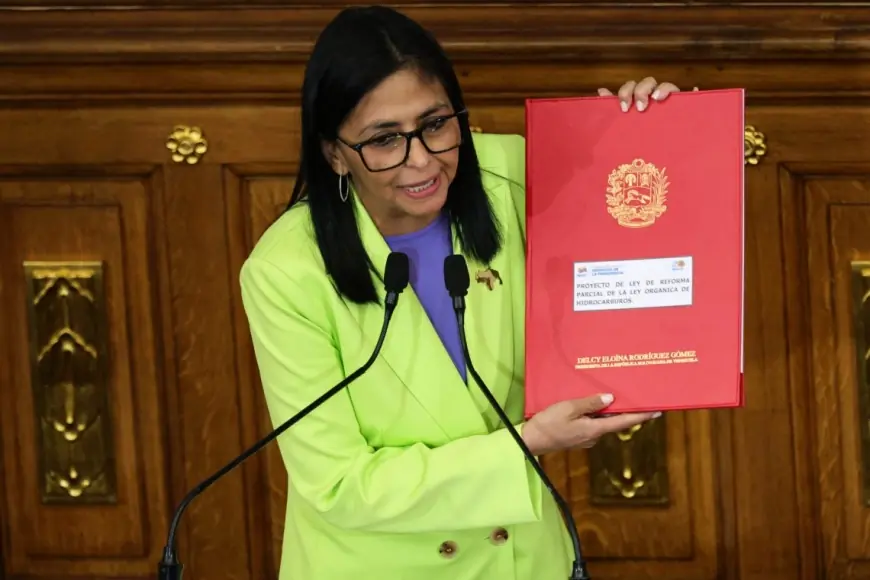
Nearly two months after the U. S. operation that captured Nicolas Maduro, delcy rodríguez is steering Venezuela under an arrangement described as U. S. oversight. The transition framework centers on stability, an amnesty law, and changes to how sanctioned oil is handled — measures that supporters say aim to keep state institutions functioning while the country moves toward a supervised reconstruction phase.
Delcy Rodríguez and the mechanics of continuity
Delcy Rodríguez consolidated leadership rapidly after the removal of the president. What unfolded was not a collapse of the regime but a reorganization: ministries continued to function, the armed forces remained cohesive, and the ruling party preserved discipline. The pattern described in the available coverage frames her role not as a mere placeholder but as the operator of the regime’s internal mechanics.
Her career trajectory is presented as a string of sequential control points that align with core pillars of governance: narrative, legitimacy, legality and administration. Over years she served in communications, finance and foreign roles, led a constitutional body, and held executive vice-presidential responsibilities. Those positions gave her credibility across the military hierarchy, party elites and economic networks, enabling a functional transfer of authority when the president disappeared.
- Key roles highlighted in the context: communications minister, finance minister, foreign minister, head of the constitutional assembly, executive vice president, and vice president.
The available accounts emphasize that delcy rodríguez balanced ideological cohesion with pragmatic openness to negotiation. Her early decisions combined public condemnations of foreign intervention with steps toward prisoner releases and normalization, a posture designed to preserve revolutionary continuity while enabling international engagement.
U. S. oversight, amnesty and oil controls shaping the transition
The current political framework places U. S. authorities in an oversight role intended to stabilize Venezuela and prevent broader conflict. Stabilization priorities outlined in the context include stopping repression, reviving the economy and releasing political prisoners through an amnesty law. U. S. officials framed direct engagement with state security leaders as necessary to avoid civil war, prevent factional clashes and stop mass migration.
Measures for the energy sector figure prominently. Sanctioned oil is to be released under new licensing arrangements: companies will be licensed to transport and market petroleum, and proceeds will be deposited into an account supervised by U. S. oversight. The stated purpose is to ensure resources are audited and allocated for health, education, safety and wages rather than enriching an entrenched elite. The plan aims to keep oil from being provided at subsidized terms to other states and to bring greater financial control into the stabilization process.
Officials projected that a stabilization phase could be completed within a defined short-term horizon, with the expectation that Venezuela’s own resources would finance reconstruction rather than relying on external taxpayer aid. The move toward supervised revenue management and an amnesty law is presented as part of a phased approach to normalization and eventual transition to broader political representation.
What this means next
The two strands running through the current narrative are institutional continuity under a functioning internal operator and external supervision focused on stabilization and resource control. If the framework holds, delcy rodríguez will continue to manage the day-to-day mechanics of governance while U. S. oversight oversees key economic and security levers tied to stabilization goals.
Uncertainties remain about how political elites and external actors will adapt to this arrangement, and whether the balance between ideological continuity and negotiated normalization will prove durable. Recent coverage presents the situation as an activated structure built to survive leadership shocks; how that structure evolves under oversight and new economic controls will determine the pace and scope of Venezuela’s transition.