
























Meta’s 6-Gigawatt GPU Pact Sends Amd Stock Higher as Multiyear Chip-for-Stock Deal Unfolds

Meta and AMD announced a multiyear agreement Tuesday that will have Meta buy upward of 6 gigawatts' worth of AI chips as part of its AI build-out, and amd stock reacted sharply. The deal includes a stock-for-chips element that ties AMD equity issuance to delivery milestones, a structure that aims to link hardware shipments to long-term value creation.
Deal terms: 6 gigawatts and a stock issuance tied to milestones
The agreement will see Meta purchase upward of 6 gigawatts' worth of AI chips. As part of the deal, AMD will issue Meta 160 million shares of common stock that will vest in a series of tranches if AMD hits certain milestones. The first tranche will vest when AMD ships its first 1 gigawatt of chips. The arrangement was announced Tuesday and is structured so equity compensation follows measurable execution milestones.
Amd Stock reaction and market moves
amd stock jumped as much as 10% in premarket trading before paring those gains in the regular session. The immediate market move reflected investor focus on the commercial scale of the agreement and the stock-for-chips mechanics that limit upfront dilution while incentivizing deliveries.
What AMD executives say about revenue and alignment
AMD CFO Jean Hu framed the partnership as one that should drive substantial multi-year revenue growth and be accretive to non-GAAP earnings per share, describing the deal as a significant step in delivering on AMD's long-term financial model. Hu also emphasized that the performance-based structure tightly aligns AMD and Meta around execution and long-term value creation.
Product deployment: MI450, Helios racks and EPYC CPUs
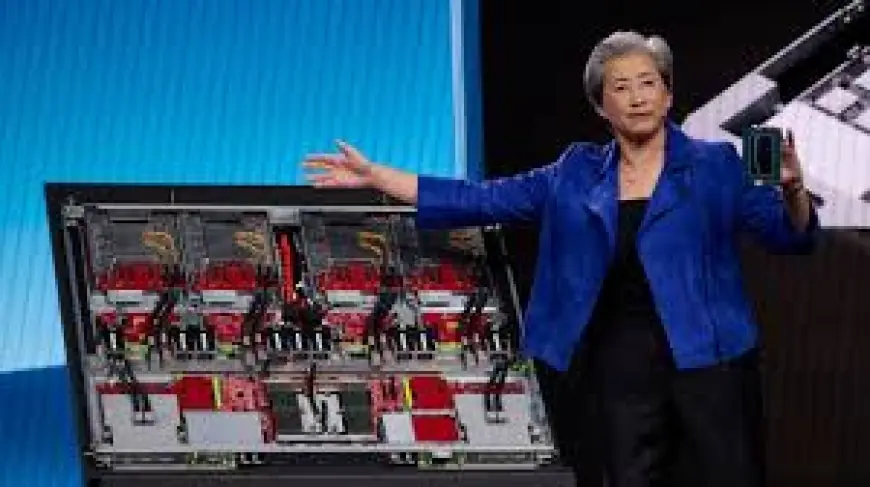
The first GPUs under the deal will be AMD’s MI450 line and will be deployed in Meta’s Helios rack-scale data center systems, complete with EPYC CPUs, in the second half of the year. Meta will also purchase a large additional CPUs, including AMD’s Venice chip and its next-generation Verano processor. The announcement highlights a notable role for CPUs as companies prepare to run agentic AI services and focus on inference workloads.
How this fits into Meta’s broader AI build-out and the competitive landscape
Meta’s agreement with AMD follows a separate multiyear deal announced last week with a rival chipmaker that will provide millions of Blackwell and Rubin GPUs. That rival also said Meta will host the first large-scale deployment of its Grace CPU servers; that rival’s architecture typically pairs Grace CPUs with two Blackwell or Blackwell Ultra processors to form GB200 and GB300 superchips that slot into rack-scale platforms.
The AMD deal arrives as Meta plans to spend upwards of $135 billion in capital expenditures throughout 2026 for its AI expansion, funding everything from data center construction and chips to model training. Meta, Amazon, Google, and Microsoft together plan to spend some $650 billion on AI, a scale of investment that has prompted investor caution about returns.
Investors have shown selective patience. Meta has fared best among the big spenders, with shares down just 2. 5% since it reported earnings on Jan. 28 and announced its investing plans. By comparison, Google shares have fallen 8. 7% since its news, Amazon has declined 11. 9%, and Microsoft has dropped 15. 5% since revealing its spending strategy.
Chip-stock outlook and competitive risks
Chip stocks broadly have cooled as Wall Street weighs the possibility of an AI bubble and the risk that custom chips developed by companies such as Amazon, Google, Meta, and Microsoft could erode GPU dominance in data centers. In November, recent coverage said Meta was in talks with Google to use its TPU chips for AI applications; analysts have noted that it will be difficult for those TPU-class chips to supplant the more general-purpose AI processors that Nvidia and AMD build.
The Meta–AMD deal adds another commercial channel for large-scale GPU deployment while embedding a performance-based equity element intended to align incentives. The arrangement tightens ties between a major cloud-scale buyer and a leading chip designer at a moment when capital plans, competitive strategies, and investor sentiment are all in flux. Story by Daniel Howley. Details may evolve as milestones and deployments progress.