

















Supreme court ruling leaves Trump's new 10% global tariff in place as supreme test of presidential power

The supreme court blocked many of President Donald Trump's sweeping import taxes in a 6–3 decision on Friday, and just hours after that ruling the president signed an executive order imposing a new 10% global tariff that is set to begin on 24 February. The move restarts a contentious set of trade measures and comes amid warnings of greater uncertainty for businesses and the risk of retaliation from trading partners.
How the Supreme Court narrowed the president's emergency authority
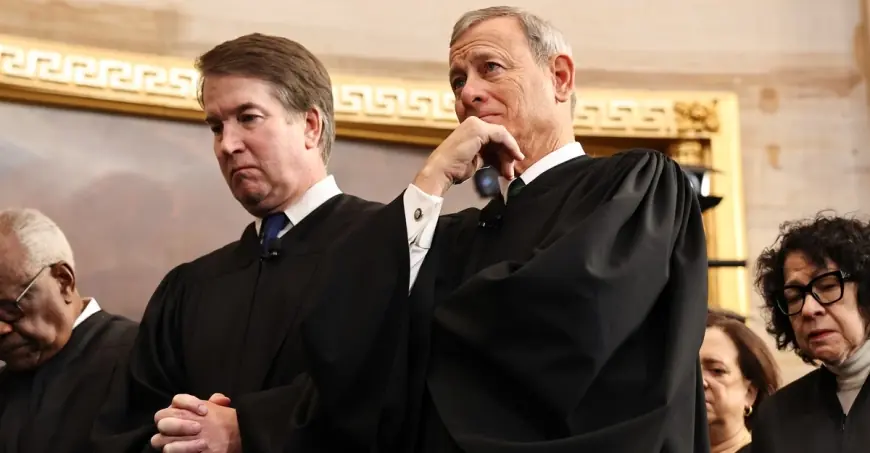
In a 6–3 decision, Chief Justice John Roberts wrote that the president had overstepped his powers when he introduced sweeping global tariffs last year using the International Emergency Economic Powers Act. The justices found limits to the use of that authority, a ruling that struck down many of the earlier import taxes on Friday.
Trump's executive order, 10% levy and Section 122 mechanics
Hours after the court's decision the president signed an executive order to impose a temporary 10% levy, effective from 24 February. The administration is applying the charge under Section 122 of the 1974 Trade Act, which allows the president to impose the duty for 150 days without congressional approval. The executive order says the temporary import duty is intended to "address fundamental international payments problems and continue the Administration's work to rebalance our trade relationships to benefit American workers, farmers, and manufacturers. " The president later threatened to raise the tariff to 15% but has not yet issued an official directive to increase the rate.
Economic numbers cited and past emergency tariffs
The president has argued that tariffs are necessary to reduce America's trade deficit. That deficit reached a fresh high last week, widening by 2. 1% compared to 2024 and hitting roughly $1. 2 trillion (£890bn). The United States has already collected at least $130bn in tariffs using the 1977 International Emergency Economic Powers Act.
Analyst warnings: business uncertainty and escalation risk
Carsten Brzeski, an analyst with investment bank ING, said the fast-changing tariffs add to "the chaos and mess" for businesses and increase uncertainty. He said, "In terms of uncertainty we're back to where we were last year, " and warned that "the risk of a real fully-fledged tariff war - trade war - escalation is clearly higher than last year. " He made those remarks on the Today programme.
International reactions, threats of retaliation and parliamentary warnings
After the Supreme Court ruling, the president warned on Monday he could impose higher tariffs on countries that "play games" with recent trade deals. Countries around the world said they were evaluating what tariffs and trade deals would stand following the decision. The UK said no reciprocal action was "off the table" if the US did not honour its tariff deal with the UK, while adding that "no one wants a trade war. " The European Union said it would suspend its ratification of a deal struck over the summer.
Brando Benifei, chair of the European Parliament's delegations for relations with the US, said the EU had asked the US for clarity over the tariffs and urged collective action: "If we get worse conditions then we need to react. " He added, "I think you should demand respect, " and appealed, "My plea is that all the countries in the world that do not like that we are being treated this way... try to work a bit together. " He made those remarks on the Today programme.
The Roberts Court's broader project and Trump's record at the Court
Commentary within the court's coverage argues the Roberts Court is not a simple partisan instrument. Last term, only 10 decisions, or 15 percent of decided cases, were 6–3. The Court's liberal justices—Sonia Sotomayor, Elena Kagan, and Ketanji Brown Jackson—were the sole dissenting votes in six of those 6–3 cases; the Court's most conservative justices—Clarence Thomas, Samuel Alito, and Neil Gorsuch—were the sole dissenting votes in the other four.
Among both 5–4 and 6–3 cases, the liberal justices dissented together 15 percent of the time and conservatives dissented together 15 percent of the time. Most closely divided cases—70 percent—were mixed, with conservatives and liberals on both sides, and almost half of the Court's cases were unanimous. Last June each liberal justice wrote a unanimous opinion in ideologically charged disputes that included cases involving religious liberty, gun-manufacturer liability, and reverse discrimination.
The justices appointed by Republican presidents do not vote as a bloc: Neil Gorsuch and Brett Kavanaugh, both Trump appointees, voted together in closely divided cases only half the time last term. In the term before that, Sotomayor, Kagan, and Jackson were more likely than Alito and Thomas to be in the majority.
On presidential outcomes, Trump had the lowest success rate at the Supreme Court of any president in at least a century in his first term. The first Trump administration was the first modern presidential administration more likely to lose than win before the Supreme Court, including in cases involving immigration and the census. The Court unanimously rejected Trump's attempt to change the outcome of the 2020 election.
In his second term the president has not only lost on the tariffs case; the Court also blocked him from federalizing the National Guard in Chicago and from using the Alien Enemies Act to deport people without due process. Commentators say the larger project the Roberts Court seems to have undertaken is reining in the power of the presidency and making the president more politically accountable. The context ends with an incomplete fragment—"Joe Biden’s student-l"—which is unclear in the provided context.
President Trump's public reaction
President Trump was highly critical of the Supreme Court's decision, calling it "ridiculous, poorly written, and extraordinarily anti-American. " On Monday he warned he could impose higher tariffs on countries that "play games" with recent trade deals.