





















Baby Monkey Punch Draws Crowds as Ichikawa City Zoo Says He Is Integrating with Group

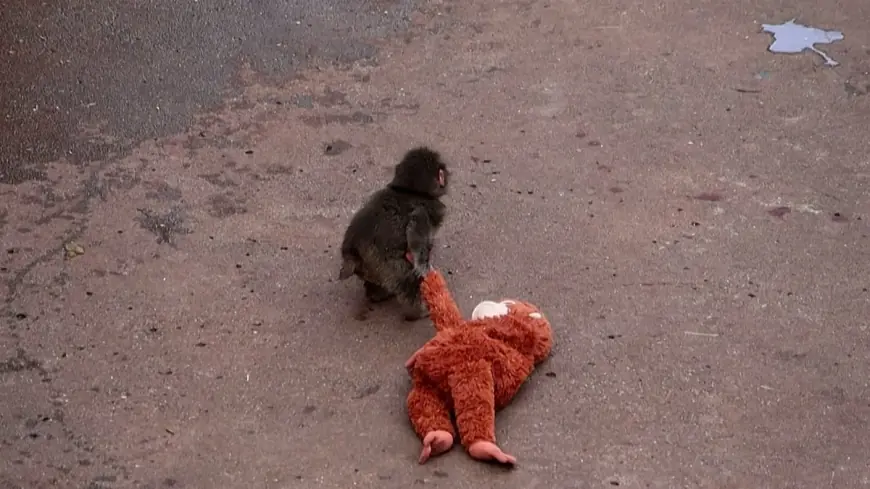
Punch, an abandoned young Japanese macaque who went viral after being seen clutching a stuffed orangutan given by keepers, has begun to find acceptance among other macaques at Ichikawa City Zoo. The development matters because the animal’s early reliance on human carers and a toy appears to be shifting toward natural social behaviours that are crucial for long-term welfare.
Baby Monkey Punch at Ichikawa City Zoo
Punch first captured public attention when videos circulated showing him dragging and playing with a soft orangutan toy that zookeepers provided as a substitute for his mother. The baby monkey punch had struggled during the first few months of his life to bond with other monkeys in the zoo’s enclosure, and his primary companions were human keepers and the stuffed toy.
Stuffed orangutan offered after maternal rejection
Keepers presented the stuffed orangutan as a comforting object when Punch was abandoned and rejected by his mother. That toy became central to the footage that went viral and drew widespread sympathy. Over the first few months, Punch’s lack of integration with the group left him reliant on human interaction and the soft toy for comfort.
Grooming and a hug signal social shift, says Trentham Monkey Forest director Matt Lovatt
Recent videos show a clear change: Punch was given a hug by one monkey and was seen grooming others, behaviours that are described as key to macaque socialisation. Matt Lovatt, director of Trentham Monkey Forest, noted that grooming is the principal way these primates build friendships within their group. Lovatt oversees the well-being of Barbary macaques at a wildlife sanctuary near Stoke-on-Trent and welcomed the footage as an encouraging sign that Punch is beginning to form bonds.
Fans flock and public interest fuels visitation
Clips of Punch have driven people to visit the Japan zoo to see him in person, with visitors drawn by the viral footage. The wider public response followed the distribution of short video pieces that highlighted Punch’s attachment to the orangutan toy and his early difficulties integrating.
Video placement alongside other short items on the broadcaster’s platform
The monkey footage appeared alongside a range of short video items on the same video page, demonstrating how such clips sit within a broader short-form offering. Nearby items included footage of Thai police going undercover as lion dancers to catch a thief; a 2026 Lunar New Year round-up; a report on giant tortoises returning to a Galápagos island after nearly 200 years; segments about Andrew Mountbatten-Windsor and his arrest; discussion of why more Americans have not faced charges in the Epstein case; a skier describing panic during an avalanche on Italian slopes; an Italian town’s flying oranges carnival; a giant robot tribute to Brazil’s President Lula finishing last in a carnival competition; the moment a crew docks at the International Space Station; an interview with Gisèle Pelicot describing survival; and an episode titled "Ros Atkins on... Mandelson and the vetting system. " Some of those items were labeled with durations such as 00: 01: 22 and 00: 00: 46, reflecting short-format video lengths on the page.
Broadcast programming and specialist series in the media environment
Within the same media landscape are scheduled programmes and specialist series aimed at different audiences: a flagship morning TV show broadcasts news and insights live from Brussels every morning at 08. 00 and is also available as a newsletter and podcast; The Ring is described as a weekly political showdown where two political heavyweights face off; Tech Talks explores the impact of new technologies through explanations and Q& As; a series called The Food Detectives follows food experts working to crack down on fraud; Water Matters examines Europe’s water challenges, including pollution, droughts and floods affecting drinking water, lakes, rivers and coastlines; and climate-focused reporting meets experts on the front line of climate change. Taglines in the programming slate emphasize straightforward presentation, using phrasing such as "No agenda, no argument, no bias, No Comment. "
What makes this notable is that a sequence of small, observable behaviours—hugging and grooming after months of isolation—can mark a turning point in a young primate’s social trajectory. Because Punch relied on human carers and a substitute toy during his earliest weeks, those interactions appear to have both supported his survival and delayed his integration; the recent grooming and embrace suggest the zoo’s interventions have begun to have the intended effect of helping him join his species’ social network.
Unclear in the provided context is the exact timeline of recent footage beyond "recent videos, " and attendance figures for visitors who have come to see Punch. The zoo’s decision to provide a stuffed orangutan and the subsequent monitoring of Punch’s behaviour remain the concrete actions documented in the available material.