




















Antoinette Rijpma-de Jong wins surprise Olympic 1,500m gold as husband helped her escape the Olympic bubble

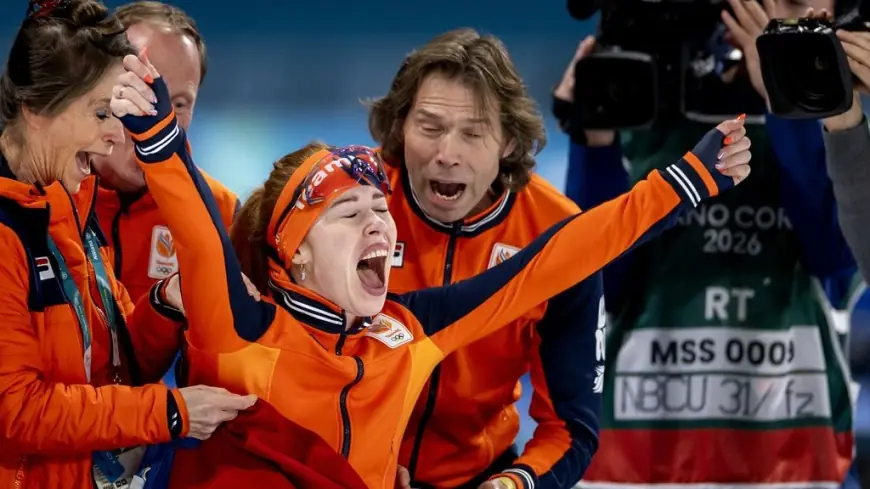
antoinette rijpma-de jong captured a surprise Olympic title in the 1, 500 metres in Milan, clocking 1: 54. 09 to beat Norway’s Ragne Wiklund by 0. 06 seconds. The victory matters now because it paired a razor-thin on-ice triumph with a deliberately constructed off-ice routine her husband helped maintain, a combination the couple says paid dividends.
Development details
Rijpma-de Jong posted her gold-medal time of 1: 54. 09 in the penultimate pair and watched as the favored skater Miho Takagi failed to top that mark in the final heat. The margin of victory was 0. 06 seconds; Wiklund had earlier set a benchmark of 1: 54. 15 in the preceding pair, while Canadian Valérie Maltais took bronze.
The Dutch rider produced a remarkably fast opening lap of 25. 26 seconds, building nearly a half-second lead on Wiklund early. After laps of roughly 28. 0 and 29. 8 seconds the advantage had dwindled to 0. 01 seconds entering the last circuit, but Rijpma-de Jong’s closing lap regained enough ground to finish 0. 06 clear. She is 30 years old, this is her first Olympic title and the sixth Olympic medal of her career; it marks her fourth appearance at the Winter Games.
Earlier in these Games she had already won silver in the team pursuit, and her season form included two second-place finishes in World Cup events and a silver at last year’s World Championships. Teammate Femke Kok placed fifth in her Olympic 1, 500m debut with a time of 1: 54. 79, while Marijke Groenewoud finished tenth in 1: 55. 16 after earlier disappointments in the 3, 000m and 5, 000m.
Antoinette Rijpma-de Jong and life outside the Olympic bubble
The win was not only a product of ice tactics but also of daily routines off the ice. Her husband, Coen Rijpma, slept in an apartment beside the Olympic village during the Games and helped create a small, private environment where she could step away from the competition bubble. He prepared simple comforts — including pancakes and laundry — so she could briefly relax before returning to the team environment.
They deliberately rented a nearby apartment so she had a place to go when she wanted to escape the intensity of the village, and she arrived in Milan early to train with the team pursuit crew and Femke Kok. The couple framed that decision as purposeful preparation: he said the arrangement had ‘‘paid off’’ after the gold. What makes this notable is how an athlete combined meticulous race execution — a rapid opening lap and a faster final circuit — with structured off-ice respite created by close personal support.
Immediate impact
The result extends a streak for Dutch women in the Olympic 1, 500m: Rijpma-de Jong is the fifth consecutive Dutch woman to take Olympic gold at that distance, following a line that includes Ireen Wüst and Jorien ter Mors. For the athlete herself it fills the remaining gap in her Olympic résumé: after winning individual bronzes in the 3, 000m and the 1, 500m, and medals in team pursuit, she now has one gold among six Olympic medals.
Within the Dutch squad, the race underscored depth: Kok’s fifth-place time came despite limited international racing this season, and Groenewoud rebounded from earlier setbacks to remain part of medal-winning team pursuit efforts. On the wider field, the absence of reigning world champion Joy Beune from the Olympic qualifying picture had left Miho Takagi as the pre-race favorite, a role she could not convert into gold on the final run.
Forward outlook
The Olympic speed skating tournament is nearing conclusion. The final scheduled events include the mass-start races for men and women on Saturday, where Marijke Groenewoud is still set to compete after taking silver in the team pursuit. For Rijpma-de-Jong, the immediate calendar centers on the closing days of these Games and on returning home with an Olympic title added to her record of World Cup podiums and world championship results.
Her triumph in Milan closes this chapter of the Winter Games while leaving concrete milestones in place: a first Olympic gold, a sixth career Olympic medal, and the mass-start finale to bring the tournament to an end.