

























Spinosaurus mirabilis named from Sahara fossils and cast as a ‘hell heron’ wader

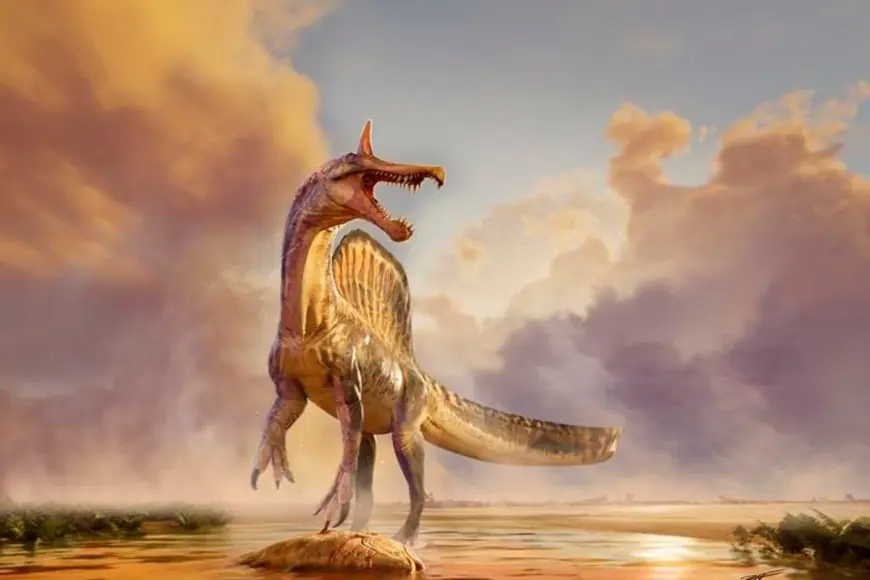
Scientists have named a new spinosaurus species, Spinosaurus mirabilis, after scimitar-shaped skull bones unearthed in the Sahara Desert; the fossils, dated to roughly 95 million years ago, point to a fish-eating predator that stalked rivers rather than a fully aquatic diver.
Spinosaurus found far inland in the Sahara
The fossils were recovered in central Niger, in a region that is desert today but was a network of rivers and wetlands during the Cretaceous. Researchers identified bones from multiple individuals—around 10—allowing them to reconstruct a skull that bears a large, sword-shaped crest. The team places the animals in the mid-Cretaceous, around 95 million years ago, and says these spinosaurs lived in inland wetlands rather than only in coastal environments.
A sabre crest and sail built for display
The skull shows a pronounced curved crest that the authors describe as scimitar-shaped; the bony core of that crest measured at least 40 centimeters high on large individuals, and comparisons with modern crested birds suggest a keratinous sheath could have made the crest at least 50 centimeters high in life. Along with the familiar tall sail on the back, the crest was probably a visual display feature for attracting mates or deterring rivals. The fossil skull also preserves interdigitating teeth—lower jaw teeth that fit between the upper teeth—an arrangement well suited to trapping slippery river fish.
‘Hell heron’—a wading predator, not a deep diver
Paul Sereno, the lead author of the study, describes the animal as a kind of "hell heron, " envisioning an animal that could wade into water up to two meters deep but spent most of its time stalking shallower traps for large fish. The team argues that a suite of features—elongated jaws, neck proportions, broad feet and the inland location of the finds—places these spinosaurs close to wading animals like herons rather than obligate swimmers.
Size estimates drawn from the material place Spinosaurus mirabilis in a similar range to its famed relatives: the study notes lengths on the order of 10 to 14 metres for large individuals. The new species’ crest is substantially larger than that described for previously named spinosaurs, and the researchers suggest bright coloration and the keratinous sheath would have made the crest an even more prominent visual signal along riverbanks.
Fieldwork that produced these specimens followed earlier, decades-old fossil discoveries in the same Saharan region and built on renewed expeditions to remote sites. The authors assembled the skull using multiple individuals and 3D digital models to piece together fragmentary bones recovered from the desert.
The research is published in the journal Science and leaves open many questions about spinosaur diversity and behavior. The paper’s authors note that better-preserved specimens are still needed to resolve remaining uncertainties about these sail-backed predators and their relatives.
The immediate next step confirmed by the study is the appearance of the results in Science; the research team emphasizes continued fieldwork and the search for more complete fossils to refine the picture of how Spinosaurus mirabilis and its kin lived and displayed themselves along ancient rivers.