




















jesse jackson’s Wardrobe Was a Political Signal as Much as a Style Statement

Civil rights leader Jesse Jackson, who died Tuesday at 84, left a layered legacy that included an unmistakable visual identity. Beyond speeches and campaigns, his wardrobe functioned as rhetoric — aesthetic choices that reinforced messages about heritage, dignity and political ambition.
Clothing as a Form of Political Communication
Across decades on the national stage, Jackson used clothing to frame his arguments and position himself within shifting currents of the civil rights movement and American politics. He embraced garments that spoke to different audiences and moments: a dashiki that signaled a reclaimed African past, a turtleneck and blazer that placed him among the emergent leaders of the 1960s, and tailored suits that fit the role of an elder statesman by the 2000s.
These were not merely fashion choices. They were deliberate acts of identity work. By alternating between traditional Western tailoring and garments with visible African references, he broadcast both respectability and cultural affirmation. The dashiki, in particular, served as a public claim on heritage and communal history — a visible, wearable assertion that tradition and modern political life were not in conflict.
A Visual Record of Transition and Tension
Jackson’s wardrobe traced a transitional generation. He did not fully conform to the sober suits associated with earlier civil rights elders, nor did he pursue flamboyance for its own sake. Instead, his clothes often read as punctuation marks to his oratory: emphatic, sometimes theatrical, always purposeful.
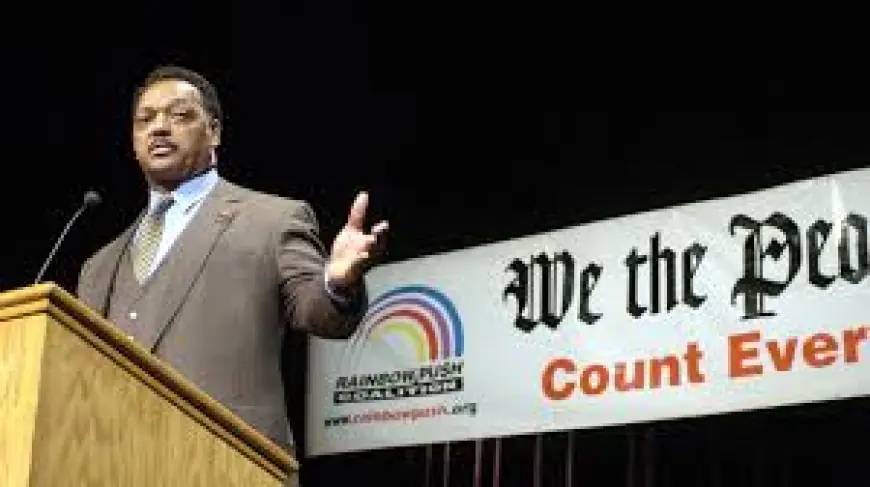
Moments captured in photographs underscore that intent. In the late 1960s he stood in an olive turtleneck under a blazer at a pivotal, traumatic moment in the movement’s history — an image that married gravitas with an emerging informality. Later, in 2008, as a gray-haired elder celebrating a milestone electoral victory, his suits and sports jackets read as both camouflage and costume: a seasoned activist adapting the language of establishment politics while retaining a distinct personal cadence.
That in-between visual identity reflected larger tensions within Black political life — between respectability politics and cultural assertion, between ministerial dignity and lay theatricality. Jackson’s choices made those tensions legible to broader audiences and helped him craft a narrative of dignity, possibility and fairness that audiences could see as well as hear.
Legacy: Style as Strategy
Jackson was neither a dandy nor a purely conventional dresser. His look evolved with his roles: preacher, organizer, candidate and elder statesman. Whether in a three-piece suit, a leisure suit, or shirtsleeves with epaulets, his clothing choices conveyed the stakes he saw in each moment and the constituencies he sought to address.
As leaders and observers reflect on his death, attention to his visual presentation helps explain how he moved between crowds and institutions. His garments were functional and symbolic, signaling both belonging and aspiration. For many, those choices remain a vivid part of what Jackson offered the nation: a reminder that political communication extends beyond words and into the public grammar of dress.
In the wake of his passing, the images endure: a career told in fabric and silhouette as much as in oration and policy fights. That visual record will be part of how history remembers him — not only for what he fought for, but for how he chose to present those fights to the country.