



















elana meyers taylor and Kaillie Armbruster Humphries Inspire With Gold, Guilt and Grace

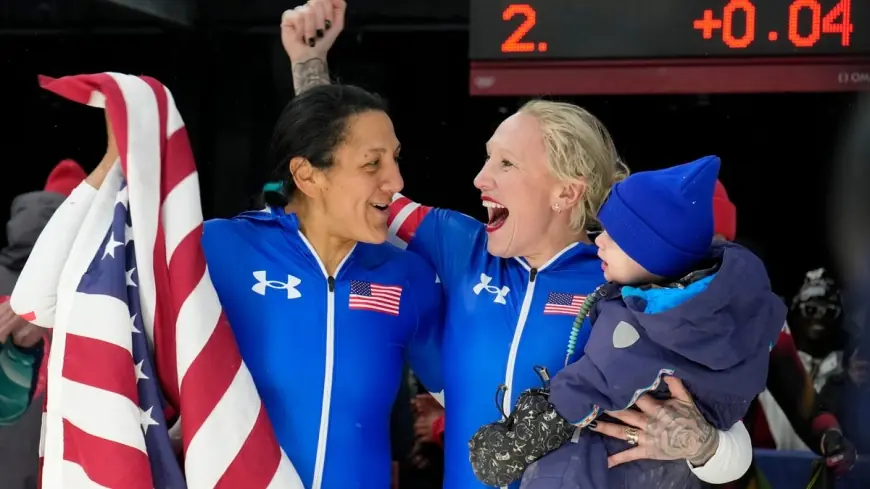
Elana Meyers Taylor clinched the Olympic monobob crown on Monday, Feb. 16 (ET) in Cortina d’Ampezzo, finishing ahead of Germany’s Laura Nolte and teammate Kaillie Armbruster Humphries. Standing on the podium with their small sons at the edge of the celebration, both athletes turned a medal ceremony into a broader statement about motherhood, sacrifice and persistence in elite sport.
Gold on the track, perspective off it
The win for Meyers Taylor was more than a career milestone; it was a long-sought dream realized. Her monobob victory was framed not only by the usual measures of speed and technique but by the vantage point of a parent who has built a second life alongside elite competition. She made clear that claiming an Olympic title at this stage of life is not a contradiction of motherhood, but an expansion of it.
Armbruster Humphries, also on the podium, has been navigating the emotional tightrope of competing while caring for a toddler. She described the wrench of being apart from her son for the first time since his birth, acknowledging the emptiness that came with that separation even as she accepted the necessity of rest and focus ahead of competition. Both women credited the support networks around them—husbands, extended family and trained staff—with helping them manage the practical demands of parenthood while remaining competitive.
Compartmentalizing, support systems and the quiet work of mothers
The two athletes emphasized a theme familiar to many working parents: compartmentalization. Armbruster Humphries said she had to recognize and acknowledge mom guilt in order to be her best. Meyers Taylor echoed that sentiment, noting that motherhood does not mean abandoning personal ambitions. She dedicated her medal to the mothers who couldn’t chase their own dreams but pour themselves into their children instead, and to those who reached out to encourage her during hard times.
These remarks underscore the less visible labor behind elite performance. Training schedules, recovery routines and travel are all negotiated against nap times, childcare logistics and the emotional labor of parenting. Both athletes benefit from partners who understand the sport’s demands and families who step in; they also benefit from institutional resources that ease some burdens. Still, neither suggested there was an easy formula—only deliberate choices and frequent recalibration.
What the podium moment means beyond sport
Standing with their sons nearby transformed the medals ceremony into something more than a personal triumph. For many observers, the image of top-level athletes who are also mothers offers a practical example that high achievement and parenthood are not mutually exclusive. Meyers Taylor and Armbruster Humphries want that to resonate beyond the few who aim for Olympic glory: they hope working parents see permission in their example to pursue goals that matter to them.
Both athletes also challenged age-based assumptions. Armbruster Humphries reflected on how perspectives have shifted from an era when motherhood and advancing age were seen as an automatic decline in competitive prospects. Their performances suggest a different script—one where training, experience and life-stage adjustments can coalesce into peak moments, even if the shape of a career changes over time.
Their message was simple and human: ambitions can survive and even thrive alongside parenthood, though the path will look different and require trade-offs. For many women balancing careers and families, the sight of two mothers on an Olympic podium in Cortina d’Ampezzo will be a quiet, stubborn reassurance that neither motherhood nor age need be a barrier to pursuing big goals.