























‘Tyler Perry’s Joe’s College Road Trip’ Review: Grandpa Knows Best

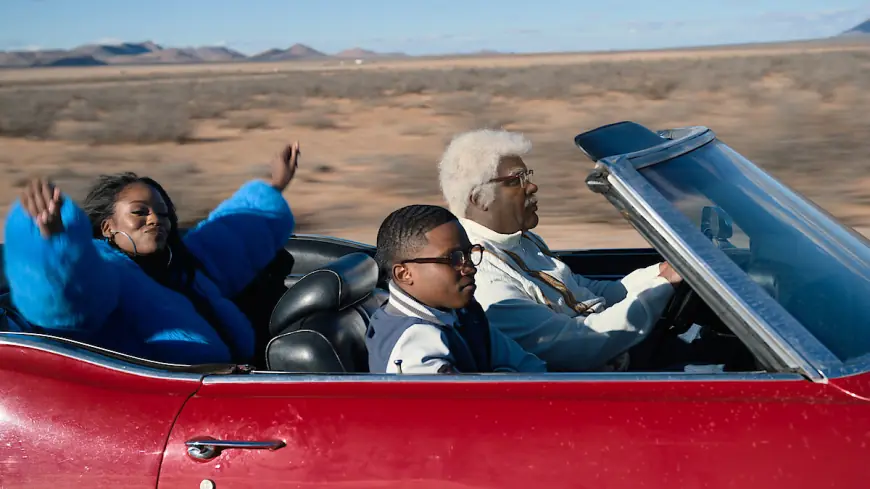
Tyler Perry leans into chaos and conscience in a road-trip comedy that puts his aging, outrageous character Joe squarely in the driver’s seat. Short on Madea and long on curmudgeonly wisdom, the film mixes profanity, unexpected detours and a late reveal that reframes the movie’s messy, affectionate heart.
What the film is and where it goes
The title may be a mouthful, but the premise is simple: a teenager rejects the idea of attending a nearby historically Black college for a far-off university in California, and his father sends Joe, the family’s foul-mouthed elder, along to make sure he gets there. Tyler Perry plays multiple roles here — including Joe and the boy’s father — and the picture unfolds as a long, boisterous highway lesson. The film is rated R and runs 1 hour 49 minutes.
Expect scenes that will unsettle viewers who come expecting a standard holiday-style family comedy. The script repeatedly uses racial epithets and leans heavily on coarse language; there are also stops that many audiences won’t expect in this kind of film, including a visit to a brothel and musical turns that blend the profane and the soulful. Those choices push the film into a rougher, more adult register than much of the creator’s past work.
Performances, tone and the film’s surprise
Jermaine Harris anchors the picture as B. J., the naïve teen whose ambitions set the trip in motion. Harris creates a believable arc, moving from sheltered uncertainty to a sharper, streetwise clarity. Opposite him, the elder Joe is a bracing force: profane, fearless and oddly affectionate. Perry gives Joe enough attitude to fuel the movie and then some, turning what could have been a one-note curmudgeon into a complicated guide. A supporting turn as Destiny, a character who educates B. J. in ways neither parent could, brings unexpected warmth and worldliness to the road narrative.
The film’s tone is deliberately anarchic. Frequent expletives are used not merely for shock but to underline a generational and social impatience that animates the story. The result is uneven — some sequences feel indulgent, while others land with genuine emotional power. One early-seeming vignette, where Joe asks B. J. to pose for a photo by the Mississippi, proves to be more significant than it first appears; attentive viewers will sense the thematic freight of certain scenic moments well before the film spells them out. That slow-burn revelation helps the movie close on a note of pride and anger that feels fitting for its mid-February premiere during Black History Month (ET).
Verdict: messy, loud and unexpectedly persuasive
This is not a polite film, nor is it always coherent. It is, however, honest in its unruliness. The screenplay’s willingness to venture into uncomfortable territory — sexual frankness, harsh language, and abrupt tonal shifts — gives the film an erratic energy that will alienate some viewers and thrill others. At its best, the movie’s anger and dignity converge to make a persuasive statement about family, identity and the lessons older generations pass on in unconventional ways.
For audiences prepared for profanity, detours and a late emotional reveal, the picture delivers a distinct experience: messy, raucous and, ultimately, heartfelt. For those who expect a tamer, more familiar comic template, this road trip will be a bumpy ride.