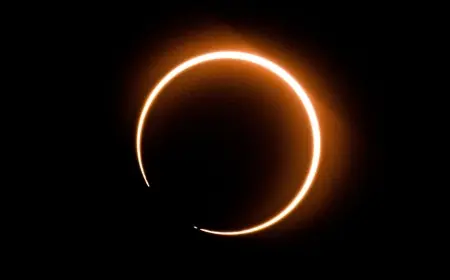
























Where the Feb. 17 annular 'ring of fire' eclipse will be visible

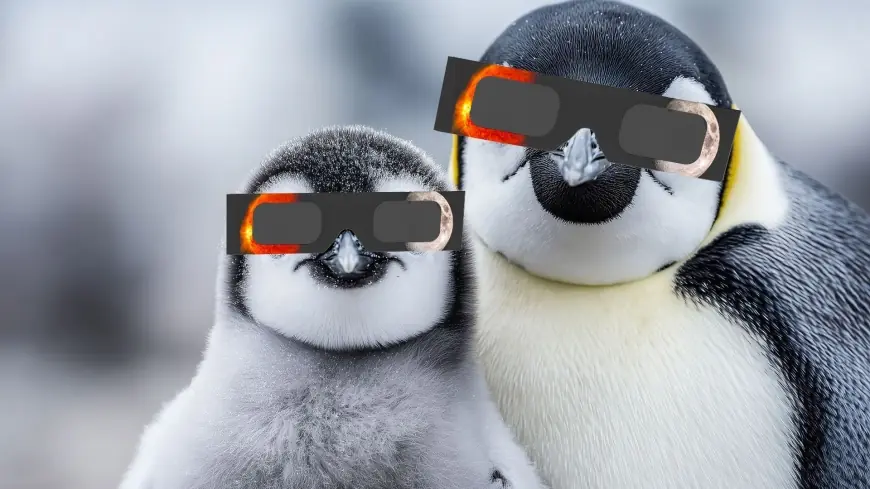
The first solar eclipse of 2026 is an annular event — a dramatic “ring of fire” — set for Feb. 17, 2026. The narrow swath where the full annulus will be visible crosses largely unpopulated ice and ocean, meaning far fewer humans than penguins are expected to witness the spectacle. Many more locations in the Southern Hemisphere will, however, see a partial eclipse.
Path of annularity: remote and Antarctic
The path where the moon will sit directly in front of the sun but leave a bright ring around its edge stretches roughly 2, 661 miles (4, 282 kilometers) long and about 383 miles (616 kilometers) wide. That corridor moves across western Antarctica and skims the Davis Sea coast of the Southern Ocean. The eclipse will rise over mainland Antarctica and set offshore near the Davis Sea.
Because the track sits over such remote polar regions, very few permanent research stations or temporary visitors will be located in the narrow band of annularity. Observers inside that band who are positioned on clear ground or sea ice will be able to see the full ring; anyone outside that corridor will only see a partial obstruction of the sun.
Where the partial eclipse will be visible and timing
A much wider area will experience the partial phase, during which the moon takes a “bite” out of the sun but does not create a ring. The partial eclipse will be visible across Antarctica, parts of southeastern Africa, the southern tip of South America, and over portions of the Pacific, Indian, Atlantic and Southern oceans. Territories along the route may also include subantarctic islands and surrounding sea lanes.
Observers in locations that fall within the broad partial zone should expect the first signs of the eclipse in the early morning hours on Feb. 17. The initial partial contacts are expected to begin at about 6: 42 a. m. ET. Exact local times will vary widely depending on longitude and whether the observer is positioned near the annular path or further afield.
Viewing safety and what to expect next
Never look directly at the sun without appropriate protection. During annular and partial phases, the sun’s surface is still very bright and can cause permanent eye damage. Use certified solar eclipse glasses or indirect viewing methods such as a pinhole projector. Even when the ring appears, it is unsafe to view the sun without proper filters.
For skywatchers planning ahead: two weeks after the Feb. 17 annular event, Earth will pass through a total lunar eclipse on March 3–4, 2026. That total lunar eclipse will paint the moon a deep red for observers across western North America, Australia, New Zealand and East Asia, with totality lasting around 58 minutes in some locations. Nearly one-third of the global population is expected to fall within the lunar eclipse visibility footprint.
Looking farther ahead, the next annular solar eclipse will occur on Feb. 6, 2027, with a path crossing parts of South America and West Africa, offering better chances for human observers to experience the full ring of fire.
For travelers and scientists considering a trip to witness the annular ring over Antarctica: expect complex logistics, extreme conditions and strict travel windows. For most skywatchers, the partial views across southern continents and oceanic regions will provide the safest and most accessible way to enjoy this February event.