
























Elana Meyers Taylor finally breaks through for Olympic monobob gold at 41

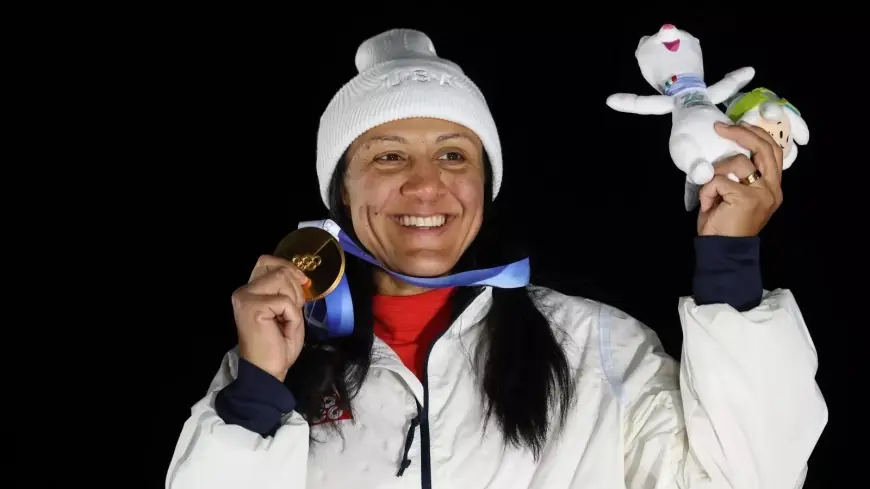
Elana Meyers Taylor spent four Winter Games stacking medals without ever standing on the top step. On Monday, Feb. 16, 2026 (ET), that streak ended in dramatic fashion as she won women’s monobob Olympic gold in Cortina, closing a four-run race with the kind of precision that turns hundredths into history.
Her winning total time of 3:57.93 edged Germany’s Laura Nolte by 0.04 seconds, a margin so tight it effectively came down to one clean steering decision in the final run.
A four-run finish decided by hundredths
Monobob is unforgiving because every athlete races the same sled model and the event is built to magnify driving skill. After three heats, Nolte held the advantage and looked positioned to finish the job. Then the final run flipped the leaderboard: Meyers Taylor delivered a faster closer while Nolte’s last trip down the track included an early scrape that cost speed.
Women’s monobob (final, Feb. 16, 2026 ET)
| Medal | Athlete | Country | Total time | Margin |
|---|---|---|---|---|
| Gold | Elana Meyers Taylor | United States | 3:57.93 | — |
| Silver | Laura Nolte | Germany | 3:57.97 | +0.04 |
| Bronze | Kaillie Humphries | United States | Not publicly confirmed | — |
Beyond the headline time, the race also showed how fine the line is between control and chaos on this track. In bobsleigh, “small” errors can cascade—one wall touch changes the sled’s angle, which changes speed through the next curve, which changes the next entry, and suddenly a medal is gone.
The run that turned silver into gold
Meyers Taylor’s win wasn’t built on one wild moment; it was built on repeatable speed. She posted standout single-run times during the competition, including a 59.08 that set the pace early and a 59.51 in the final heat that held up under maximum pressure.
That closing run mattered because it came at the exact time athletes feel the most conflicted: you must attack for speed, but you can’t attack so hard you lose the line and bleed time on the exit. Meyers Taylor found that balance, taking calculated risk at the start and then driving cleanly through the high-speed sections where mistakes multiply.
A career defined by medals—and the missing one
The significance of this gold goes beyond adding another line to an already decorated résumé. Before Monday, Meyers Taylor owned an Olympic collection that spoke to consistency—multiple silvers and bronzes across years of competing against different generations, different tracks, and evolving technical standards. What she didn’t have was the defining validation that often shapes how careers are remembered in the broad public: an Olympic title.
Now she has it, and the timing adds weight. At 41, in her fifth Olympics, she became the oldest American woman to win Winter Olympic gold and reached six career Winter Olympic medals, tying a longstanding U.S. mark for most by a woman. She also extends her standing as one of the most decorated athletes in the sport’s modern era.
A U.S. podium with Kaillie Humphries in bronze
The bronze medal went to Kaillie Humphries, another veteran who continues to rewrite what longevity looks like in sliding sports. Her place on the podium alongside Meyers Taylor underscored two realities at once: experience still matters in events decided by steering, and the U.S. program currently has more than one pilot capable of medaling under pressure.
The optics also mattered. Two mothers in their 40s finishing on the Olympic podium in a speed-and-power event is a direct challenge to the idea that these sports are only a young athlete’s game.
What the win changes heading into the next bobsleigh races
Monobob is a solo test, but the next big question is whether the momentum carries into the team events, where starts and synchronization can win medals as much as driving does. With 2-woman bobsleigh still to come later this week, the U.S. now brings something tangible into the remaining schedule: proof that its pilots can convert leads—and hunt down leads—when the whole tournament is on the line.
For Meyers Taylor personally, the gold changes the tone of everything that follows. She’s no longer chasing a missing achievement; she’s defending a standard she just set. And in a sport where confidence can be the difference between a perfect line and a single costly tap, that shift can be its own competitive edge.