























Women’s Olympic Hockey at Milano Cortina 2026 Sets Up Yet Another USA–Canada Gold-Medal Clash

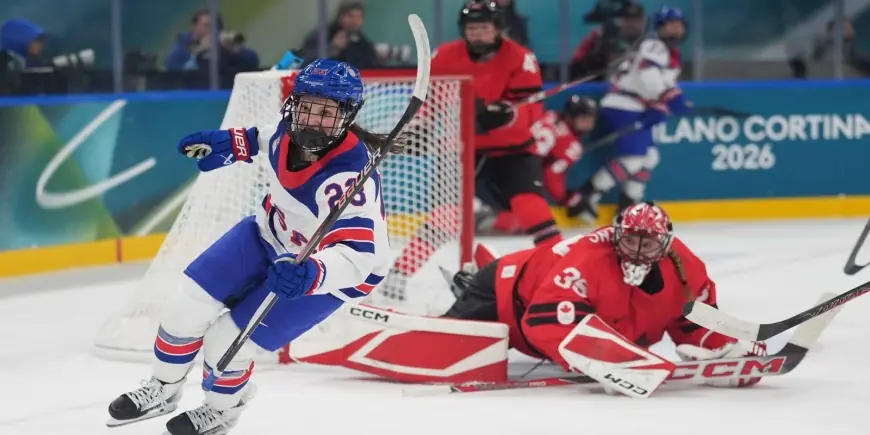
Women’s Olympic hockey has reached its most familiar, most volatile destination: the United States and Canada are headed to the gold-medal game at the 2026 Winter Games in Milan, renewing a rivalry that has defined the sport’s Olympic era and routinely turns a two-week tournament into a single, high-pressure afternoon.
The U.S. powered into the final on Monday, February 16, 2026 ET with a 5–0 semifinal shutout of Sweden, a result that reinforced just how suffocating its tournament has been so far. Canada advanced the other way: a tight 2–1 win over Switzerland that looked less like a runaway and more like a reminder of how thin the margins get once the medal rounds begin. The championship game is scheduled for Thursday at 1:10 p.m. ET.
What happened in the women’s Olympic hockey semifinals
The U.S. semifinal against Sweden was decisive early and relentless throughout. The Americans built separation on the scoreboard, but the more telling detail was the game state: Sweden rarely found sustained offensive time, and the U.S. never looked forced into survival mode. The shutout extended a defensive run that has made opponents chase perfection just to stay within reach.
Canada’s semifinal was the opposite kind of stress test. Switzerland played the kind of disciplined, low-error hockey that turns favorites into anxious puck-managers, and Canada needed composure, special-teams execution, and timely finishing to get through. In a medal-round setting, that kind of win can be either a warning sign or a sharpening stone.
Why women’s Olympic hockey keeps circling back to USA vs Canada
This final is not just a rematch. It’s the gravitational center of women’s hockey as a product.
The U.S. and Canada have the deepest pipelines, the most established developmental structures, and the largest pools of elite players who can drive play at international pace. They also carry a unique cultural weight: many players on both sides have faced each other for years across youth worlds, senior worlds, pro leagues, and Olympic cycles. That familiarity raises the level, but it also compresses the tactical edge. Surprise is hard. Execution becomes everything.
That reality can feel repetitive from a distance, yet it also keeps delivering the sport’s most watchable games. The same dynamic that frustrates parity advocates is what creates must-see stakes.
What’s behind the headline: incentives, stakeholders, and pressure points
The incentives in women’s Olympic hockey are layered.
For the U.S., the pressure is to convert a dominant tournament into a single win without letting control turn into caution. When a team rolls through group play and posts lopsided scorelines, anything short of gold can be framed as a failure to finish, even if the sport’s randomness says otherwise.
For Canada, the incentive is revenge and recalibration. A tight semifinal can be spun as vulnerability, but it can also be reframed as readiness: the ability to win when the game is ugly, when legs are heavy, and when the opponent refuses to break.
The stakeholders extend beyond the two teams. International federations want the medal rounds to validate investment in women’s programs. Broadcasters want an apex matchup that carries casual viewers. Sponsors want star power and clear storylines. Emerging hockey nations want proof that the gap can be narrowed, even if it isn’t closed yet.
What we still don’t know heading into the gold-medal game
Even with a predictable pairing, several pieces remain unsettled:
-
Goaltending deployment and leash length: one early mistake can trigger a change, or lock a coach into ride-or-die confidence
-
Special teams: power plays that looked routine in group play often tighten up when whistles disappear
-
Physical tone: rivalry games can drift into penalty trouble or swing on a single momentum shift after a big hit
-
Third-line impact: when top units cancel out, depth scoring is frequently the difference
-
How Canada responds psychologically to falling behind: does it open up, or stay patient and structural
Second-order effects: what this final means for the sport beyond the medals
A high-quality, high-visibility final accelerates the business case for women’s hockey. It drives interest in domestic leagues, strengthens youth enrollment, and creates leverage in funding conversations. It also reinforces an uncomfortable truth: the sport’s biggest stage still depends on a single rivalry to pull in the widest audience.
That can cut two ways. If the final is a classic, it boosts the entire ecosystem. If it’s a blowout, it can reignite the parity debate and push organizers to rethink tournament structures, investment strategies, and competitive development pathways.
What happens next: realistic scenarios and triggers
-
A tight one-goal final that swings late
Trigger: disciplined neutral-zone play and a special-teams moment that breaks symmetry -
A U.S. statement win
Trigger: early lead plus continued defensive stranglehold that forces Canada into low-percentage rush chances -
A Canada bounce-back with opportunistic finishing
Trigger: quick-strike goals off turnovers and heavy net-front pressure that draws penalties -
Overtime drama
Trigger: both teams prioritizing error avoidance, turning the third period into a chess match -
A broader shift in the bronze game narrative
Trigger: Switzerland’s ability to turn its semifinal form into a medal, strengthening the case that the next tier is getting closer
Women’s Olympic hockey rarely needs help finding meaning, but this one has it anyway: a dominant U.S. run meeting a Canada team that just proved it can win without comfort. On Thursday at 1:10 p.m. ET, the tournament becomes what it always becomes at the end a single rivalry, a single game, and a single standard: gold or regret.