






















Olympic hockey bracket chaos could send top teams home early


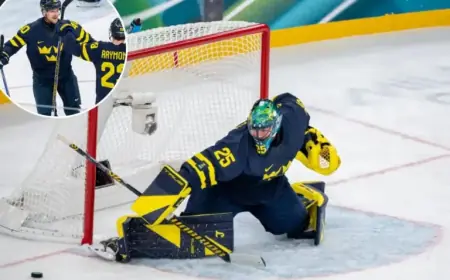
The men’s Olympic hockey tournament has lurched into a scenario that could eliminate one of its elite teams well before medal Sunday. A three-way tie in Group B and the Olympics’ head-to-head tiebreak procedures — decided by goal differential among the tied teams — mean Sweden, Finland and Slovakia have effectively reshuffled the path to the knockout rounds. That domino effect could force a quarterfinal showdown between Sweden and one of the North American powers as soon as Wednesday (ET).
How a three-way tie produced a brutal tiebreaker
Group B finished with Sweden, Finland and Slovakia level on points. The tournament’s rules first compare placements within the group, then use results among the tied teams to separate them. The head-to-head scores between the three sides have become decisive: Slovakia beat Finland 4-1, Finland beat Sweden 4-1, and Sweden beat Slovakia 5-3. That set of results leaves Slovakia with the best goal differential in the mini-table and Sweden third, a swing driven in part by a late Slovakia goal that seemed meaningless at the time but ultimately reshaped the standings.
What Sunday’s preliminaries mean (ET)
The preliminary stage wraps up Sunday (ET) with two games that will confirm the official seeding: Canada faces France and the United States plays Germany. Those outcomes are expected to determine which North American team takes the top one-two spots that grant byes directly to the quarterfinals. Once all 12 teams are ranked, the top four receive byes, while the remaining eight play in qualification games that immediately feed into a fixed quarterfinal bracket.
Why Sweden is suddenly on a collision course with Canada or the U. S.
Because Sweden’s spot in the group places them outside the top four in the tournament projection, they are likely to be seeded among the qualification-game teams. The Olympic bracket does not reseed after the qualification round, so a Sweden win in that match would slot them against a specific quarterfinal opponent determined by the bracket map — in the most likely scenarios that opponent will be either Canada or the United States. That setup turns a preliminary ministorm into a potential elimination match between two of the tournament favorites.
Single-elimination makes early matchups unforgiving
From the qualification games onward the tournament is win-or-go-home, with the only reprieve being the bronze-medal game for semifinal losers. That format amplifies the danger of a tough quarterfinal draw: a single bad night, an off-goaltender, an unlucky bounce or a special-teams breakdown can end a favored team’s medal hopes. The head-to-head tiebreak that pushed Sweden down the list illustrates how fragile positioning can be when margins and minutes matter so much.
What to watch: goal margins, line deployment and late-game decisions
Expect teams to be particularly conscious of goal differential over the remaining preliminary minutes. Coaches may choose to keep lines rolling late in games to protect or improve margins, and late substitutions or tactical gambles could carry extra weight. A seemingly inconsequential late goal that once looked like trivia has already altered the bracket picture; with the quarterfinals set for Wednesday (ET), every goal and every shift in the next 48 hours will matter even more than usual.
With the bracket locked and no reseeding, the tournament’s most compelling matchups could arrive much earlier than traditional expectations. Fans should be prepared for high-stakes hockey midweek, when the draw created by Group B’s chaos could produce one of the tournament’s first heavyweight eliminations.