
























Malinin’s Collapse Hands Surprise Gold in Dramatic Men’s Figure Skating Final at 2026 Winter Olympics


Ilia Malinin entered the men’s free skate as the heavy favorite but faltered under Olympic pressure, falling twice and completing only part of his planned technical arsenal. The upset cleared the way for a historic victory by Mikhail Shaidorov, who moved from fifth after the short program to win gold.
How the free skate unfolded
The long program on Feb. 13, 2026 (ET) began with promise for Malinin, 21, who opened with a near-perfect quad flip that earned a high technical mark. What followed was a costly unraveling: an attempted quad axel that was popped into a single axel, a downgraded quad loop, and two falls that erased medal hopes. By the end of the night he had completed only three of his planned seven quadruple jumps and slipped from podium contention to an eighth-place finish.
Medalists and final scores
Mikhail Shaidorov claimed gold with a total of 291. 58 points, producing a composed free skate that vaulted him from fifth to first overall. Yuma Kagiyama took silver with 280. 06 points, repeating his Olympic podium success, while Shun Sato earned bronze at 274. 90. Malinin finished with 264. 49 points — a result strikingly distant from his personal best of 333. 81.
Malinin’s reaction and context
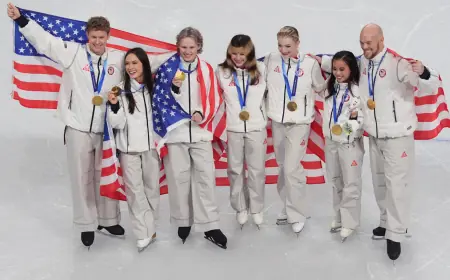
After the program Malinin was blunt: "I blew it, " he said, describing the experience as surreal and dominated by pressure. He acknowledged the weight of expectations at his first Olympic Games and admitted that the moment moved faster than he could adapt, leaving little time to correct mistakes mid-routine. Earlier in the Games he had helped his nation capture gold in the team event, but the individual free skate exposed a vulnerability that stunned fans and competitors alike.
What went wrong technically
The pivotal sequence centered on jump execution. The quad axel — a jump no one else has reliably attempted in competition and one Malinin has been associated with landing — did not materialize. The attempted axel was popped, which yielded only a fraction of the value Malinin had hoped to bank. A downgraded quad loop and a fall on a second quad lutz compounded the deductions. Judges penalized both the under-rotations and the falls, and the cumulative loss of base value and grade-of-execution points proved decisive.
Broader significance and next steps
The result served as a reminder that even the era’s most technically advanced skaters are not immune to the psychological intensity of the Olympics. Experts have pointed to the unique pressure of a first Games and the fine margins that separate triumph from disappointment in high-stakes settings. For Malinin, the performance will be reframed as a high-profile learning moment rather than a career-defining failure; he still leaves the Games with a team gold and experience few athletes acquire so early in their careers.
For Shaidorov and his country, the victory is historic: the first Olympic men’s figure skating gold for his nation and a breakthrough that will reshape expectations on the international circuit. For the rest of the field, the final offered proof that standings can change dramatically in a single program, and that consistency under pressure remains the most valuable commodity in Olympic figure skating.