

























Bobsled Breakthrough: AJ Edelman Leads Israel’s First Olympic Bobsled Team After Historic Year

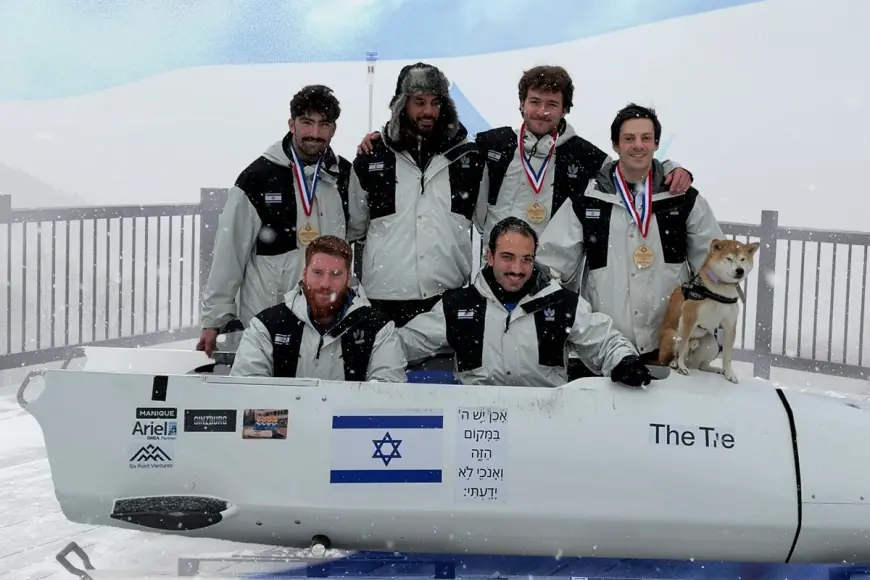
Adam “AJ” Edelman has already rewritten record books heading into the 2026 Winter Olympics. The 34-year-old Brookline, Massachusetts, native — the first Orthodox Jewish athlete to compete at the Winter Games and now the first Israeli to qualify in two different Winter Olympic sports — steered a long-shot project into reality when Israel qualified a bobsled team for Milan-Cortina.
From hockey prospect to Olympic bobsled captain
Edelman’s path to the ice was unconventional. Originally a hockey player who competed through college at the Massachusetts Institute of Technology, he was recruited by Israeli sport officials in 2013 and later shifted focus to skeleton. After placing 28th in skeleton at the 2018 Winter Olympics, he set his sights on building a bobsled program rather than chasing another medal for himself.
He moved to Israel in 2016 and persisted through limited resources, teaching himself elements of sliding sport on YouTube when coaching was unaffordable. That self-discipline and resourcefulness are visible in the team he assembled and the milestones he helped Israel reach — including the nation’s first sliding-sport Olympic appearance in 2018 and its first bobsled medal at the IBSF North American Circuit.
A 12-year mission: sport as a vehicle for community change
Edelman has framed the Olympic journey not as an end but as a tool to shift how Israeli and Jewish communities view sport. He said the Games provide a certificate of excellence that can change investment priorities and inspire infrastructure, coaching and role models for the next generation.
That broader ambition grew from a conviction that many within his community opted out of competitive sport early because sporting achievement wasn't a visible or supported path. Edelman set out to reverse that dynamic by building a team that could stand on the world stage.
Shul Runnings: an unlikely roster with diverse backgrounds
The team Edelman built — affectionately nicknamed “Shul Runnings” — combines athletes from a range of sporting pasts. Recruited through direct outreach and social media, the roster includes a former discus and shot-put champion, a sprinter, a pole vaulter and a rugby player. One teammate is poised to become the first Druze athlete to represent Israel at a Winter Olympics, adding a layer of representation to the squad’s achievement.
Several athletes were persuaded to return to high-level competition after having set aside Olympic dreams; others were training for entirely different sports when Edelman recruited them. The coaching staff also came from outside traditional sliding disciplines, illustrating how the program has improvised expertise to catch up with established winter-sport nations.
Setbacks, resilience and the Olympic timetable
The team’s road to Milan-Cortina has not been smooth. Members experienced logistical and security setbacks while training overseas, including a theft that deprived the squad of passports, equipment and thousands of dollars’ worth of gear. The delegation also confronted hostile reactions from parts of the crowd at the opening ceremony in Milan.
Despite those challenges, the schedule ahead is clear: the two-man bobsled heats are set for February 16–17, 2026 ET, followed by the four-man competition on February 21–22, 2026 ET. Edelman will pilot the two-man sled with Menachem Chen and lead the four-man unit, carrying a set of high expectations born of long preparation rather than medal forecasts.
Legacy: redefining possibility for Israeli winter sport
Whether or not the sleds finish atop a podium, the qualification represents a symbolic victory that could alter investment and aspiration in Israeli winter sport for years to come. Edelman’s stated goal was never solely Olympic hardware; it was to create a pathway and visible model for communities that previously lacked sporting role models.
As Israel’s bobsled team makes its Olympic debut, the narrative is less about an upset result and more about a structural shift: athletes recruited from unlikely places, a program built from scratch, and a public demonstration that winter-sport success can be seeded where it once seemed improbable.