

























Astronomers Discover Unlikely Solar System, Defying Expectations

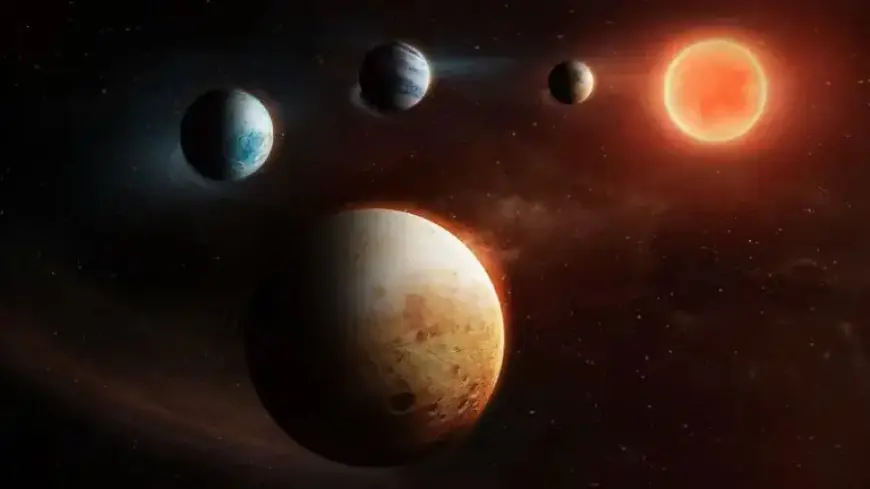
A newly discovered exoplanetary system approximately 116 light-years from Earth is challenging existing theories on planet formation. Researchers utilized telescopes from NASA and the European Space Agency (ESA) to uncover this unexpected arrangement of planets orbiting a red dwarf star known as LHS 1903.
Unique Planetary Arrangement
The LHS 1903 system comprises four planets, each following an unusual sequence. The innermost planet is rocky, while the two middle planets are gaseous. Contrary to established norms, the outermost planet is also rocky, which contradicts the typical arrangement seen in our solar system where rocky planets are closer to the sun and gas giants are positioned farther away.
Unexpected Rocky Planet
Named LHS 1903 e, this outer rocky planet has a radius about 1.7 times that of Earth, categorizing it as a “super Earth.” This revelation raises pertinent questions about its formation. Thomas Wilson, a physicist from the University of Warwick, stated, “This is the first time in which we have a rocky planet so far away from its host star, and after these gas-rich planets.”
Formation Theories
Traditionally, theories suggest that rocky planets form closer to a star due to high temperatures vaporizing volatile compounds, while gas planets emerge beyond the “snow line,” where temperatures allow those materials to condense into solids. Wilson’s study suggests that the planets in the LHS 1903 system formed in a different sequence than previously thought. The rocky planet LHS 1903 e likely formed later, when less gas and dust remained in the disk surrounding the star.
- First planet: Rocky
- Second planet: Gaseous
- Third planet: Gaseous
- Fourth planet: Rocky (LHS 1903 e)
Scientific Collaboration
The discovery began with NASA’s Transiting Exoplanet Survey Satellite (TESS) and was further analyzed by ESA’s CHaracterising ExOPlanet Satellite (Cheops). A worldwide collaboration of astronomers contributed data to verify the system’s unusual structure.
Implications for Planetary Science
This finding may signify a pivotal shift in the understanding of planet formation around red dwarf stars. Sara Seager from the Massachusetts Institute of Technology remarked that this discovery offers potential evidence that could reset existing paradigms about how planets develop in the universe.
Researchers aim to explore LHS 1903 e’s atmosphere further, given its potential to host various atmospheric conditions. Heather Knutson from the California Institute of Technology noted that observing this planet, particularly with the James Webb Space Telescope, could yield significant insights.
Future Research Directions
The complexities of planetary formation remain a topic of intense study. Néstor Espinoza, an astronomer from the Space Telescope Science Institute, emphasized the importance of this discovery as a valuable data point that may prompt revisions to existing models. Future observations of the LHS 1903 system could provide deeper understanding of how various types of planets evolve.
As research continues, the LHS 1903 system stands as a unique example of planetary systems that deviate from traditional models, paving the way for new discoveries in the field of exoplanet science at Filmogaz.com.