

























Astronomers detect a solar system they say should not be possible

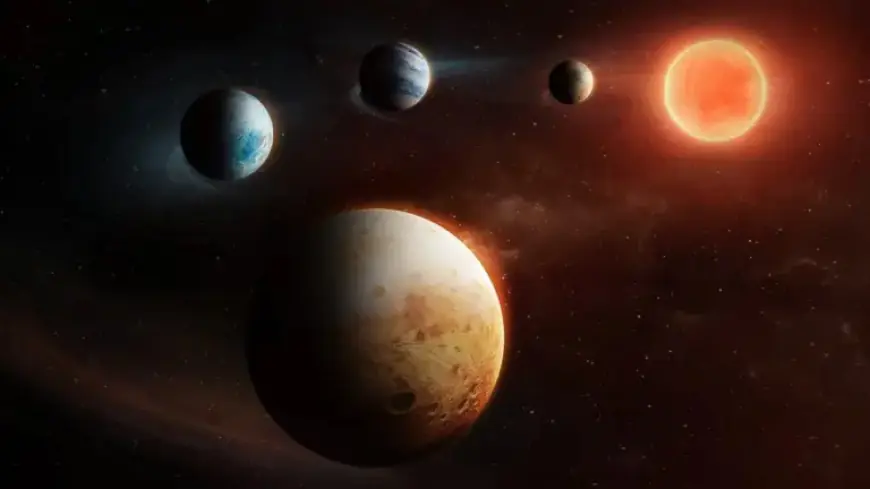
A small, dim star in the Milky Way appears to host a planetary lineup that flips a bedrock rule of planetary science, placing a rocky world on the system’s outer edge instead of a gas-rich planet. The discovery strengthens the case for a little-seen mode of planet building and raises fresh questions about how young planetary systems evolve and use up their raw materials.
A red dwarf with four worlds
The star, LHS 1903, is a cool M-dwarf with roughly half the Sun’s mass and an age of around seven billion years. Initial detections revealed three planets hugging close to the star, a configuration familiar across the galaxy: an innermost rocky super-Earth followed by two sub-Neptunes swaddled in thick atmospheres. That tidy pattern broke when a fourth world emerged at a wider orbit.
Follow-up observations with a precision photometry mission sharpened the view of the system. The added world, designated LHS 1903 e, appears to be compact and dense, with no sign of a puffy gaseous envelope. The system’s architecture—rocky, gaseous, gaseous, then rocky—reads like planetary physics in reverse.
The planet that breaks the rule
Conventional formation models predict small, rocky planets near a star and gas-laden planets farther out. Close-in regions are hot and harsh; stellar radiation strips light gases, leaving behind dense cores. Farther from the heat, cooler temperatures allow forming planets to capture hydrogen and helium, building sub-Neptunes and giants. LHS 1903 e disrupts that script: it orbits in the colder reaches yet presents as a bare, rocky body.
That combination is difficult to engineer with the usual explanations. If the planet once possessed a thick atmosphere, something would have had to remove it long after the protoplanetary disk dispersed—a major impact or sustained erosion. If it started closer in and migrated outward, the system would likely bear dynamical scars. Neither scenario fits comfortably with the evidence.
Rethinking how planets assemble
The research team favors a different pathway: sequential, inside-out assembly within a gas-depleted disk. In this picture, planets formed one after another, starting near the star while the natal disk was still rich in gas and dust. The inner rocky super-Earth and its two gaseous neighbors took shape early, when material was abundant. Over time, the growing planets and stellar radiation cleared out the remaining gas. By the time the outermost world began to coalesce, the system had largely run out of the light gases needed to build a sub-Neptune, leaving only solids—pebbles and dust—to pile up into a compact rocky planet.
This “gas-depleted formation” mechanism naturally yields an inside-out order: bigger, more volatile-rich worlds inside, capped by a smaller rocky planet outside. It also offers a snapshot of disk evolution in action, emphasizing how timing—the order in which planets claim their share of the disk—can sculpt the final architecture.
Why collisions and migrations seem unlikely
Alternative explanations were stress-tested. A giant impact capable of stripping an atmosphere would likely inject noticeable dynamical chaos or create other signatures; modeling indicates the planetary orbits appear stable. Large-scale migration, where planets swap positions after formation, can also scramble a system, but the observed layout and inferred masses favor a calmer history. While those pathways cannot be completely dismissed, they require added complications that the sequential-formation scenario does not.
The observational trail began with a transit survey that flagged the inner trio, then sharpened with targeted measurements that uncovered the outer fourth. Cross-checks with multiple facilities strengthened the case that LHS 1903 e is indeed rocky and not quietly harboring a hidden atmosphere.
What this means—and what’s next
LHS 1903 sits in the Milky Way’s thick disk and has endured for billions of years, suggesting the system’s unusual blueprint is dynamically durable. If gas-depleted, inside-out formation can happen here, it may be more common than current planet catalogs imply—especially around M-dwarfs, where disks evolve quickly and planets often huddle close to their stars.
Next steps are straightforward. Precision radial-velocity campaigns can tighten mass estimates and probe for any additional, unseen companions. Atmospheric spectroscopy of the two sub-Neptunes could reveal how much gas they retained and how their compositions diverged from their rocky neighbors. Longer-baseline monitoring may also search for a debris belt or outer bodies that could further contextualize the system’s history.
For now, the message is clear: astronomers detect a solar system they say should not be possible, and in doing so, they spotlight the clockwork of planet formation—where timing, not just location, can decide a world’s fate.