























Kristen Santos-Griswold chases redemption at Milan-Cortina after Beijing heartbreak

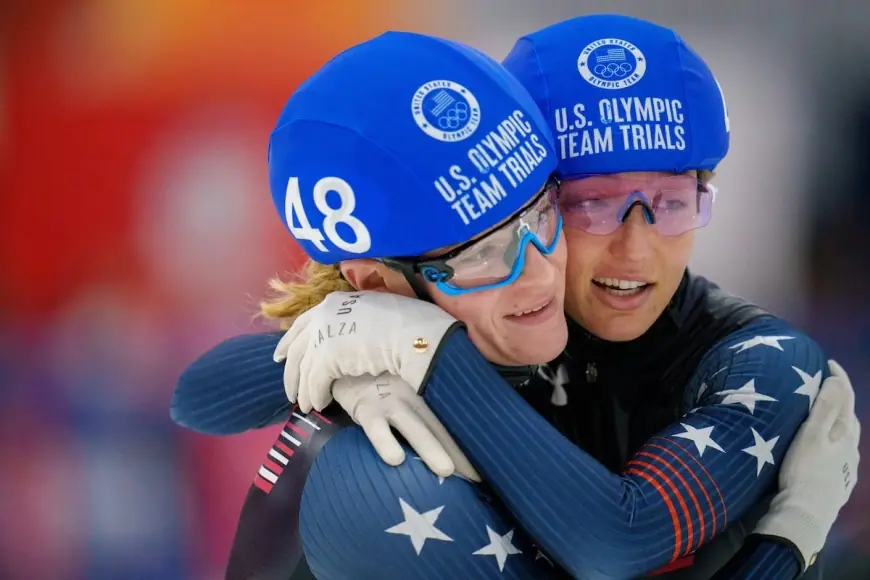
Four years after a crash in the final lap of the women’s 1,000 meters shattered her medal hopes, Kristen Santos-Griswold is back on Olympic ice with a clearer mind, a stronger résumé, and unfinished business. As the 2026 Winter Games continue on Thursday, Feb. 12 (ET), the 31-year-old American short track standout is targeting the podium that slipped away in Beijing.
A crash that reshaped a career
In 2022, Santos-Griswold entered the Games ranked second in the world and skated herself into medal position in the 1,000-meter final. Then came the moment she long tried to avoid replaying: a bump from Italy’s Arianna Fontana on the last lap, both skaters crashing into the pads, the American crossing in fourth. The contact was later penalized, but the results did not change.
For years afterward, she couldn’t bring herself to watch the race. The footage felt like a trigger for what she described as failure. “I’ve been an emotional wreck up and down,” she said in the lead-up to Milan. “That's something that I'm working on the most, it's my mental game. In this sport, it can be so unforgiving.”
Last year, she finally pressed play. What she expected to be a painful exercise turned into a reset. “It was definitely therapeutic and helped me move on from it,” Santos-Griswold said. “Watching it now, it just makes me that much more proud that I'm here competing today and I'm going for it again. I’m hoping that I can learn from that experience, not make any of the same mistakes, have a better result this next time, but also more importantly, enjoy it more this next time.”
Choosing the ice over retirement
Beijing’s sting had her considering a full break. Santos-Griswold weighed retiring to focus on graduate school, where she is pursuing a doctorate in physical therapy. Her coach, Stephen Gough, offered space for reflection and a perspective on what lay ahead. “When we spoke, I was like, ‘It’s about to start being really fun,’” he said. “It’s not going to be easy, but you’re in a place where you can win medals. And why wouldn’t you ride this wave? Because when you stop skating, it’s all over.”
She chose to stay. The decision would redefine the next chapter of her career.
Building back to world-beating form
Santos-Griswold’s response to heartbreak was a run of results that reestablished her as one of the sport’s premier all-around threats. At the Four Continents Short Track Speed Skating Championships in November 2023, she swept the 500, 1,000 and 1,500 meters. The following season, she captured four individual golds on the 2024–25 ISU Short Track World Tour, finished as the overall champion, and lifted the Crystal Globe as the tour’s top skater.
That breadth—sprinting prowess in the 500, tactical precision in the 1,000, and engine in the 1,500—has long hinted at her Olympic ceiling. Those wins affirmed it and, critically, helped restore a sense of control in a discipline where chaos is always one slip, bump, or blade away.
Lessons from injury and a sharper mindset
The climb back wasn’t linear. A broken collarbone and other setbacks interrupted her momentum during the most recent tour season. Rather than derail preparations, Gough said the detours forced a smarter reset. The injuries “allowed her an opportunity to refocus her training, and everything snapped into place really fast. So she's in a good place,” he said. “I don't know that she's thinking too much about four years ago. Given what she's been through in the last eight, nine months, it's helped her focus on the right stuff, which is her preparation, her tactics, the things that are within her control.”
That emphasis meshes with Santos-Griswold’s own recalibration. She has spoken of letting the race come to her, of embracing the volatility without letting it define her. The film she once feared now serves as a lesson bank—lane choices, body angles, where to press and where to wait.
What a medal would mean now
Short track rarely grants storybook endings. Yet the contours of Santos-Griswold’s return add up to a compelling attempt: a veteran in her prime, armed with a dominant tour season, hard-earned resilience, and the humility that comes from rebuilding after both heartbreak and injury. Medaling in Milan would mark not only a career pinnacle but also proof that she transformed a defining setback into fuel.
Whether the podium comes in a sprint, a middle distance, or a relay, her approach is the same—skate the race in front of her and leave as little as possible to chance. Four years after the crash that lingered, she is present in the moment she’s chased. The goal is simple and, after everything, profound: execute, enjoy it more, and leave with no what-ifs.