

























El Paso airspace closure: FAA ground stop lifted after hours, questions remain

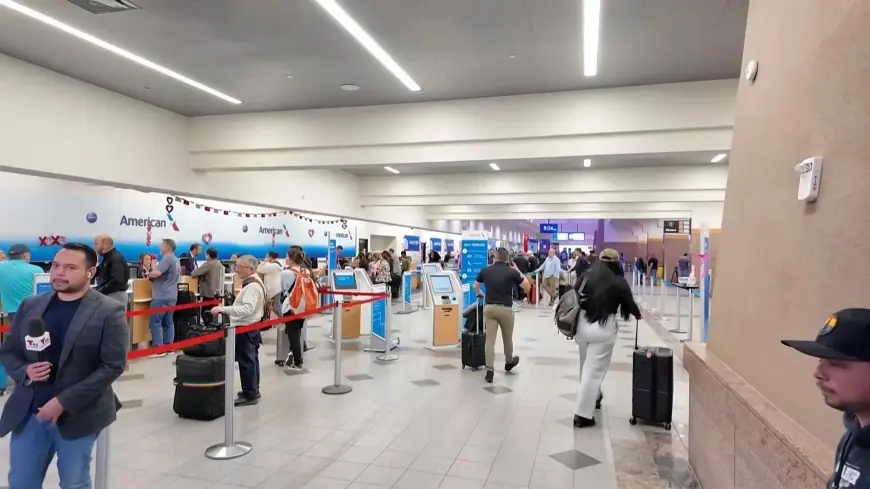
Commercial flights in and out of El Paso International Airport resumed after a sudden Federal Aviation Administration ground stop that was initially described as a 10-day closure for “special security reasons.” The restriction, issued with little notice late Tuesday, briefly shut down nearly all aviation activity around El Paso, Texas—affecting passenger service, cargo, general aviation, and even emergency flights—before being lifted Wednesday morning.
The whiplash decision triggered confusion for travelers and airlines, sharp criticism from local officials, and a scramble across the region to reroute time-sensitive medical transport.
What the NOTAM did in practice
The FAA restriction was issued as a Temporary Flight Restriction in a Notice to Air Missions (NOTAM) that effectively closed most air operations around El Paso and nearby Santa Teresa, New Mexico. It covered airspace below 18,000 feet mean sea level within roughly a 10 nautical-mile radius and included the airspace surrounding the nearby military airfield as well.
Unlike many security-related restrictions, the El Paso order was notable for how broadly it applied. Local leaders said medical evacuation flights had to divert to other airports in southern New Mexico, adding distance and time for critical transports.
Timeline: from “10 days” to a same-day reversal
The restriction was published late Tuesday night and set to run through February 21, but it lasted only a fraction of that time. The FAA later issued a short public statement saying there was no threat to commercial aviation and that flights would resume as normal.
| Item | Detail (ET) |
|---|---|
| NOTAM published | Tue., Feb. 10 at about 10:32 p.m. |
| Restriction began | Wed., Feb. 11 at 1:30 a.m. |
| Restriction lifted | Wed., Feb. 11 at 8:54 a.m. |
| Stated scope | No flight operations below 18,000 ft within ~10 NM of El Paso |
| Practical impact | Ground stop for most flights, with diversions and cancellations |
Airlines worked to rebook passengers and reposition aircraft once the airspace reopened, but the early-morning disruption still cascaded through schedules for the rest of the day.
Why it happened: competing explanations
Federal officials offered differing accounts about what prompted the restriction. One version described a counter-drone response along the border, suggesting concern about hostile drones operating near U.S. airspace. Another account tied the shutdown to nearby military activity involving counter-drone technology testing—high-energy systems designed to defeat small unmanned aircraft—raising concerns about whether the test could affect civilian aviation.
Separately, officials familiar with the incident described a recent case in which a small balloon was mistakenly treated as a drone target during the broader counter-drone posture. That episode, combined with unclear coordination across agencies, helped fuel criticism that the airspace closure was imposed before key stakeholders fully understood the risk—or could clearly explain it to the public.
At this point, the precise trigger for the original “10-day” language has not been publicly detailed in a way that resolves the contradictions.
Fort Bliss, Biggs Field, and the border context
El Paso sits next to major military infrastructure and an active border corridor, which makes the region a natural proving ground for counter-unmanned-aircraft capabilities. The presence of Fort Bliss and the adjacent military airfield adds layers of airspace complexity even on normal days, with training and operational flights regularly sharing the wider region with commercial traffic.
That context matters because any testing or rapid-response activity—especially involving directed-energy or other specialized counter-drone tools—can introduce safety questions the FAA is obligated to resolve quickly. The controversy is whether that safety coordination occurred before a sweeping restriction was imposed on a major city’s airport.
New Orleans airspace confusion: what it did and didn’t mean
The El Paso shutdown also overlapped with separate FAA notices affecting New Orleans airspace that circulated widely online, adding to public confusion. Those New Orleans notices centered on unmanned aircraft restrictions in multiple small areas rather than a full shutdown of commercial flights.
The contrast became part of the story: El Paso experienced a broad all-traffic halt that included passenger operations, while New Orleans was dealing with targeted restrictions that looked more like event-related controls.
What travelers should watch now
Flights are operating at El Paso International Airport, but the episode has left two practical questions for the days ahead:
-
Whether any additional restrictions will be issued in the region as counter-drone activity continues.
-
Whether federal agencies will clarify what happened—including what risk was identified, who requested the restriction, and why the initial timeline was set for 10 days.
For travelers, the immediate risk is less about another full shutdown and more about residual delays and aircraft repositioning after the disruption. For policymakers, the larger issue is coordination: a major metro airport can’t be effectively “switched off” without clear communication to the city, hospitals, and operators who depend on aviation for emergency response.