

























Why is the stock market down today: Nasdaq slides as tech and software selloff deepens, earnings disappoint, and rate-cut hopes fade

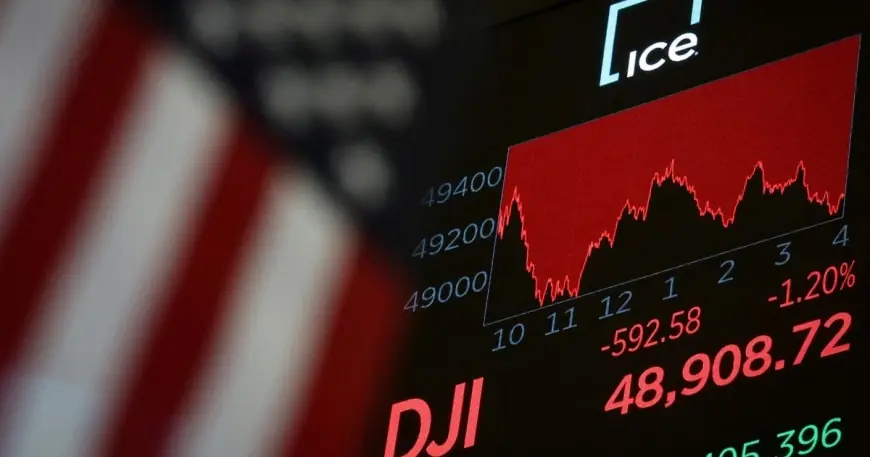
U.S. stocks are lower today, Thursday, February 12, 2026, ET, with the Nasdaq taking the hardest hit as investors sell technology and software shares and reassess how much profit will actually come from the massive spending wave tied to artificial intelligence. The Dow Jones Industrial Average is also down, dragged by a handful of heavyweight declines, while the broader market weakens amid a familiar mix of earnings surprises and shifting interest-rate expectations.
The short version of today’s market move is this: risk appetite is shrinking. When investors get nervous, the most expensive, fastest-moving parts of the market, especially growth and tech, often fall first.
Nasdaq today: the drop is being led by tech, software, and “AI spending fatigue”
The center of gravity in today’s selloff is technology, particularly software and AI-adjacent names. Investors have been willing to pay premium valuations for companies positioned as AI winners, but that trade depends on one assumption: that the spending boom turns into durable cash flow, not just bigger data-center bills.
Today’s price action suggests the market is demanding proof. As more companies outline enormous capital spending plans, traders are questioning timelines, margins, and who captures the real economics: chip makers, cloud platforms, software providers, or the end customers who adopt the tools. When that uncertainty rises, investors de-risk by cutting exposure to the same names that powered the rally.
This also explains why the Nasdaq can underperform even when there is no single headline “shock.” A valuation-heavy index is more sensitive to sentiment shifts, and those shifts can snowball as selling triggers more selling.
Dow Jones stock markets: a few big losers can weigh on the whole index
The Dow’s slide today is partly structural. Because it is price-weighted, sharp moves in a handful of high-priced components can pull the entire index down even if many stocks are not collapsing.
A key driver has been earnings-related damage in large, widely held names. When a mega-cap or a blue-chip reports weaker margins, cautious guidance, or a miss that raises doubts about the next quarter, it does not just hurt that stock; it also hits confidence in the broader earnings picture. In a market already on edge, negative surprises get amplified.
Market psychology: rate-cut expectations are shifting again
Another force in today’s decline is the ongoing tug-of-war over interest rates.
Recent economic signals have made it harder for investors to assume quick or aggressive rate cuts ahead. When the market believes rates will stay higher for longer, valuations compress, especially for growth stocks whose earnings are expected further in the future. That is a headwind for the Nasdaq in particular.
There is also an anticipation effect at work. With major inflation data points looming, traders often reduce exposure beforehand. Even if the next report is not out yet, the fear of being positioned the wrong way can prompt preemptive selling.
Behind the headline: what’s really being repriced today
Today is less about one bad number and more about a broader repricing of uncertainty. Three overlapping questions are driving the mood:
First, will the AI investment cycle produce winners quickly enough to justify today’s valuations, or will it look like an arms race where everyone spends and margins suffer?
Second, is the economy cooling smoothly, or is it still hot enough that central bankers feel no urgency to ease policy?
Third, can earnings growth keep up with the expectations embedded in stock prices, especially after a strong run in prior months?
The market is answering these questions in real time by demanding a higher “proof threshold.” That is why the same themes keep showing up on down days: expensive growth, momentum stocks, and the most crowded trades.
What we still don’t know today
Several missing pieces will shape whether this is a one-day stumble or the start of a deeper pullback:
-
Whether upcoming inflation data confirms cooling price pressures or reignites fears of stickier inflation
-
Whether big tech companies can show measurable returns from AI spending rather than just bigger budgets
-
Whether earnings guidance stabilizes, especially in sectors that have been priced for near-flawless execution
-
Whether bond yields keep drifting lower, which can cushion equities, or snap higher, which can accelerate selling
Until those pieces are clearer, intraday swings can remain sharp and headlines can look contradictory: “no catalyst,” yet real selling pressure.
What happens next: realistic scenarios to watch
-
A rebound if inflation data and bond yields cooperate, letting investors lean back into growth at slightly lower prices
-
Continued choppiness if earnings keep delivering margin warnings and the market stays skeptical about AI payoffs
-
A broader rotation if investors favor defensive or value areas while trimming tech exposure
-
A sharper leg down if rate-cut expectations get pushed further out and valuations compress more aggressively
-
A quick stabilization if selling exhausts itself and buyers step in around key technical levels
For today, the answer to “why is the stock market down” is straightforward: tech and software are being repriced as investors demand clearer evidence that huge AI-era spending will translate into profits, while the interest-rate outlook remains uncertain and earnings surprises are punishing complacency.