
























Lindsey Vonn injury update: surgery after broken left leg in Olympic downhill crash

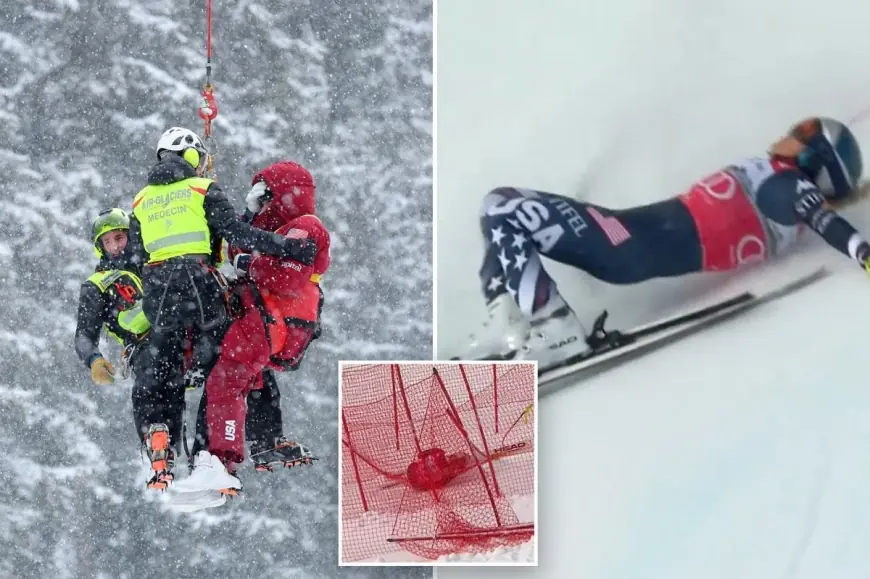
Lindsey Vonn is recovering after surgery to stabilize a fractured left leg following a terrifying crash in the women’s Olympic downhill in Cortina d’Ampezzo on Sunday, February 8, 2026. Team officials said she is in stable condition, and the hospital treating her said the operation was performed Sunday afternoon local time (early afternoon ET) after she was airlifted off the mountain.
The 41-year-old American fell just seconds into her run, ending a comeback bid that had already been complicated by a serious injury to the same leg in the days leading into the race.
What’s confirmed right now
Medical staff said Vonn underwent an orthopedic procedure to stabilize the fracture in her left leg. Team officials said she is stable and receiving care from both American and Italian doctors.
The crash happened almost immediately after she left the start gate—roughly 12–13 seconds into her run—when she lost control at speed and slammed into the safety netting. She remained on the snow while medics attended to her before being transported by helicopter to a hospital in the Treviso area.
How the crash happened
Early accounts describe Vonn clipping a gate in the opening section, a small contact that can have outsized consequences in downhill. When a racer’s upper body is knocked off line, it can flatten a ski edge or shift weight just enough for the skis to stop carving cleanly. At downhill speeds, that instability can turn into a violent edge-catch, launching the skier into a tumbling fall.
Video of the crash looked especially severe because it occurred in the acceleration phase, when athletes are still building speed and there is little room to recover if the skis lose their track.
Why the response took time on the hill
Downhill medical protocols prioritize stabilization before movement, particularly when there is concern for fracture or head and spine trauma. On-slope crews typically assess breathing and circulation, check for neurological symptoms, immobilize the injured limb, and manage pain before initiating evacuation.
The helicopter transport reflects both the seriousness of the mechanism of injury and the geography of the venue, where rapid access to imaging and surgical care can be critical.
The bigger context: she raced with a major knee injury
Vonn’s Olympic start came after she disclosed a significant injury to her left knee sustained about a week earlier. She had indicated the knee was unstable and that she planned to race with support.
That context matters because downhill requires constant micro-adjustments—tiny balance corrections at high speed. When a leg is compromised, those corrections can be harder to execute, and the margin for recovery after any disruption can shrink dramatically.
What remains unconfirmed
Details beyond “broken left leg” and “surgery performed” have not been publicly nailed down in a consistent, specific way. Here’s the clean line between what’s clear and what’s still not:
-
Confirmed: left-leg fracture; orthopedic surgery performed Sunday; stable condition
-
Unconfirmed publicly: exact fracture location (which bone or bones); whether the knee injury worsened; any associated ankle/ligament damage; concussion evaluation results; estimated recovery timeline and rehabilitation plan
Without a more detailed medical bulletin, it’s not responsible to infer the type of fracture or project a return window.
What comes next for Vonn
The next 24–72 hours usually bring the most meaningful clarity in cases like this: post-operative imaging details, swelling assessments, and a more specific diagnosis description. If the injury involves multiple structures—or if there are concerns beyond the fracture—those details often emerge after the immediate stabilization phase.
For Vonn’s Olympic outlook, the short-term reality is straightforward: her crash ended her downhill competition, and her focus now shifts to recovery. Longer-term questions—whether she will race competitively again, and what rehabilitation will look like—depend on information that has not yet been made public.
Sources consulted: Reuters, Associated Press, PBS NewsHour, ESPN