

























Team USA edges Japan for Olympic team-event gold after Ilia Malinin’s clincher

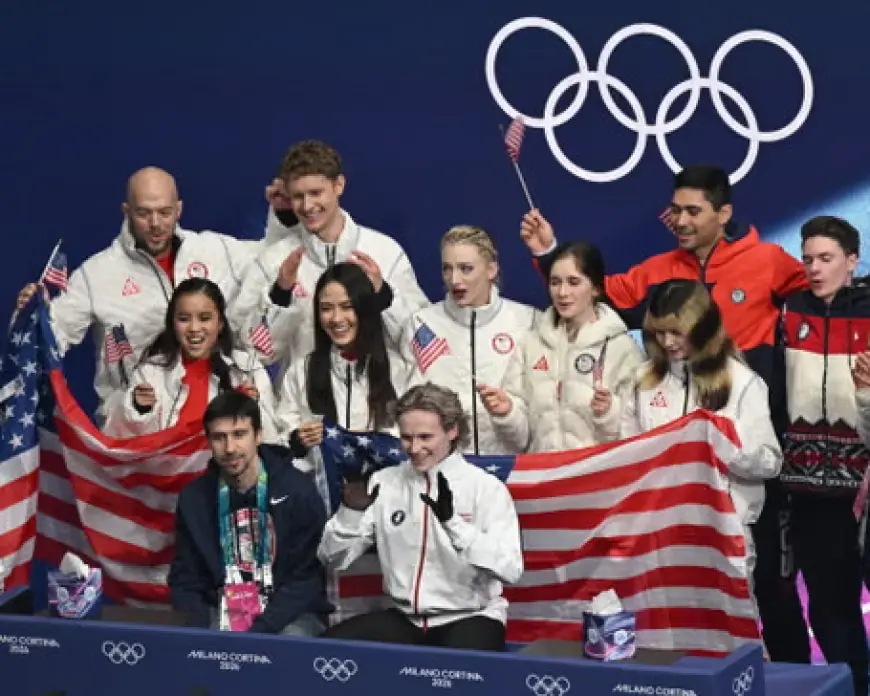
Team USA surged past Japan and locked down the Olympic figure skating team event on Sunday, Feb. 8, 2026, after Ilia Malinin delivered a high-difficulty men’s free skate that proved decisive in a finish separated by a single point. The Americans entered the final segment under maximum pressure after Japan’s strong earlier skates erased what had been a narrow U.S. advantage, turning Malinin’s program into a de facto medal decider.
Malinin’s score of 200.03 in the men’s free skate gave the U.S. enough cushion to hold off Japan’s closing push and secure the team title in Milan.
Malinin’s free skate flips the final math
The team event came down to the last performance because the standings were tight after the women’s free skate pulled Japan even with the United States. That meant Malinin didn’t need “perfect,” but he did need “big”—a clean enough skate with enough base value to outpace Japan’s entry and protect the overall point total.
Malinin’s program leaned into the identity that has made him the sport’s most watched technical risk-taker: multiple quadruple jumps, fast rotational speed, and transitions designed to keep the technical panel engaged throughout. The execution was not described as flawless, but the combination of difficulty and scoring margin over Japan’s skater gave Team USA the separation it needed when the team totals were finally added up.
Japan’s surge made it a true final-segment showdown
Japan’s team pushed the U.S. to the edge with two key ingredients: a top-end women’s free skate and a major pairs performance that narrowed the gap before Malinin even took the ice.
Kaori Sakamoto’s women’s free skate score of 148.62 was the kind of result that forces the math onto the final skater. In the pairs segment, Riku Miura and Ryuichi Kihara delivered a season-best 155.55, a swing that tightened the standings and amplified every point of Malinin’s eventual margin.
Japan’s men’s free skate was skated by Shun Sato, who posted 194.86—a career-best level in the Olympic moment—keeping the pressure on right until the final totals landed.
The U.S. formula: banking points across disciplines
Team USA didn’t win this gold on one skate alone. The Americans built a platform by consistently collecting top placements across ice dance, pairs, and singles—then relied on Malinin’s firepower to close the door.
Ice dance was a major advantage. Madison Chock and Evan Bates delivered results that kept the U.S. near the top even as Japan rallied elsewhere. In pairs, Ellie Kam and Danny O’Shea provided important stability with a performance that held their ground in a segment where point swings can be dramatic.
The women’s free skate created the late drama. Amber Glenn’s program left the Americans vulnerable enough that the title required a strong men’s free skate rather than a safe one. That set the stage for Malinin to turn a tight contest into a final-point win.
Final standings and the one-point margin
With the men’s free skate completing the event, the medal order settled into a narrow top-two and a clear third-place finisher.
| Team | Final points | Medal |
|---|---|---|
| United States | 69 | Gold |
| Japan | 68 | Silver |
| Italy | 60 | Bronze |
| Georgia | 56 | — |
| Canada | 54 | — |
Italy’s bronze marked a major home-Games moment, powered by strong contributions across segments and a steadier overall profile than the teams behind it.
What this means heading into the individual events
The team event often functions as both a medal contest and a temperature check. For the U.S., Malinin’s 200-point free skate reinforces his status as a leading contender for individual gold, while also highlighting the team’s ability to win even when the women’s segment doesn’t go to plan.
For Japan, the silver signals depth and momentum across disciplines, especially with Sakamoto and the Miura/Kihara pair delivering headline scores under Olympic pressure. The narrow margin also underscores how small the differences are at this level: one downgraded element, one step-out, one lost level can change the color of the medal.
With the team event finished, attention now shifts to the individual competitions, where the scoring resets and each skater carries the full weight alone—without the cushion of teammates’ points.
Sources consulted: Reuters, International Skating Union, NBC Olympics, CBS News