






















Kid Rock becomes a Super Bowl culture-war lightning rod again—how competing halftime programming is reshaping the weekend’s entertainment narrative

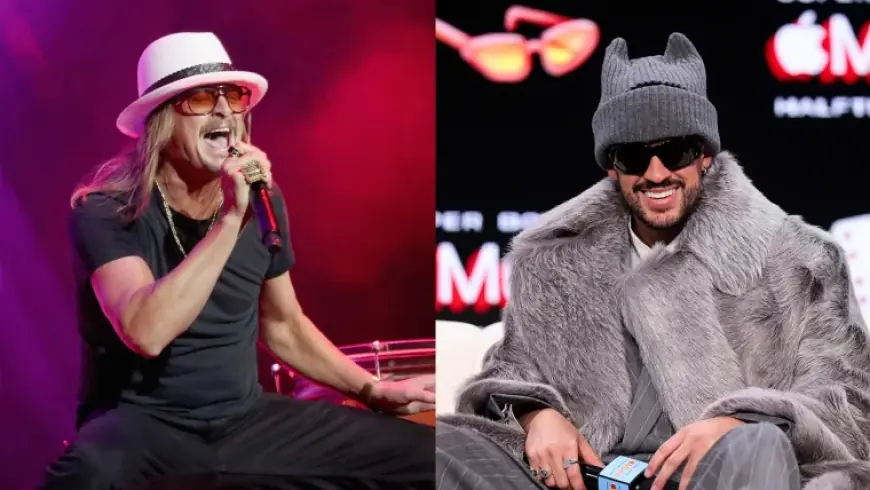
Super Bowl weekend has increasingly become a two-track entertainment event: the official halftime spectacle inside the game, and a growing ecosystem of counterprogramming built to siphon attention, reshape the conversation, and signal cultural identity. This year’s flashpoint is Kid Rock, tapped to front an “All-American” alternative halftime production timed to overlap the game’s break—an effort that has pulled politics back into the center of what used to be a mostly music-driven debate.
The result is a weekend narrative where the halftime show isn’t just a performance. It’s a proxy fight over language, patriotism, and who major American pop culture events are “for.”
The official halftime show sets the stage
This year’s headliner is Bad Bunny, whose booking is historic in its own right: a global superstar expected to perform primarily in Spanish on the biggest live TV stage in the United States. That milestone has energized fans who see it as a straightforward reflection of modern American culture and demographics.
It has also invited backlash from conservative corners that argue the choice reads as cultural signaling. That dynamic—celebration on one side, grievance on the other—creates the conditions where an alternative show can thrive, because it offers a simple option: switch channels during halftime and make your entertainment choice a statement.
How the competing halftime show is positioned
The alternative production is marketed around “faith, family, and freedom,” with Kid Rock leading a country-leaning lineup. Its pitch is not subtle: it frames itself as a parallel halftime event for viewers who want a more overtly patriotic tone than the official broadcast.
Crucially, it is designed for frictionless access. Instead of requiring tickets or a separate venue experience, the show is distributed broadly enough to be treated like a plug-and-play replacement at house parties—exactly where halftime is often watched collectively, debated loudly, and turned into a social moment.
Why Kid Rock fits the role
Kid Rock has long operated at the intersection of music and identity politics. Even when the conversation starts with songs, it tends to end with symbolism: who he represents, what crowds claim him, and how his persona functions as a cultural marker.
That’s why he becomes a lightning rod so easily. In this framing, he isn’t just a performer competing with the official halftime show; he’s cast as a rebuttal to it—an “answer” to a headliner whose language and cultural associations have become politicized by critics. Whether viewers agree with that framing or reject it outright, the controversy itself drives attention, and attention is the currency of halftime weekend.
What changes when “halftime” becomes a menu
The biggest shift isn’t that there are two shows. It’s that the audience now experiences halftime as a set of choices, each with a social meaning attached:
-
The official halftime show is treated as the mainstream event, engineered for maximum reach and global appeal.
-
The alternative show is treated as identity programming, engineered to feel like opting out of a culture you don’t recognize or don’t want.
-
The surrounding weekend specials—celebrity parties, branded concerts, and fan festivals—fill in the rest of the “halftime industrial complex,” giving viewers endless ways to engage without ever engaging with each other.
When entertainment becomes a menu, the shared moment shrinks. People aren’t arguing about whether a performance was good; they’re arguing about which performance they chose to watch in the first place.
The entertainment impact: attention, not just ratings
Even if the alternative show draws a fraction of the official audience, it can still succeed at its real goal: dominating the conversation in certain online communities and turning halftime into an ongoing political and cultural storyline that lasts all week.
That reshapes the incentives for everyone involved. Artists become symbols faster. Brands become more cautious about association. And fans are encouraged to treat entertainment preferences as civic identity, not taste.
Key takeaways:
-
Counterprogramming has turned halftime into a cultural choice, not a single shared event.
-
Kid Rock’s role functions as symbolic opposition as much as musical entertainment.
-
The controversy amplifies both productions, ensuring neither exists in a vacuum.
What to watch on Sunday night
The most telling metric won’t be who “wins” halftime. It will be what dominates the next morning’s conversation: performance quality, production ambition, guest moments—or the political framing around who watched what.
If viewers spend Sunday night debating symbolism rather than setlists, the weekend’s narrative will have proven the point: the halftime show is no longer just part of the game. It’s a cultural battleground where competing programming is now part of the main event.
Sources consulted: Reuters, ABC News, The Washington Post, San Francisco Chronicle