

























Sun Unleashes Four Powerful Solar Flares

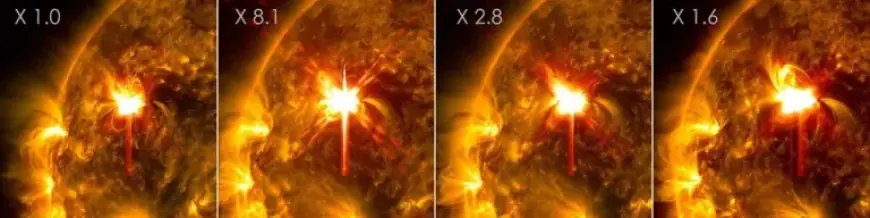
The Sun recently released four significant solar flares within a two-day period, drawing attention worldwide. These events were observed on February 1 and February 2, showcasing the Sun’s dynamic nature and its potential impacts on Earth.
Details of the Solar Flares
The solar flares peaked at specific times, with three occurring on February 1:
- First flare: 7:33 a.m. ET (X1.0)
- Second flare: 6:37 p.m. ET (X8.1)
- Third flare: 7:36 p.m. ET (X2.8)
The fourth flare was recorded on February 2, peaking at 3:14 a.m. ET and classified as X1.6.
Understanding Solar Flare Classifications
Solar flares are categorized based on their intensity. The classification system includes:
- X-class: Most intense flares
- Numerical value: Indicates strength (e.g., X1.0, X8.1)
This classification helps scientists communicate the potential impacts of such solar activity.
Impacts of Solar Flares on Earth
Solar flares can affect various technologies and systems, which include:
- Radio communications
- Electric power grids
- Navigation signals
- Spacecraft operations and safety
These events can pose risks to astronauts and technology in orbit around the Earth, making monitoring essential.
Nasa’s Role in Monitoring Solar Activity
Nasa’s Solar Dynamics Observatory consistently observes the Sun. This facility captures valuable images and data regarding solar activity. As part of its role, NASA contributes to understanding space weather and its implications for Earth.
For additional information on space weather forecasts, consult NOAA’s Space Weather Prediction Center, which serves as the U.S. government’s official source.
The recent flares signal the continued activity of Solar Cycle 25, with scientists closely monitoring future solar events and their potential implications.