

























Bitcoin price tumbles as risk-off hits tech and crypto; analysts point to deleveraging and weak sentiment

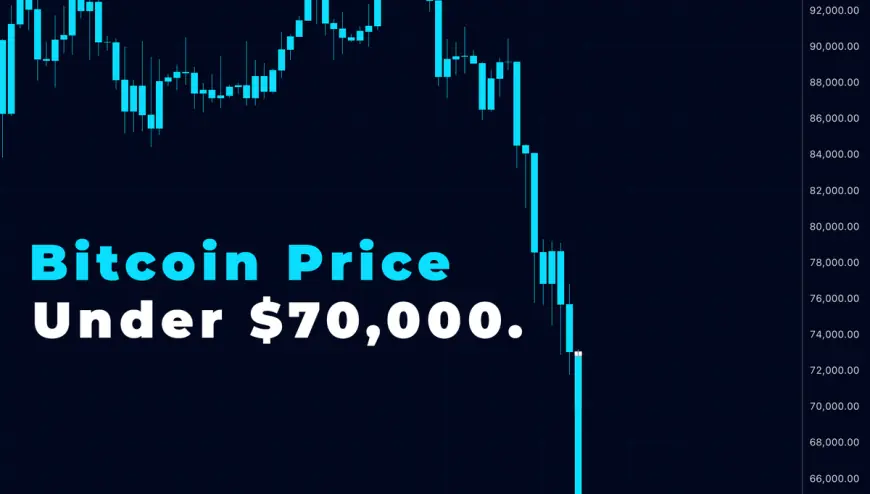
Bitcoin slid into the mid-$66,000 range Thursday as a broad “risk-off” mood swept across markets, dragging down both tech shares and digital assets and accelerating a selloff that has pushed crypto well below last year’s rally highs. The drop has been amplified by deleveraging in derivatives markets and a sour shift in sentiment as traders reassess rates, liquidity, and how much speculative premium remains in crypto.
Latest prices and today’s range
As of 1:00 p.m. ET on Thursday, Feb. 5, 2026, major tokens were sharply lower, with wide intraday swings signaling stressed liquidity.
| Asset | Latest (USD) | Day move | Intraday high–low (USD) |
|---|---|---|---|
| Bitcoin (spot) | 66,164 | -8.64% | 73,866 – 66,164 |
| Ether (spot) | 1,953.26 | -7.92% | 2,180.01 – 1,934.85 |
Bitcoin’s move below the $70,000 area has been a psychological blow for a market that had leaned heavily on momentum and steady inflows for much of the prior run.
Why the selloff is deepening
Three forces are pushing in the same direction.
First, macro risk appetite has weakened. When investors pull back from higher-risk trades, crypto often trades like a high-beta tech proxy rather than a defensive hedge, so it can drop at the same time as growth stocks.
Second, the U.S. dollar has firmed, a common headwind for dollar-priced risk assets. A stronger dollar can tighten financial conditions at the margin and reduce overseas buying power, especially during periods when traders are already trying to cut exposure.
Third, positioning became vulnerable. After a long advance, many portfolios had built meaningful allocations—some with leverage—leaving prices prone to fast drawdowns when the tape turns.
Deleveraging: the mechanical driver behind the air pockets
A key feature of this downturn has been the speed and “gappiness” of price action—moves that look less like patient selling and more like a cascade. That’s typical when derivatives markets are forcing hands:
-
Margin pressure and liquidations: When prices fall quickly, leveraged long positions can be closed automatically, creating sudden bursts of selling.
-
Stop clusters: Breaks of widely watched levels can trigger layered stop-loss orders, accelerating declines through thin order books.
-
Basis and funding shifts: When futures pricing and funding rates flip sharply, it can encourage more unwinds as traders reduce carry trades and directional exposure.
This is why bitcoin can bounce sharply and then slip again within hours: short-covering rallies appear, but they struggle to hold if broader deleveraging is still underway.
Weak sentiment meets policy uncertainty
Sentiment has also been undercut by uncertainty around the U.S. policy outlook for rates and regulation. Traders have been watching signals that could point to a more hawkish tilt at the central bank, and that perception has weighed on speculative assets broadly.
At the same time, expectations that pro-crypto policy momentum would translate into faster legislative progress have cooled. When the market’s “good news” timeline gets pushed out, short-term holders often become less willing to sit through volatility—especially after a steep drawdown.
How much has been erased from the broader crypto market?
The pullback is not limited to bitcoin. The total market value of cryptocurrencies has fallen by roughly $2 trillion from its October 2025 peak, a decline that has shifted behavior across the complex. In these phases, rallies are often sold quickly, liquidity gets patchier, and traders become more sensitive to cross-asset signals from equities, yields, and the dollar.
Bitcoin itself is now down sharply for the year, and ether has fallen even more, reflecting how quickly speculative appetite can fade once price momentum breaks.
What could drive the next leg of volatility
The next move likely depends less on narrative and more on whether markets can stabilize mechanically.
-
Can bitcoin hold a range? The earliest sign of a healthier tape is not a big rally—it’s fewer violent swings and more time spent consolidating.
-
Do liquidation waves slow? A drop in forced selling would reduce the “air pocket” risk and make bounces more durable.
-
Does the dollar keep climbing? Continued dollar strength can keep pressure on crypto even if occasional rebounds appear.
-
Do flows steady? Sustained outflows from large investment vehicles can weigh on prices until longer-term buyers absorb supply.
For now, the market is still trading like it’s in a cleanup phase: fragile confidence, heavy sensitivity to risk-off moves in tech, and price action driven as much by leverage reduction as by long-term fundamentals.
Sources consulted: Reuters; Financial Times; Bloomberg; Investopedia