

























Punxsutawney Phil sees his shadow, calling for six more weeks of winter

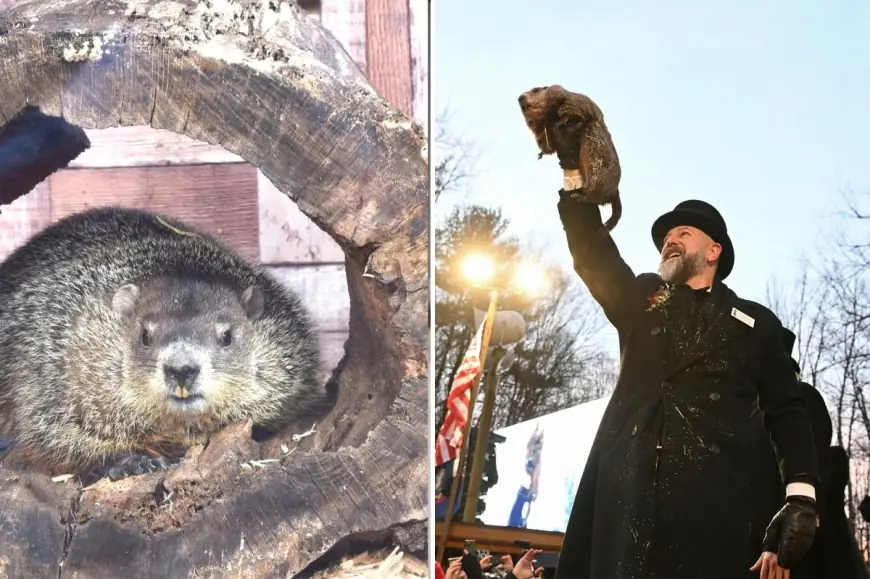
Punxsutawney Phil delivered the headline many bundled-up visitors expected: a shadow sighting that signals six more weeks of winter. The call, announced just after daybreak Monday at Gobbler’s Knob, lands in the middle of a stretch of deep cold across parts of the eastern United States and keeps the annual tradition at the center of early-February conversation.
The ritual remains part folklore, part spectacle, and part local identity—an event that draws travelers, camera crews, and costumed fans even when temperatures are in the single digits.
The 2026 prediction at daybreak
Phil’s handlers brought the groundhog out of his stump around 7:25 a.m. ET and declared that he saw his shadow. In Groundhog Day lore, that outcome means winter conditions stick around for roughly six more weeks; the opposite result would have pointed to an early spring.
This year’s announcement followed a familiar script: top hats, a scroll-style proclamation, and a crowd counting down to the moment the animal appears. While the premise is playful, the turnout is real—tens of thousands typically travel to the rural hillside outside Punxsutawney for a few minutes of ceremony.
Cold weather sets the scene
The weather matched the mood of the forecast. The celebration unfolded in frigid conditions, with readings around a few degrees above zero Fahrenheit in the pre-dawn hours. Fans danced, chanted, and waited through the cold, treating the morning like a winter festival more than a weather briefing.
That atmosphere is part of why Phil’s prediction remains sticky in the public imagination. It’s a midwinter release valve—an excuse to gather, laugh, and mark the calendar at the midpoint between the winter solstice and the spring equinox.
What “six more weeks” really means
Phil’s forecast isn’t a day-by-day outlook, and it’s not intended to be. The traditional claim is simply that winter lingers longer when the shadow appears. In practical terms, the next several weeks hinge on large-scale patterns that can swing quickly: storm tracks, Arctic air intrusions, and the timing of warm-ups that can arrive in bursts rather than a clean seasonal turn.
For many viewers, the prediction functions more like a seasonal vibe check than a strict meteorological call. It frames the question people already ask in early February—“Are we done with this yet?”—and gives it a definitive, if whimsical, answer.
Why the tradition keeps growing
The enduring appeal comes from three things: repetition, ritual, and shared language. People know the rules, the ceremony feels timeless, and the outcome is easy to understand. The event also taps into a broader American tradition of local mascots and small-town pageantry, where community identity becomes the main story.
It helps that the celebration has a built-in narrative arc: anticipation in the dark, the reveal at dawn, and an immediate “result” everyone can debate on the ride home.
Key takeaways
-
Phil “saw his shadow,” signaling six more weeks of winter in the traditional legend.
-
The announcement came around 7:25 a.m. ET at Gobbler’s Knob outside Punxsutawney, Pennsylvania.
-
The event drew a large crowd despite single-digit temperatures and biting wind chills.
Accuracy, folklore, and what to watch next
Independent reviews of historical outcomes have long found that groundhog predictions are closer to chance than science. That hasn’t hurt the event; if anything, the mismatch between certainty and reality is part of the fun. When the weather later contradicts the groundhog’s call, it adds another chapter to a story people already enjoy retelling.
The next real test is how late-winter weather unfolds across the East and Midwest through February and March—especially any sustained warm spell that would challenge the “more winter” narrative. For Punxsutawney, the forecast’s real value is immediate: it keeps the town in the national spotlight for a day and reinforces a tradition that has become its signature.
Sources consulted: Associated Press; National Oceanic and Atmospheric Administration; Punxsutawney Groundhog Club; Pennsylvania Tourism Office