
























NYT Connections puzzle #965 spotlights parties, paint and Y-shaped things

Saturday’s NYT Connections grid (game #965, dated January 31, 2026) leaned into everyday words with a twist: familiar “event” terms that double as party types, practical painting tools, and a deceptively clean set of Y-shaped objects. The result was a puzzle that many solvers found straightforward once a single category clicked, but sticky at the start if you didn’t immediately spot the shape theme.
NYT Connections #965: categories and answers
Game #965’s 16 tiles mixed social words (BALL, SHOWER), objects with obvious physical silhouettes (WISHBONE, TUNING FORK), and a classic wordplay finale built around a single clue word (“SHIFT”) that can point to multiple meanings.
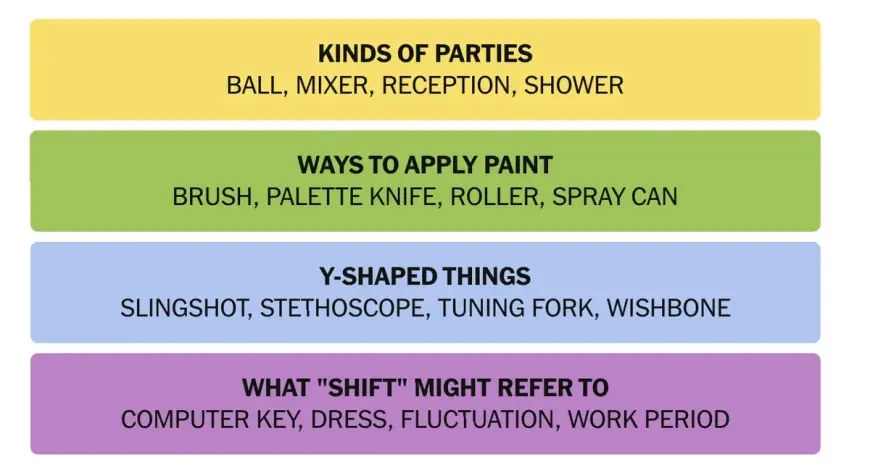
The four groupings for January 31 were:
Yellow centered on kinds of parties: BALL, MIXER, RECEPTION, SHOWER.
Green focused on ways to apply paint: BRUSH, PALETTE KNIFE, ROLLER, SPRAY CAN.
Blue turned on Y-shaped things: SLINGSHOT, STETHOSCOPE, TUNING FORK, WISHBONE.
Purple landed on what “shift” might refer to: COMPUTER KEY, DRESS, FLUCTUATION, WORK PERIOD.
A noteworthy wrinkle in the purple set is that it doesn’t ask you to define “shift” once—it asks you to recognize four valid, different references. That makes it a classic late-game category: easier by elimination, harder if you try to force one unified definition too early.
Why the opening felt harder
Even when the eventual answers are clean, the early board can feel like noise if multiple “almost-groups” compete for attention. In #965, ROLLER can tug you toward sticky surfaces (a recurring theme in past puzzles) as easily as it can tug you toward paint. Likewise, BALL can read as an object before it reads as an event.
The fastest path for many players was spotting a single strong anchor—WISHBONE or TUNING FORK—and letting the silhouette do the work. Once the Y-shape set is locked, the rest of the board becomes more “toolbox and invitations” than “random nouns.”
A growing ecosystem around the daily grid
The daily puzzle’s popularity has also built a broader ecosystem of analysis, difficulty scoring, and archives—much of it aimed at keeping players engaged after the four categories are solved.
An official archive for subscribers launched in October 2024, letting players revisit earlier puzzles and track progress in a more structured way. And the game’s popularity has been big enough to inspire a wave of unofficial clones and creators—along with legal pressure from The New York Times to rein in sites that replicate the core experience or distribute full archives of past boards.
That tug-of-war matters because it shapes how people discover and share puzzles: whether they stay inside official apps and subscriptions, or drift toward community tools that make creating and remixing boards easier.
Sports Edition keeps the format rolling
The format has also expanded beyond general vocabulary. A Sports Edition—built in partnership with The Athletic—uses the same 16-tiles-and-four-groups structure but constrains the vocabulary to sports terms, team references, and league-specific trivia. Like the main game, it runs on a daily cadence and resets at midnight Eastern Time.
That extension is a sign of how flexible the design is: the mechanic stays constant, while the domain (general words vs. sports terms) changes the kind of knowledge that helps you win.
Key takeaways
-
#965 rewarded solvers who recognized shapes early, especially the Y-themed blue set.
-
The purple category again leaned on wordplay and multiple meanings, with “shift” doing double and triple duty.
-
Beyond the daily grid, archives, analysis tools, and spin-offs are becoming part of the routine as much as the puzzle itself.
What to watch next
The near-term storyline isn’t a single “hardest puzzle ever,” but the steady evolution of the game’s surrounding features: more stats, more official back-catalog access, and more themed variants that widen the audience. For players, that likely means a clearer split between people who want a pure daily challenge and people who want a trackable, replayable hobby—complete with difficulty metrics and community discussion.
Sources consulted: The New York Times; TechRadar; Tom’s Guide; Parade; InPublishing; The Verge