

























Microsoft stock slides after earnings as AI spending worries weigh on MSFT

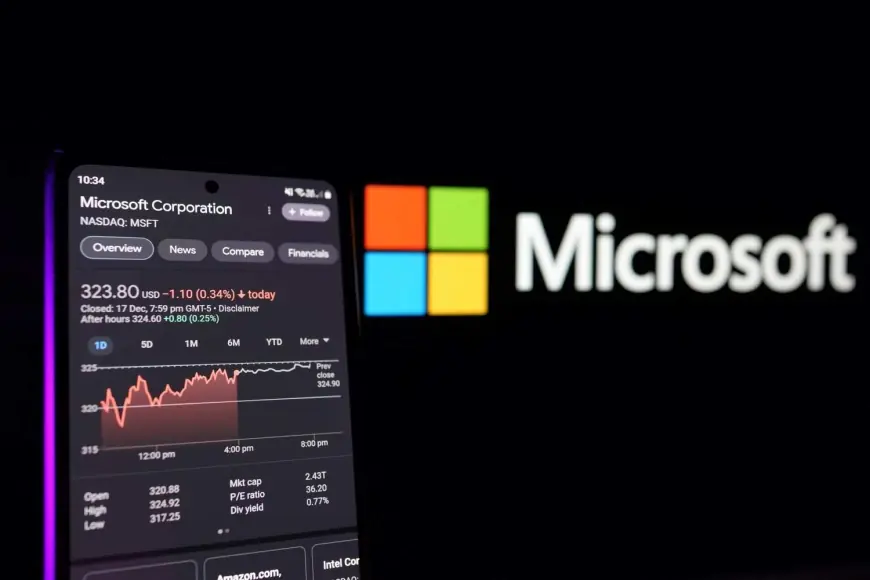
Microsoft stock moved lower after its latest quarterly release, with investors focusing less on headline profit and more on the cost of scaling AI. The reaction has centered on how fast revenue can grow while data-center spending rises, and whether cloud momentum is strong enough to justify the pace. Searches for “msft,” “msft stock,” “microsoft stock price,” and “msft stock price” have spiked alongside the blunt question many traders are asking: why is microsoft stock down.
At Friday’s close, Microsoft Corporation (MSFT) finished at $430.29, down $3.27 (-0.75%) on the day, and traded lower in late after-hours around $429.24 (-0.24%).
| MSFT snapshot | Value |
|---|---|
| Microsoft stock price (close, Fri.) | $430.29 |
| Day change | -$3.27 (-0.75%) |
| After-hours (late Fri.) | $429.24 (-0.24%) |
| Open | $439.07 |
| Day low / high | $426.51 / $439.42 |
| Volume | 58.5M |
Microsoft earnings set up a “spend vs. return” debate
Microsoft earnings landed with solid demand signals, but the market’s attention quickly shifted to investment intensity. The company has been building out AI capacity across data centers and silicon, and the spending trajectory has become the central variable for near-term cash flow and margin expectations.
That’s why “msft earnings,” “microsoft stock earnings,” and even the misspelling “msft earning” have been trending together: investors are trying to reconcile strong product momentum with the cost of delivering it at scale. In this environment, the stock’s direction can be driven as much by capex commentary and guidance tone as by revenue and EPS.
Why microsoft stock is down after the report
The selling pressure has come from a handful of overlapping concerns that traders keep circling back to:
First is AI infrastructure spending. Even investors who are bullish on AI demand are sensitive to the near-term impact of higher capex and operating costs. When spending ramps faster than consensus expectations, it can compress free cash flow in the short run, and that tends to hit valuation-sensitive mega-cap names.
Second is the tempo of cloud growth, especially Azure-related expectations. The cloud business remains large and expanding, but the market has been looking for acceleration that clearly matches the speed of the AI buildout. Any perception of “good but not explosive” growth can be enough to trigger profit-taking when positioning is crowded.
Third is conversion timing. Enterprise customers may commit to AI projects, but revenue recognition can lag if capacity constraints, implementation timelines, or procurement cycles slow the ramp. When the market thinks demand is real but conversion is uneven, the result is often a lower multiple until visibility improves.
Put simply, “why is microsoft stock down” has less to do with a single line item and more to do with a narrative shift: investors are forcing a clearer bridge between today’s spending and tomorrow’s returns.
What MSFT guidance signals investors are pricing
Forward-looking commentary matters most when a company is spending heavily. Investors want to see two things at once: evidence that AI workloads are expanding, and signs that the spend curve can normalize over time.
For MSFT, the key questions being priced into the next few quarters include:
-
Does the company expect AI capacity additions to remain a bottleneck, or does supply start to catch up?
-
Will depreciation and operating costs rise quickly enough to pressure margins even if revenue grows?
-
How quickly do AI products show measurable monetization rather than just usage?
When the market does not feel it has clean answers, it often treats the stock as “guilty until proven profitable,” especially after a strong run.
OpenAI shows up as both a boost and a question mark
OpenAI is part of the story in two different ways.
One is purely financial optics: the quarter included a notable benefit tied to investments connected to openai, which helped reported profitability. Investors typically separate those accounting gains from the underlying operating trajectory when valuing an infrastructure-heavy cycle.
The second is strategic: the partnership and ecosystem around openai reinforces Microsoft’s AI positioning, but it also highlights the capital intensity of the overall buildout. Markets have been debating how much industry-wide AI investment is needed and how fast it translates into durable, high-margin revenue. That debate can weigh on sentiment even when the long-term thesis remains intact.
What to watch next for msft stock
The next phase for msft stock is likely to hinge on a short list of measurable proof points:
-
Cloud and Azure momentum: signs that growth is firming, not just holding steady.
-
Capex trajectory: indications that spending is scaling with demand in a way the market can model.
-
AI monetization: clearer revenue contribution from Copilot-style offerings, agent tooling, and consumption-based AI services.
-
Cash flow resilience: evidence that free cash flow can stabilize as the buildout matures.
If those indicators improve, the market’s current tension between “build now” and “earn later” can ease quickly. If they don’t, the stock can remain sensitive to any hint that costs are rising faster than revenue conversion.
Sources consulted: Microsoft Investor Relations, Microsoft Source, Reuters, Financial Times, Bloomberg, CNBC