

























NASA Reveals 20-Petaflop Supercomputer, Its Most Powerful Yet

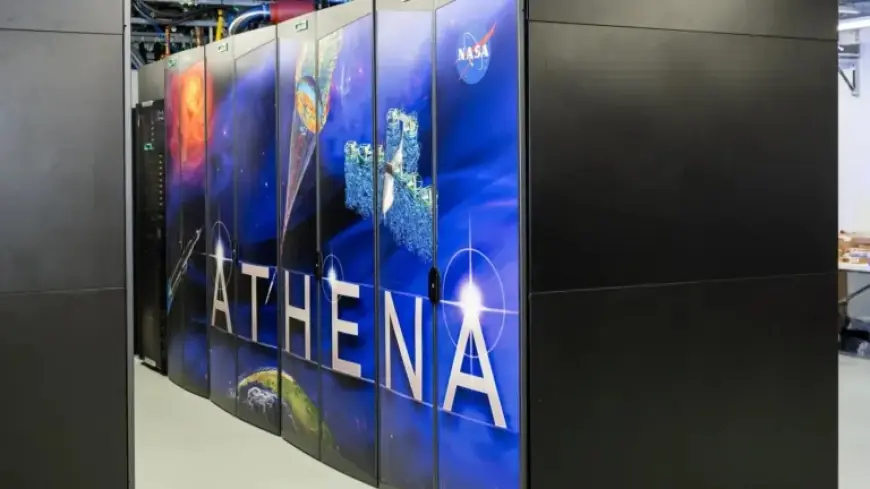
NASA has unveiled Athena, its most powerful supercomputer, marking a significant advancement in its computing capabilities. Announced on January 27, this 20-petaflop system is set to play a crucial role in the agency’s upcoming space and aeronautics missions.
Athena: A New Era of Supercomputing
Located at NASA’s Ames Research Center in Silicon Valley, Athena serves as the flagship of NASA’s High-End Computing Capability (HECC) project. This supercomputer is designed to handle increasingly complex simulations and enable extensive training of artificial intelligence (AI) models.
Key Features of Athena
- Peak Performance: Over 20 petaflops, significantly surpassing the capabilities of earlier models like Aitken and Pleiades.
- Processing Power: Utilizes 1,024 nodes powered by AMD EPYC processors for high-speed calculations.
- Memory: Equipped with 786 TB of memory to analyze vast datasets efficiently.
NASA’s Chief Science Data Officer, Kevin Murphy, stated, “Exploration has always driven NASA to the edge of what’s computationally possible.” With Athena, the agency aims to provide tailored computing resources necessary to meet evolving mission needs.
Applications of Athena
Athena’s advanced capabilities allow NASA to simulate complex rocket launches and model next-generation, fuel-efficient aircraft. This supercomputer can save millions by reducing the need for extensive physical testing.
Furthermore, Athena aids in training large-scale AI models that can process petabytes of satellite data. This technology helps identify patterns and derive insights that are challenging for human researchers to achieve independently. For example, it can simulate atmospheric patterns and assess the impacts of solar storms on Earth.
Availability and Hybrid Computing Model
Athena became fully operational for all users on January 14, 2026. NASA has made the supercomputer accessible to both internal researchers and external scientists involved in NASA programs who can apply for access.
In a shift towards modern computing practices, NASA has embraced a hybrid approach with Athena. This enables scientists to leverage its physical power alongside commercial cloud platforms, offering flexibility for various computing needs, such as complex physics simulations and data processing.
The Meaning Behind the Name
The name “Athena” was chosen by NASA’s workforce in 2025, reflecting a connection to Artemis and symbolizing wisdom. As NASA continues to push boundaries in space exploration, Athena will be integral in performing the complex calculations required for mission safety.
Looking Forward: Upcoming Missions
As NASA prepares for its Artemis II test flight, Athena’s capabilities come into play. Engineers are on track to finalize preparations for the SLS rocket and Orion spacecraft. A critical wet dress rehearsal, an important milestone for lunar exploration, is scheduled for January 31.
With Athena, NASA lays the groundwork for future discoveries, enhancing its ability to tackle challenges in space exploration.