

























Study Reveals Optimal Conditions for Enhancing AI with Data

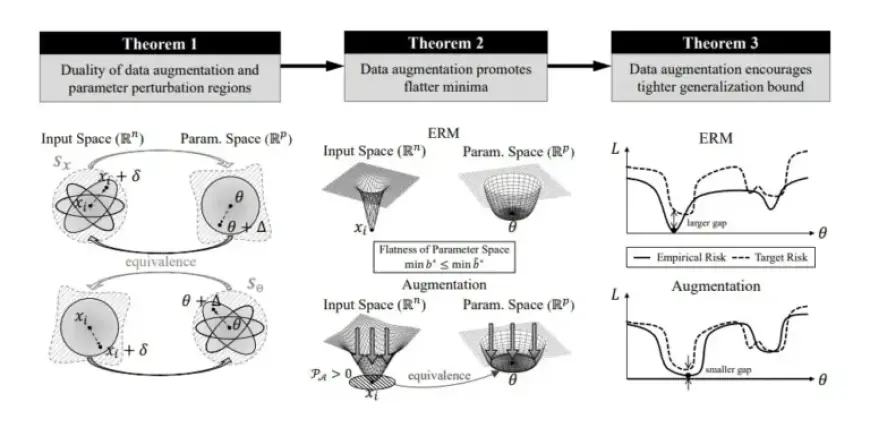
Recent research has unveiled key conditions for enhancing the robustness of artificial intelligence (AI) models through data augmentation. Robustness is crucial as it allows models to perform reliably under unexpected changes, such as data corruption or adversarial attacks. This study focuses on the theoretical underpinnings that define when and how data augmentation can effectively improve model resilience.
Optimal Conditions for Data Augmentation
Professor Sung Whan Yoon and his team from the Graduate School of Artificial Intelligence at UNIST have developed a mathematical framework that addresses data augmentation. Their findings indicate that label-preserving augmentations can foster robustness across various distribution shifts. This theoretical framework stands out as it is applicable to all label-preserving augmentations, not just specific instances of distribution shifts.
Proximal-Support Augmentation (PSA)
The research identifies Proximal-Support Augmentation (PSA) as a pivotal condition. Under PSA, augmented data must densely cover the area surrounding original samples. This leads to flatter and more stable minima in the model’s loss landscape, which correlates with greater robustness. Models exhibiting flat minima demonstrate reduced sensitivity to unexpected shifts and attacks in data.
Validation through Experimental Results
To validate their theories, the team conducted simulations using common benchmarks based on the CIFAR and ImageNet datasets. The results confirmed that augmentation strategies adhering to the PSA condition significantly outperformed others in enhancing model robustness. This breakthrough provides a systematic approach for creating more effective data augmentation methods.
Implications for AI Development
Achieving high reliability in AI systems is vital, especially in critical applications like autonomous vehicles and medical diagnostics. As Professor Yoon stated, this research establishes a scientific basis for designing data augmentation strategies that build more reliable AI systems. Such systems will be better equipped to handle unpredictable data changes, which are commonplace in real-world scenarios.
Conference Presentation and Support
This research was presented at the 40th Annual AAAI Conference on Artificial Intelligence (AAAI-26), held from January 20 to 27, 2026, at Singapore Expo. It received support from several institutions, including:
- Ministry of Science and ICT (MSIT)
- Institute of Information & Communications Technology Planning & Evaluation (IITP)
- Graduate School of Artificial Intelligence at UNIST
- AI Star Fellowship Program at UNIST
- National Research Foundation of Korea (NRF)
The study underscores a significant advance in understanding how data augmentation can be optimized to enhance AI model performance, paving the way for more robust and reliable AI systems across various applications.