























Doomsday Clock 2026 moves to 85 seconds to midnight, the closest warning yet

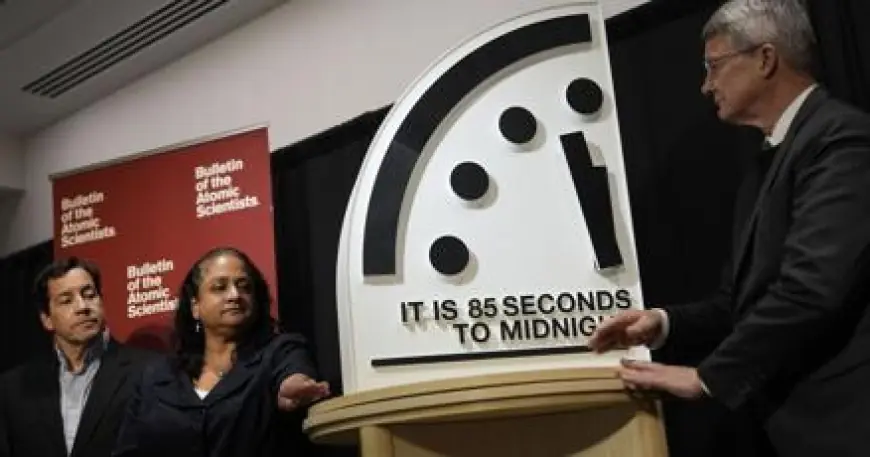
The Doomsday Clock 2026 has been set to 85 seconds to midnight, marking the closest the symbol has ever been to the metaphorical point of global catastrophe. The shift, announced Tuesday, Jan. 27, 2026 (ET), moves the clock forward four seconds from last year’s setting and sharpens a message that the world’s biggest risks are piling up faster than leaders are responding.
A four-second move that signals a worsening risk picture
The group that oversees the Doomsday Clock said it advanced the setting after a year it described as defined by intensifying aggression among major powers and a breakdown of cooperation needed to reduce existential threats. The decision is a blunt piece of communication, not a forecast of a specific event, but the symbolism is meant to land the same way: the margin for error is shrinking.
The clock has hovered near record territory for several years, but 2026 is different because the move breaks a psychological barrier. When the metric is measured in seconds rather than minutes, even a small shift reads as an alarm that the underlying trendline is moving in the wrong direction.
Nuclear flashpoints and an arms-control deadline loom large
Nuclear risk sat at the center of the rationale, with the clock setters pointing to multiple regional conflicts involving nuclear-armed states and warning that escalation pathways are multiplying. They highlighted the continuing Russia–Ukraine war, and they also cited the May clashes between India and Pakistan that included cross-border drone and missile attacks amid nuclear brinkmanship.
They also pointed to aerial attacks on Iranian nuclear facilities carried out by Israel and the United States during 2025. It remains unclear whether those attacks constrained Iran’s nuclear ambitions or instead increased the incentive to pursue sensitive work covertly.
Beyond immediate conflicts, the statement emphasized a broader arms-race atmosphere: modernization of nuclear delivery systems, expanding capabilities, and growing distrust about long-term deterrence commitments. A looming deadline amplifies the anxiety. New START, the last major agreement limiting deployed strategic nuclear weapons for the United States and Russia, is set to expire on Feb. 5, 2026 (ET), and the absence of a follow-on framework would remove a key set of constraints and verification expectations.
Climate, biosecurity, and AI risks tighten the squeeze
The clock setters also leaned heavily on climate signals, describing a year of worsening indicators and insufficient corrective action. They noted that atmospheric carbon dioxide continues to climb, and that recent years have delivered record or near-record global temperatures, alongside rising sea levels driven by melting ice and thermal expansion.
Biological risk has also widened in their framing, not only through familiar worries like lab safety and state programs, but through emerging research areas that could create new failure modes. They flagged the prospect of self-replicating “mirror life” research as a potential high-consequence hazard and warned that advanced tools, including artificial intelligence, could lower barriers for designing biological threats.
AI itself featured as a dual risk: the spread of disinformation that can erode decision-making, and the incorporation of AI into military systems, especially in sensitive chains of command. The concern is less about a single breakthrough than about layered uncertainty, where speed and automation compress the time available for humans to detect mistakes, challenge assumptions, and slow escalation.
How the Doomsday Clock is set and what it can and cannot predict
The Doomsday Clock is set annually by a panel of scientists and policy experts who weigh nuclear risk, climate change, and disruptive technologies, then choose a setting meant to reflect the world’s vulnerability to human-made catastrophe. It functions as a communications tool: a single image that translates complex, interacting risks into something the public can understand instantly.
The organization does not publish a detailed scoring model or vote breakdown for how it arrives at a specific number of seconds, and the clock is not meant to represent a probability calculation. Instead, it is a judgment call designed to motivate prevention: reduce the risks and the hands can move back.
What the 2026 setting means for people and what comes next
The impact of a Doomsday Clock move is indirect but real for two groups in particular: policymakers who shape nuclear posture, climate policy, and technology governance, and the public that absorbs the consequences when those systems fail. A third stakeholder group is industry, especially defense, energy, and AI developers, because the warning puts pressure on standards, transparency, and guardrails that can change procurement and regulation.
In practical terms, the statement calls for measurable steps rather than symbolic reassurance: renewed dialogue on limiting nuclear arsenals, maintaining the moratorium on explosive nuclear testing, accelerating a shift away from fossil fuels, and setting meaningful guidelines for the use of AI in military systems. It also urges international cooperation to prevent high-risk biological developments from outrunning safety and oversight.
The next verifiable milestone is the New START expiration date on Feb. 5, 2026 (ET), which could become a defining marker for whether nuclear risk is reduced or allowed to drift into a less predictable era. The next annual Doomsday Clock reset will follow at its usual January news conference in 2027, when the world will learn whether leaders pulled back from the brink or allowed the seconds to keep slipping away.