India-EU Trade Pact Focuses Beyond Tariff Barriers

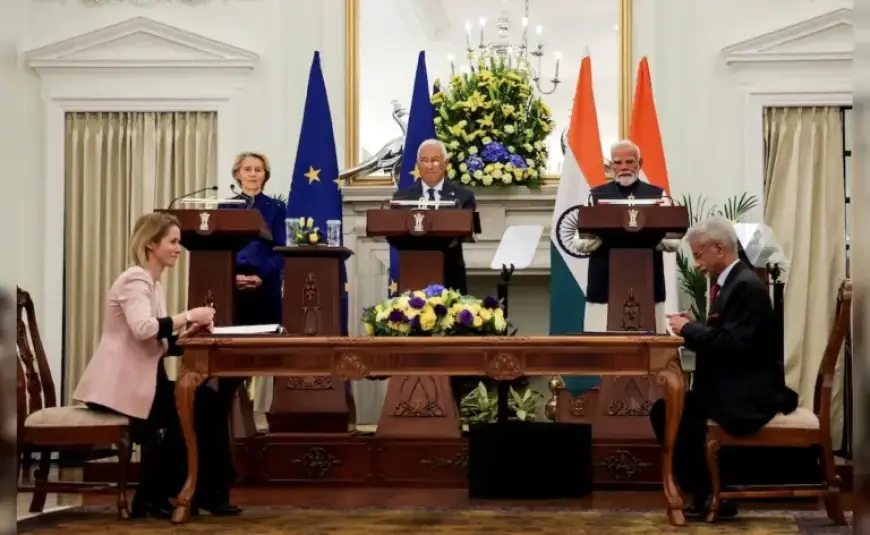
The recent signing of the India-European Union Free Trade Agreement (FTA) on January 27, 2026, marks a significant development in international trade. After nearly two decades of stalled discussions, this agreement promises to reshape economic relations between India and the EU. The deal carries importance beyond mere tariff reductions; it reflects a strategic response to geopolitical shifts, particularly influenced by American trade policies.
Impact of U.S. Trade Policies on India-EU Relations
U.S. tariffs and criticisms have inadvertently strengthened ties between India and the EU. American trade measures have acted as a catalyst, prompting both regions to align strategically. This shift emphasizes that trade dynamics are governed not solely by tariff calculations but by broader economic structures.
Key Statistics of the India-EU FTA
- Eliminates or reduces tariffs on 96.6% of EU exports to India.
- Grants preferential access to over 99% of Indian exports by value.
- Annual tariff savings for the EU estimated at EUR 4 billion.
- Projected doubling of EU goods exports to India by early 2030s.
Asymmetry in Tariff Reductions
Prior to the FTA, the EU’s average tariff on Indian imports was around 3-4%, while India imposed considerably higher tariffs on European goods, averaging 10-12%. For instance, tariffs on automobiles reached peaks of 110%, and wines and spirits faced 150% tariffs. Thus, while the agreement allows for tariff reductions, it is largely asymmetric, with India making more concessions than it receives.
Regulatory and Structural Advantages
The agreement goes beyond mere tariff reduction to address regulatory frameworks. It encompasses liberalization in services across 144 EU and 102 Indian subsectors. Furthermore, it includes provisions for intra-corporate transferees and independent professionals, promoting greater movement and collaboration between economies.
Addressing Future Trade Challenges
One of the key components of the FTA is its response to potential regulatory challenges. As India navigates the complexities of the EU’s carbon border adjustment mechanism, it has secured assurances and support, providing a buffer against future tariff impacts on carbon-intensive exports.
Strategic Economic Security Partnership
Both regions view the FTA as an economic security partnership. The EU aims to lessen its dependency on China for critical technologies, while India seeks stable access to advanced markets amidst an evolving trade landscape. This agreement illustrates a strategy of resilience, offering both parties a framework to counteract coercive trade practices.
Critiques and Completeness of the Agreement
While the agreement presents significant advancements, some critics express concerns over its limitations. Key sectors, such as agriculture, remain largely excluded, and Indian exporters could still face challenges due to stringent EU regulatory standards. Despite these critiques, the agreement’s strategic value cannot be dismissed; it represents a forward-looking approach to trade resilience.
Ultimately, the India-EU FTA encapsulates a transformative moment in global trade, evolving in response to external pressures rather than through conventional negotiations. This partnership not only symbolizes economic collaboration but also a collective move toward greater autonomy in the international market.