Mark Carney Davos Speech Puts “Middle Powers” at Center Stage as Canada Seeks New Alliances in Switzerland

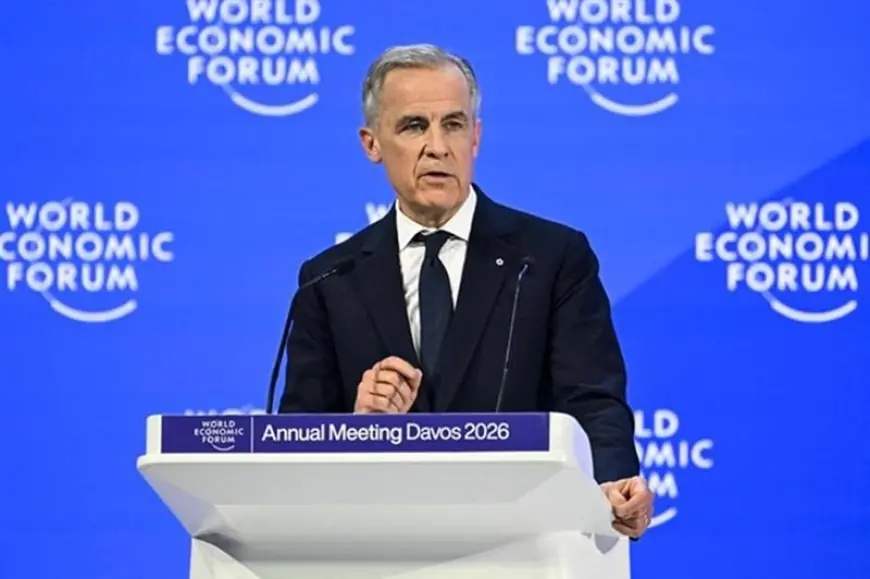
Prime Minister Mark Carney used his Davos speech in Switzerland this week to argue that the global rules many countries relied on for decades are fraying—and that nations like Canada must adapt quickly by working with other “middle powers” to protect sovereignty, prosperity, and security. Delivered in Davos on January 20, 2026 at the World Economic Forum annual meeting, the address landed as leaders and investors weighed renewed great-power confrontation, sharper trade coercion, and an increasingly transactional approach to diplomacy.
Carney’s core message was blunt: the world is entering a more competitive era where compliance and good intentions no longer guarantee stability. Instead of waiting for a return to a familiar order, he urged countries that are neither superpowers nor satellites to coordinate their economic and security strategies—building resilience at home while forging practical coalitions abroad.
Mark Carney Davos Speech: The “Rupture” Message and Why It Matters for Canada
Carney framed the current moment as a break with the past rather than a smooth transition. In that framing, Canada’s challenge is twofold: stay anchored to its democratic values and alliances, while also building more “strategic autonomy” in areas that now carry national-security weight—energy, critical minerals, supply chains, advanced technology, and defense-adjacent industrial capacity.
The political relevance at home is immediate. Canada’s economy is tightly linked to global trade and cross-border investment flows, and even small shifts in tariff regimes, export controls, or shipping routes can ripple through jobs, prices, and business confidence. Carney’s Davos stance signals that Ottawa wants a seat at the table where new rules get written, rather than simply reacting to them after the fact.
Canada’s Pitch in Davos: Practical Partnerships, Not Just Principles
A notable theme in Carney’s Davos speech was pragmatism. The message was not “withdraw from the world,” but “choose partnerships that actually reduce vulnerability.” That includes:
-
Deepening ties with like-minded economies to spread risk across supply chains
-
Attracting investment into domestic production capacity and innovation
-
Coordinating responses to economic coercion and sudden trade shocks
-
Reinforcing sovereignty norms at a time when territorial threats have re-entered mainstream geopolitics
The subtext is that Canada wants to be seen as a stable hub—politically predictable, resource-rich, and investable—while also being clear-eyed about how quickly conditions can change.
Switzerland Prime Minister? Why the Davos Setting Creates Confusion
Searches for “Switzerland prime minister” spiked alongside interest in Carney’s Davos appearance, largely because Davos is where many people “see Switzerland” on the world stage. But Switzerland does not have a prime minister in the way many parliamentary systems do.
Switzerland is run by a seven-member executive called the Federal Council, which collectively serves as the country’s government leadership. Each year, one member is elected to serve as President of the Swiss Confederation—a role that is “first among equals,” chairing meetings and representing the country ceremonially without the centralized authority associated with a prime minister.
For 2026, Switzerland’s president is Guy Parmelin. That matters for Davos optics: visiting leaders often interact with Swiss officials during the forum, but the Swiss system is designed to distribute power across the council rather than concentrate it in a single head of government.
Carney, Davos, and the New “Middle Power” Coalition Idea
Carney’s emphasis on “middle powers” is more than branding. It’s a strategic concept aimed at countries with meaningful economic weight, advanced institutions, and diplomatic reach—yet without the ability to unilaterally enforce global rules. In this view, Canada can increase leverage by acting in concert with peers rather than negotiating as a lone actor in a more confrontational world.
In practice, that could translate into:
-
Faster alignment on critical minerals and industrial policy standards
-
Joint approaches to technology security and foreign investment screening
-
Coordinated responses when trade tools are used as political pressure
-
Shared financing mechanisms for infrastructure and energy transition projects
Davos is a natural venue for that pitch because it convenes heads of government, central figures in finance, and corporate decision-makers who can move capital quickly once confidence and policy clarity are in place.
Political Fallout and Next Steps for Canada After the Davos Speech
Carney’s speech also set expectations. By describing the current period as a structural break, he implicitly raised the bar for what Canadians might expect from government: more active industrial strategy, sharper economic security policy, and tighter coordination with trusted partners. That can win support from those who want preparedness—but it can also invite criticism from those wary of higher spending, more regulation, or policies that could complicate trade relationships.
What happens next will be watched closely:
-
Whether Ottawa announces concrete investment or partnership deals tied to the Davos trip
-
How Canada positions itself in emerging disputes over tariffs, sovereignty, and security guarantees
-
Whether “strategic autonomy” becomes a consistent policy agenda, not just a Davos theme
Recent signals suggest the Carney Davos speech is intended as a blueprint—one that reframes Canada’s role in a harsher global environment while using Switzerland’s most visible annual gathering to rally partners around a more coordinated middle-power strategy.