
























Explore Disney Cruise’s Inner Workings: Unveil Water Creation Secrets

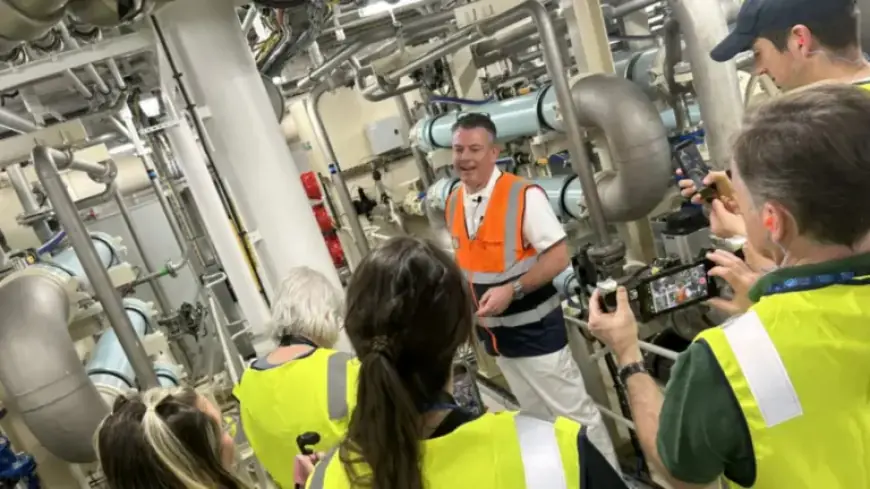
Johan Blokstra, chief engineer of the Disney Destiny, led the first recorded tour of a Disney Cruise Line ship’s inner workings. He walked reporters through systems that help the Wish class conserve energy and water. Explore these details to learn the shipboard engineering and water creation secrets.
Engine Control Room and Energy Management
The Engine Control Room is the operational core of the vessel. Crew monitor and adjust power, propulsion, and HVAC from a central console.
Photography is restricted in this area. A web-like display maps the ship’s LNG plant, power generation, and environmental controls.
Disney Cruise Line uses the ABB Ability OCTOPUS system for real-time efficiency guidance. The system advises on LED lighting, fan speeds, and pump operation.
Wish class ships emit roughly 20 percent fewer greenhouse gases than similar vessels without these technologies. The hull and optimized propulsion reduce fuel use by nearly 1,800 tons annually.
Energy-efficient HVAC systems save about 700 tons of fuel per ship each year. Continuous monitoring helps preserve reliability and maximize efficiency.
Heat Recovery and Fleet Analytics
Waste heat from engines is captured and reused in power generation and climate control. This reduces energy losses and lowers fuel demand.
Operational data is shared securely with shore-based specialists. Analysts use that information to fine-tune performance across the fleet.
Engines and Alternative Fuel
The Disney Destiny operates five large engines. Their use is carefully managed to match the ship’s needs.
The ship carries liquefied natural gas as a primary cleaner-burning fuel. LNG is stored at cryogenic temperatures in tanks spanning three decks.
LNG expands more than 600 times when warmed to gas. Storing it cold allows efficient onboard storage.
Cold Recovery and Onboard Cooling
A Cold Recovery Unit uses engine gas to chill water for the air conditioning system. The system converts heat into cooling through chemical and mechanical processes.
Condensation from air conditioning is reclaimed and treated for onboard laundry. This reuse saves about 10 million gallons of water per ship annually.
Water Production and Treatment
Wish class ships produce up to 99 percent of their freshwater onboard. Energy-efficient reverse osmosis systems turn seawater into potable water.
Gray water and sewage are processed by an Advanced Wastewater Treatment system. Oxygen and beneficial bacteria reduce contaminants to levels exceeding international standards.
Treated water may be released safely into the ocean. Engineers describe the process as analogous to domestic septic systems, but more advanced.
Recycling and Waste Reduction
All refuse is routed to a central Recycling Room. Crews sort glass, paper, cardboard, metal, and plastics for processing.
Large can crushers and cardboard balers prepare material for recycling instead of landfill disposal. Each ship recycles up to 400 tons annually across the fleet.
Disney Cruise Line has removed nearly all single-use plastics from its ships and select island destinations. The company aims for zero landfill waste.
These systems demonstrate how careful engineering reduces emissions, conserves resources, and protects oceans. Filmogaz.com provided details from the ship tour and technical briefings.