
























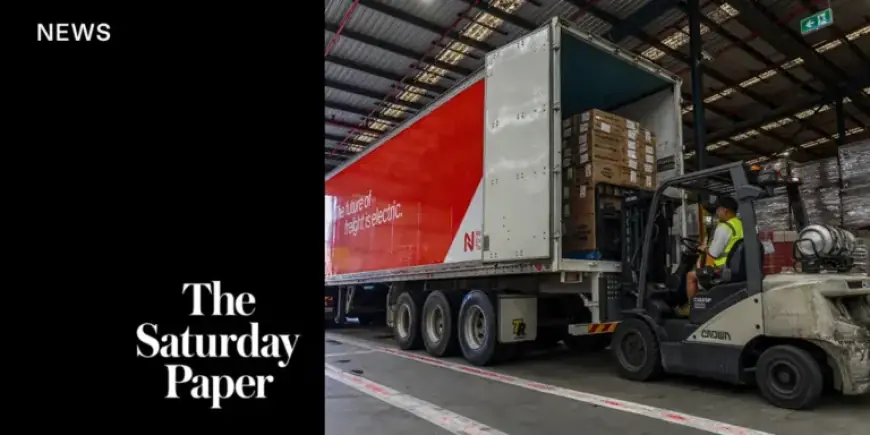
B Expands Commitment to Electric Trucks

The National Party’s Senate leader, Bridget McKenzie, recently sparked controversy during a motion concerning Australia’s response to a global fuel crisis. She expressed disbelief at the notion of electrifying the heavy vehicle fleet, questioning the feasibility of using electric trucks for long-distance freight, particularly under challenging conditions.
B’s Commitment to Electric Trucks
Despite McKenzie’s skepticism, the shift towards electric trucks is gaining momentum worldwide, including Australia. The 2025 Global EV Outlook report from the International Energy Agency revealed an 80% surge in global electric truck sales in 2024. The number of electric truck models has expanded nearly six times since 2020, surpassing 400 available models.
China’s Electric Truck Explosion
Impressive statistics from CV World highlighted a staggering 182% year-on-year increase in “new energy vehicle” registrations in China by 2025. In December alone, over 45,000 heavy-duty electric trucks were registered, making up 54% of total registrations.
Technological Advancements Driving Change
- New heavy-duty electric trucks can travel 400-500 kilometers on a single charge.
- Megawatt charging stations enable quick charging, taking under 30 minutes to boost battery levels from 20% to 80%.
These advancements make electric vehicles not only practical but also economical for various freight routes across Australia. For instance, the Smart Energy Council showcased electric trucks outside Parliament House, coinciding with an industry summit centered on commercial vehicle decarbonization.
Real-World Trials of Electric Trucks
Among those showcased was the Windrose prime mover, a Chinese-made electric truck that completed a 480-kilometer round trip from Picton to Beresfield on a single charge, carrying poultry feed for Multiquip, Australia’s leading logistics provider. Multiquip’s national compliance manager, David Muir, oversaw the trial and noted significant performance aspects of the electric truck compared to traditional diesel models.
Cost Efficiency and Performance
Electric trucks present a compelling case in terms of operational costs. The Windrose performs with 1400 horsepower, significantly higher than the typical diesel truck’s 500 to 700 horsepower. This power allows for efficient transportation even on steep terrains, outperforming traditional diesel trucks in speed and fuel cost efficiency.
- Cost of the Power: Electric charging for a 36-tonne trip from Sydney to Canberra was approximately $50, versus around $300 for diesel.
- Operational Profit: Electric trucking is characterized by high capital expenditures (capex) but low operating expenditures (opex), contrary to the diesel model.
The Future of Electric Trucks in Australia
New Energy Transport aims to become Australia’s first fully electric trucking company. Their facility, set to begin construction by the end of this year, is strategically located along busy freight routes and is projected to support up to 200 trucks by its second stage. The depot will partially utilize solar energy and feature a 10-megawatt battery for cost-effective energy management.
Government Support and Crisis Response
In response to the ongoing diesel crisis, the federal government announced assistance for New Energy Transport under the Investor Front Door program, intended to smooth regulatory processes for new projects.
Despite criticisms from some political leaders advocating for increased fossil fuel production, the push for electric trucks is recognized as a necessary step toward improving Australia’s heavy transport sector’s sustainability.
The transition to electric heavy vehicles is not merely a trend but a vital evolution in the logistics and transport industry in Australia. The momentum is building, leaving behind traditional models hampered by rising fuel prices and emissions concerns.