























Pokémon Winds and Waves makes Gen 10 official, tying new starters to Nintendo Switch 2

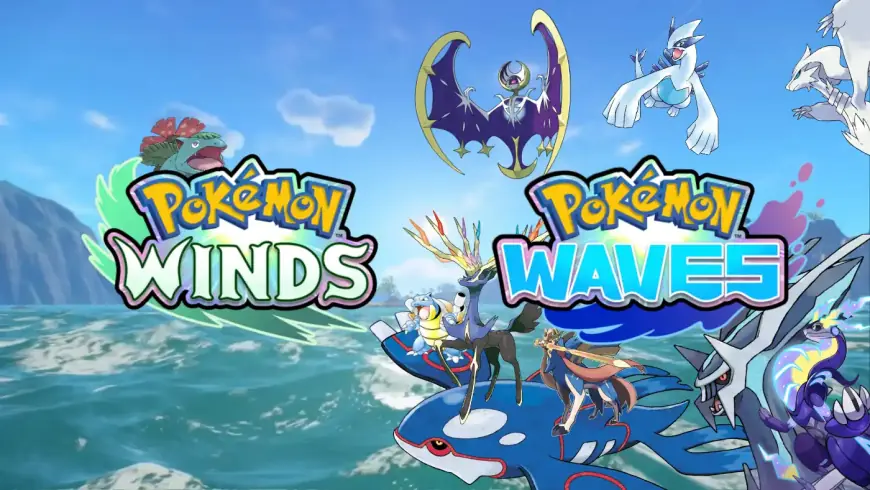
Pokémon Winds and Pokémon Waves are now official as the franchise’s 10th-generation mainline games, and they’re being positioned as a clean break from the last era: a new region built around water travel and wide-open exploration, a longer runway to release, and a hard pivot to Nintendo Switch 2 exclusivity. The reveal also locked in the first big talking point fans always chase—new Pokémon starters—introducing Browt, Pombon, and Gecqua as the Gen 10 trio that will define early teams, early memes, and early arguments for the next year.
The naming confusion began immediately. Some posts are already circulating “pokemon wind and waves,” “winds and waves pokemon,” and “pokémon wind and waves” as if it’s one title rather than a paired release, while others are rewriting the starter names into “pombom,” “brow,” “gecua,” “gecqua,” and even “pombon pokemon” like it’s a species and a brand at the same time. That’s normal in the first 48 hours after a major announcement: the internet stress-tests spelling long before it stress-tests gameplay.
Pokémon Winds and Waves starters: Browt, Pombon, and Gecqua set the tone for Gen 10
The Gen 10 starters follow the familiar three-lane formula—Grass, Fire, Water—but the designs are tuned for instant recognition at thumbnail size, which is where most people first meet them now. Browt reads like the “cute-but-serious” pick, the one players project leadership onto before it ever evolves. Pombon is clearly engineered to be the breakout: rounder silhouette, big-expression face, and a name that invites wordplay. Gecqua lands as the sleek counterbalance, a water-leaning creature that signals agility and movement—exactly the vibe you’d expect in games titled Winds and Waves.
What’s notable is how quickly the starter conversation has shifted from “which one are you picking?” to “what do their final evolutions become?”—and how little hard information exists on that point yet. The franchise has learned that final forms are marketing artillery; revealing them too early burns a chunk of the hype cycle. So for now, all the “gen 10 starters” discourse is being built on first impressions, type speculation, and fan art filling the gaps.
That’s also why you’ll see a split between “pokemon gen 10 starters” and “new pokemon starters” as two different conversations. One is about competitive potential and final typing guesses. The other is pure vibe: which one feels like your partner for a long adventure. The early consensus is less about strength and more about identity—who people want to be in a new generation.
Nintendo Switch 2 exclusivity changes the stakes for the new Pokémon game
Locking Winds and Waves to Nintendo Switch 2 is the kind of decision that will feel obvious a year from now and controversial today. For players, it’s a cost question: a new console buy-in becomes part of the price of admission to “gen 10 pokemon.” For Nintendo, it’s leverage: a mainline Pokémon generation can push hardware adoption in a way almost nothing else can.
Creatively, the exclusivity also reads like an attempt to control a narrative that has been stubborn for several releases—performance. The series has been openly ambitious about large environments and open exploration, but the gap between ambition and smooth execution has been a recurring sore point. Moving to newer hardware gives the developers more headroom. It also raises expectations sharply. Players won’t accept “it’s a handheld limitation” as an explanation anymore if the new system is being sold as the fix.
That’s why the “new pokemon game” pitch is being framed around scale and traversal. The Winds and Waves branding practically begs for mechanics tied to movement—water routes that aren’t narrow corridors, ocean spaces that feel like true geography, and a sense that getting from point A to point B is part of the adventure rather than dead time. If the new region is built to make traversal fun, it solves two problems at once: it justifies the title and it turns the open-world format into an asset rather than a burden.
Gen 10 Pokémon: what the longer timeline signals, and why it matters
A later release window isn’t just patience; it’s strategy. Stretching Gen 10’s development timeline suggests the team wants fewer compromises—more polish, more testing, more time to stabilize performance and systems. It also changes how the community behaves. With extra time, rumor cycles grow longer and more intense. Every small detail becomes a battleground. Every alleged “leak” becomes a miniature election campaign.
That’s where terms like “pokemon wind and waves starters” and the misspellings—“jim carey” style variations but for Pokémon—become more than typos. They’re markers of how information spreads now: fast, imperfect, and optimized for shareability. “Browt” becomes “Browt pokemon,” then becomes “browt,” then becomes a different name entirely in a screenshot repost. “Gecqua” becomes “gecqua,” then “gecua,” then a debate breaks out over which is real. None of that changes the game, but it shapes the emotional runway to it.
The smart move for fans is to treat anything beyond the core reveal—setting specifics, mechanics beyond what’s shown, starter evolutions, legendary details—as provisional until it’s clearly confirmed. The internet will fill the empty months regardless. The question is whether you want to live inside that churn.
What to watch next: five signals that will define Winds and Waves before launch
The next phase will be driven by a handful of reveals that always arrive in roughly the same order, even when the franchise tries to surprise people.
One, the region name and its real-world inspiration will become the anchor for everything else—new forms, architecture, clothing, even the soundtrack tone. When that lands, it will shape which theories survive.
Two, we’ll get a clearer definition of “open world” this time: is it one seamless map, a hub with large zones, or a hybrid that balances performance and density? The answer determines whether Winds and Waves feels like a confident evolution or another experiment.
Three, the starter evolutions will surface—officially or not. The moment those designs appear, the starter discourse flips from cute to divisive, because final forms are where taste fractures.
Four, the multiplayer and co-op question will re-enter the conversation. If the game emphasizes traversal and open areas, the pressure to make those spaces social will be intense.
Five, Nintendo Switch 2 performance will become the silent headline. Frame rate stability, loading behavior, and visual clarity won’t be “tech talk” this time—they’ll be the baseline for whether the audience believes the franchise learned its lessons.
For now, the early picture is clear: Pokémon Winds and Waves is Gen 10’s statement of intent—bigger world, a new trio of starters built to be instantly iconic, and a platform jump that signals a reset in both ambition and accountability. The only thing missing is the hard proof that the new hardware and the longer runway translate into the one thing fans want more than any new monster: a mainline Pokémon adventure that runs as smoothly as it plays.