
























Spacex Launch Deploys 25 Starlink Satellites in Early-Morning Flight from Vandenberg

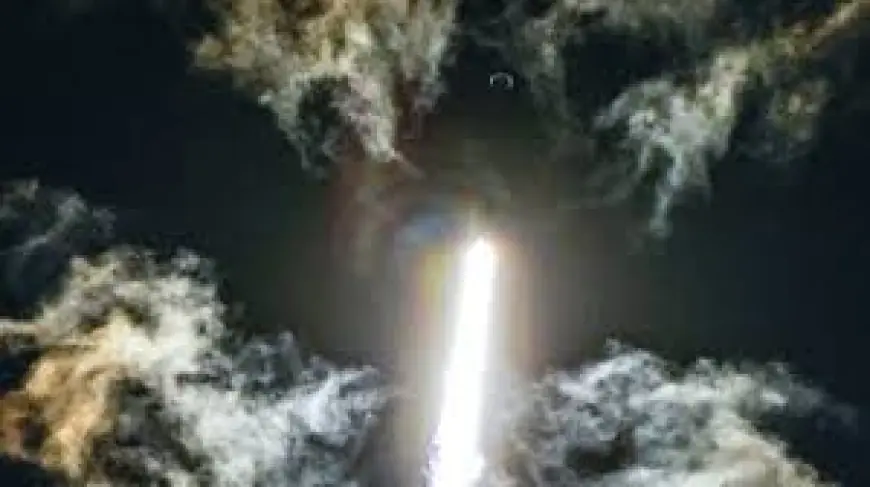
Early Sunday, a spacex launch from Vandenberg Space Force Base sent 25 Starlink V2 Mini satellites into orbit, marking another rapid-turn mission for the company and the 20th flight for the Falcon 9 booster. The flight’s timing and execution matter for both routine internet-satellite replenishment and the booster-reuse program that underpins it.
Spacex Launch at Vandenberg: liftoff time, trajectory and booster B1082
The Falcon 9 rose from Space Launch Complex 4 East at 2: 10: 39 a. m. PST (5: 10: 39 a. m. ET), departing on a southerly trajectory from the Central California site. Falcon 9 booster B1082, on its 20th mission since an inaugural flight earlier in the year, previously supported missions including USSF-62, OneWeb Launch 20 and NROL-145 along with 15 prior Starlink deliveries.
Just over eight minutes after launch the booster touched down on the drone ship Of Course I Still Love You, positioned in the Pacific Ocean. The successful sea landing concluded the booster’s ascent profile and allowed recovery teams to proceed with post-landing operations.
Starlink 17-23 satellites: deployment and mission timing
The payload stack held 25 Starlink V2 Mini satellites, which separated from the Falcon 9 second stage a little more than an hour into flight. That deployment completed the designated objectives for the Starlink 17-23 mission and added another block of broadband-capable hardware to the company’s constellation.
The mission’s precise liftoff time and the hour-plus interval to satellite release reflect the phased approach these launches use: ascent and booster recovery are sequenced before the second stage delivers its payload to the intended insertion window. The deployment count—25 satellites—contributes to the company’s ongoing cadence of internet-satellite deliveries.
Crew Dragon operations and NASA schedule adjustments
Alongside the launch activity on the West Coast, Crew Dragon astronauts Douglas Hurley and Robert Behnken completed a two-month visit to the orbiting station, prepared their SpaceX capsule for departure, and awaited a final approval to undock Saturday night to enable a Gulf of Mexico splashdown the following afternoon. Their readiness and the return timeline were coordinated with flight controllers to align splashdown recovery assets.
Separately, a NASA planetary defense mission that was set to test an asteroid impact technique moved from a July window to no earlier than November after development delays. Those delays were attributed in the mission update to work slowdowns tied to coronavirus disruptions. The schedule change illustrates how technical development challenges can ripple into launch calendars and shift coordination across multiple programs.
What makes this notable is the interplay between routine constellation replenishment and the maturation of rapid reuse: a single booster on its 20th flight both delivered payload performance and achieved a sea landing in under nine minutes, demonstrating the operational cycle SpaceX has been refining. The timing matters because each recovered booster and precise deployment slot preserve the cadence of future missions and affect downstream schedules for crew returns and other launches.
Mission controllers confirmed satellite separation and booster recovery milestones, closing the Starlink 17-23 flight profile and moving teams to post-flight assessments for both the payload and the reusable hardware. With this flight, the West Coast launch complex completed another contribution to the company’s network expansion while parallel activities for crewed return and planetary defense testing continued to adjust across the calendar.